
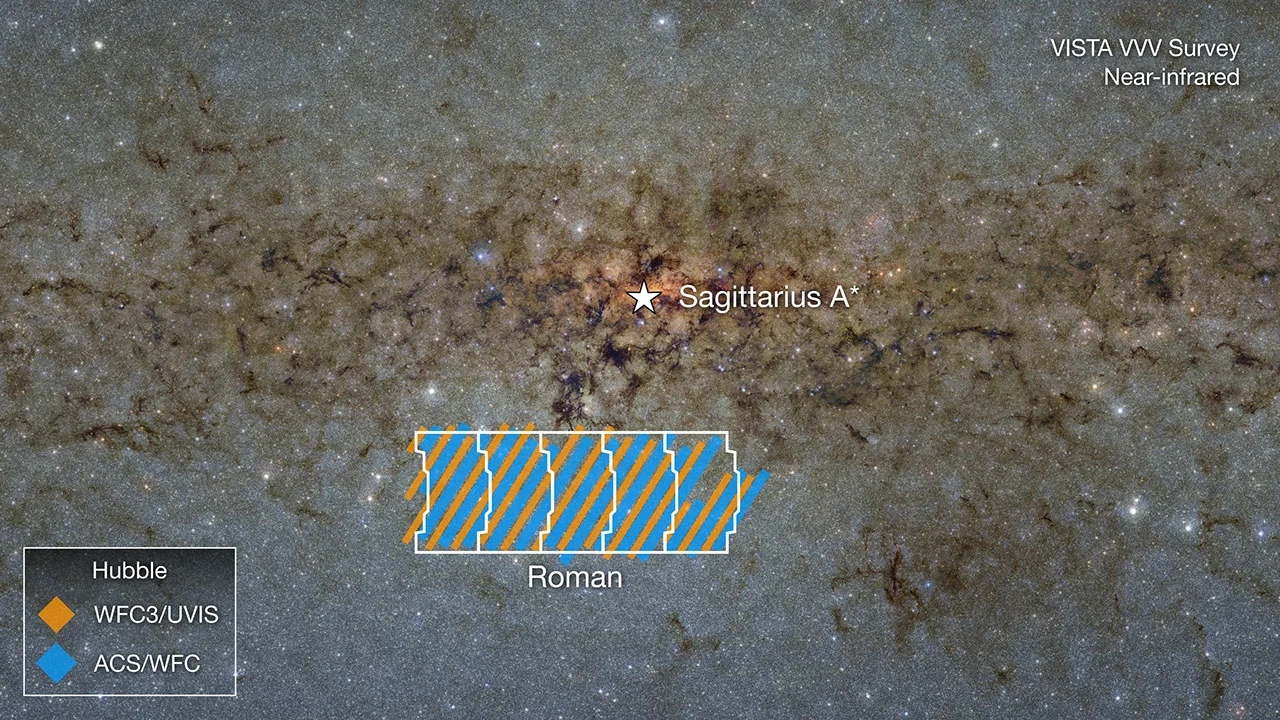
NASA’s Hubble Space Telescope began a large-scale survey of the Milky Way’s galactic bulge in 2025 to provide crucial pre-launch data that will assist the Nancy Grace Roman Space Telescope’s upcoming Galactic Bulge Time-Domain Survey. This preparatory survey aims to cover much of the same sky area Roman will observe, enabling astronomers to better interpret Roman’s data once it launches, targeted for as early as September 2026.
Hubble’s Role in Roman’s Mission
The galactic bulge, which surrounds the Milky Way’s center, contains a dense population of stars, planets, and other celestial objects. Roman’s survey will monitor this region intensively, taking images every 12 minutes during six separate 72-day observing seasons. This rapid cadence and wide field of view—about 1.7 square degrees or the area of 8.5 full moons—will enable Roman to detect millions of stars and thousands of exoplanets, including elusive free-floating “rogue planets,” neutron stars, and black holes.
Since microlensing events, where light from a distant star is gravitationally warped by a closer object, are central to Roman’s survey, having earlier observations from Hubble is vital. These earlier data allow astronomers to distinguish stars involved in lensing before events occur, clarifying which star’s light is being magnified during a microlensing event.
Sean Terry of the University of Maryland and NASA’s Goddard Space Flight Center emphasized that identifying and characterizing objects before lensing events will enable more precise measurements of individual star and planet masses, reducing uncertainties inherent in mass ratio estimates typically derived from microlensing alone.
Comprehensive Star Catalog and Dust Mapping
Hubble’s survey will create a catalog of 20 to 30 million point sources within the galactic bulge, serving as a foundation for Roman’s anticipated catalog of 200 to 300 million stars. Additionally, the data helps map regions of extinction—areas dense with dust and gas that obscure starlight—improving understanding of where stars can be observed versus where obscuration occurs.
Why it matters
This collaboration between Hubble and Roman telescopes represents a critical step in advancing the study of the inner Milky Way. The improved ability to analyze microlensing events will enable more accurate detection and characterization of a wide range of objects, including low-mass exoplanets and isolated compact objects. These insights will deepen scientific knowledge about the formation and evolution of planetary systems and stellar populations in one of the galaxy’s most complex and densely populated regions.
Background
The Hubble Space Telescope, operating since 1990, has been instrumental in astrophysics breakthroughs through its high-resolution imaging capabilities. The Nancy Grace Roman Space Telescope, managed by NASA’s Goddard Space Flight Center and scheduled for launch in the mid-2020s, is designed to conduct wide-field infrared surveys that complement and expand upon Hubble’s discoveries by covering larger sky areas with faster cadence. The Roman mission will especially advance research on exoplanets via microlensing and dark energy studies.
The current Hubble survey data are publicly accessible through the Mikulski Archive for Space Telescopes, supporting ongoing and future research efforts linked to Roman’s mission.
Sources
This article is based on reporting and publicly available information from the following source:
Read more Space & NASA stories on Goka World News.