
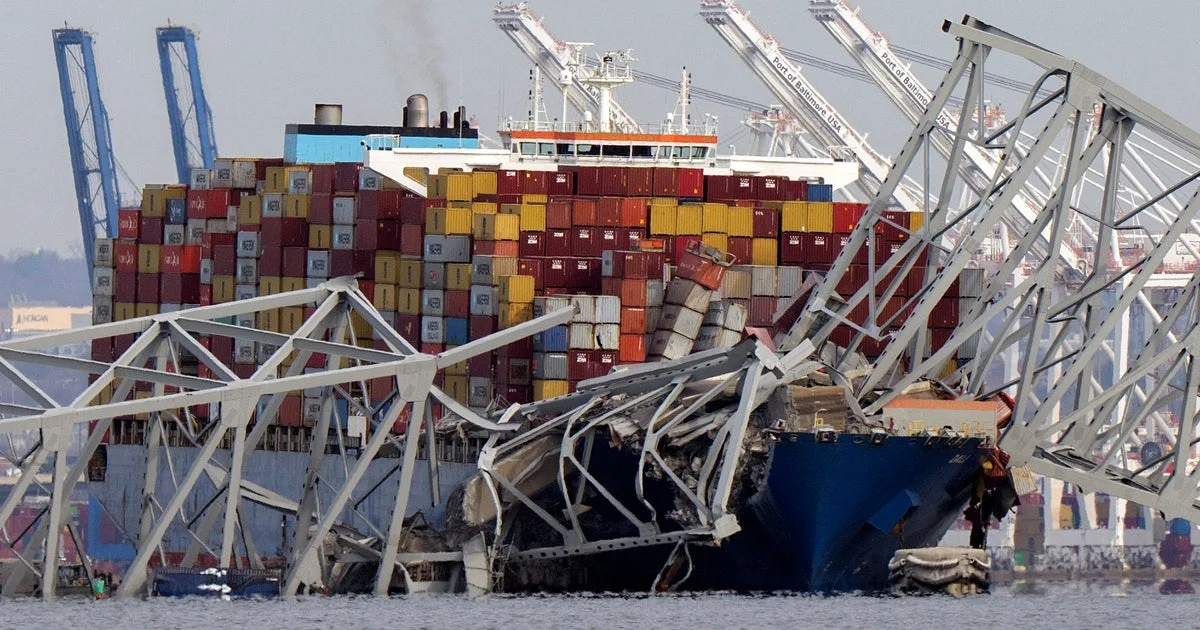
Federal prosecutors have charged Synergy Marine, operator of the container ship M/V Dali, along with its shore-based technical superintendent, Radhakrishnan Karthik Nair, in connection with the March 2024 Baltimore Key Bridge collapse. The incident resulted in six highway construction worker deaths and significant infrastructure damage.
The indictment, unsealed on May 12, 2026, alleges that Synergy Marine and Nair conspired to defraud the United States, failed to notify the U.S. Coast Guard of hazardous vessel conditions, engaged in misconduct causing death, made false statements, and obstructed a federal investigation. Nair, an Indian national overseeing the Dali’s technical operations, is charged with making false statements to the National Transportation Safety Board (NTSB) and obstructing the agency’s proceedings.
Cause of the Crash
Investigations revealed that the M/V Dali lost power twice shortly before colliding with the Key Bridge while leaving the Port of Baltimore early on March 26, 2024. The NTSB identified two onboard power outages: the first due to a loose switchboard wire causing the main engine and steering systems to shut down temporarily, and the second linked to the improper use of a “flushing pump” supplying diesel fuel to generators.
Unlike standard fuel supply pumps designed with safety redundancies and automatic restart functions, the flushing pump was intended only to clear fuel lines for maintenance and lacked such safeguards. The indictment states that Synergy Marine knowingly used the flushing pump as the primary fuel source for generators, which contributed to the second power failure. Prosecutors claim the vessel’s proper fuel pumps could have restored power in time to safely navigate under the bridge and avoid the collision.
Alleged Concealment and Prior Incidents
Federal prosecutors allege that since 2020, the ship’s operators were aware of the flushing pump’s improper use and related risks. After the crash, some employees attempted to hide evidence of the pump’s use by removing references from ship documents including audits and engineering logs. Nair was accused of falsely claiming ignorance about the flushing pump during the NTSB’s investigation.
The year before the crash, the Dali experienced a similar blackout linked to the flushing pump, and another Synergy-operated vessel, the M/V Maersk Saltoro, also suffered a related outage in December 2022, highlighting a pattern of safety violations.
Legal and Civil Consequences
This indictment represents the first criminal charges related to the Key Bridge collapse. Alongside these charges, Synergy Marine and the ship’s owner, Grace Ocean Private Limited, have faced multiple civil lawsuits from government entities, victims’ families, cargo owners, and others citing negligence. Both companies reached a settlement with the Justice Department exceeding $100 million in 2024 and with the state of Maryland in April 2026.
A large-scale bridge replacement project is underway, anticipated to cost billions and continue into the late 2020s. Additional civil claims are scheduled for trial soon, with the defendants denying negligence and asserting liability limits tied to the ship’s value.
Why it matters
The charges underscore the critical importance of maritime safety compliance and transparency in preventing infrastructure disasters and loss of life. The Key Bridge collapse profoundly impacted Maryland’s transportation infrastructure, public safety, and regional economy. Ongoing legal actions will test accountability standards for maritime operators involved in major civil engineering accidents.
Sources
This article is based on reporting and publicly available information from the following source:
Read more US News stories on Goka World News.