
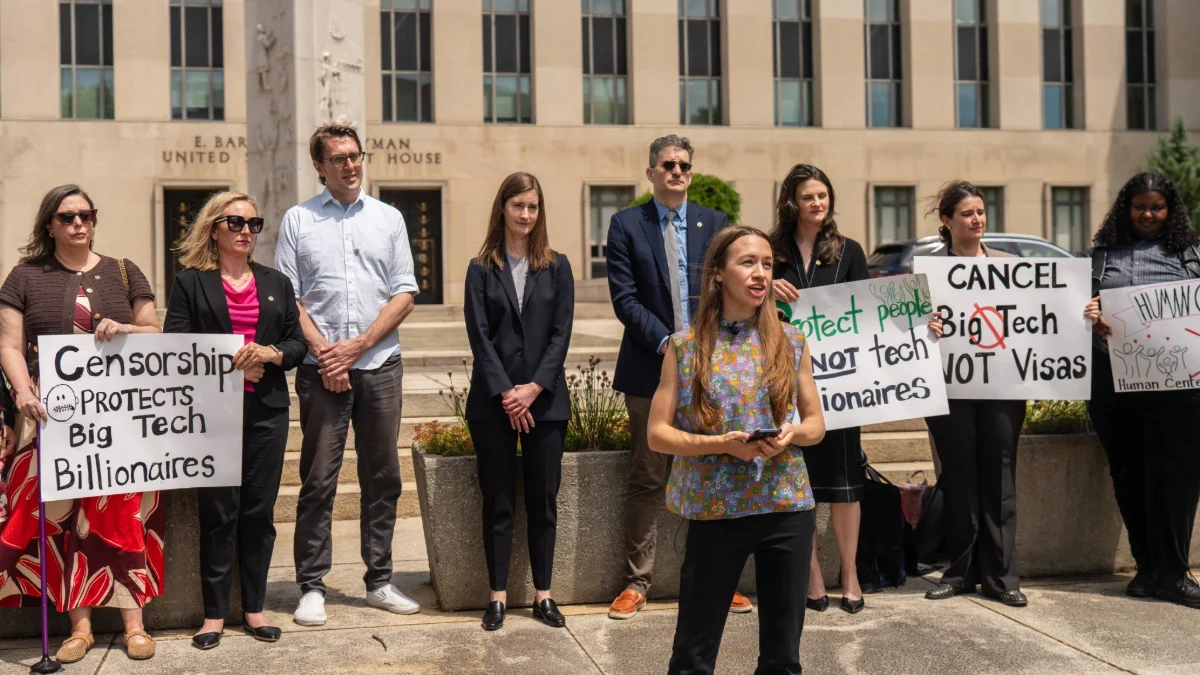
A federal court in Washington, D.C., heard arguments on Wednesday in Coalition for Independent Technology Research v. Rubio, a lawsuit contesting the Trump administration’s visa restriction policy that targets noncitizen researchers, fact-checkers, and trust and safety workers in the technology sector. The case raises constitutional questions about free speech and the government’s discretion in overseeing immigration based on national security and foreign policy concerns.
The policy, first announced in May 2025, allows the Secretary of State broad, largely unreviewable authority to deny or revoke visas for foreign nationals whose activities in the United States could have “potentially serious adverse foreign policy consequences.” Although the policy was framed for foreign government officials or state actors, it has been applied to independent scholars and experts researching content moderation, platform advertising, and online harms, generating a chilling effect on academic and professional speech.
Legal Issues Addressed in Court
U.S. District Judge James E. Boasberg identified four primary issues during the hearing: whether the policy constitutes a single cohesive rule; whether the Coalition for Independent Technology Research (CITR) and its members have legal standing to sue; the constitutional implications under the First Amendment; and available remedies if the policy is found unlawful.
CITR, represented by the Knight First Amendment Institute at Columbia University and Protect Democracy, argues the policy unlawfully punishes individuals for their viewpoints and professional associations. Attorney Carrie DeCell emphasized that the policy not only chills the speech of affected noncitizen researchers but also restricts the First Amendment rights of U.S. citizens who rely on collaboration with these experts.
The government contends its policy targets behaviors involving foreign governments rather than speech, asserting the rights of U.S. citizens are unaffected. Government lawyer Zack Lindsey faced skepticism from the judge over the vague definition of “working for or with foreign governments” and the broad potential for targeting anyone who communicates with or advocates before foreign authorities. Judge Boasberg questioned whether such an interpretation could criminalize routine academic or policymaker interactions with foreign entities.
First Amendment and Government Discretion
The hearing revealed judicial concern about the government’s position that visa denials based on this policy fall outside immediate constitutional review, suggesting affected individuals must challenge each denial individually. The judge highlighted the impracticality of this approach and raised hypothetical scenarios to illustrate potential abuses of unfettered executive discretion.
Observers noted the proceeding underscored the tension between immigration authority and safeguarding free expression, especially amid increasing global scrutiny of major technology platforms. The case also reflects the complexities of regulating online content, balancing national security interests, and protecting fundamental speech rights within academic and research environments.
Why it matters
The outcome of this case could define the boundaries of executive power over immigration enforcement tied to expression and association, particularly for foreign nationals contributing to critical research on social media, online harms, and platform governance. It also questions how the U.S. government uses visa policy to influence what research is permitted and who can engage with digital platform regulation. This legal challenge assumes broader importance as debates around content moderation, democratic discourse, and technology oversight intensify globally and in the context of emerging technologies like artificial intelligence.
Background
The Trump administration’s visa restriction policy emerged as part of efforts to counter perceived foreign censorship of American speech online, explicitly targeting noncitizen scholars and professionals deemed affiliated with foreign governments or involved in content moderation studies. Since its implementation, the policy has deterred researchers from pursuing or continuing work on platform accountability and online safety, hindering empirical research essential for policymaking on harms such as misinformation, extremist content, and risks to children and marginalized communities.
The Coalition for Independent Technology Research, comprising researchers and organizations focused on independent technology study, filed suit in March 2025 seeking to block enforcement of the policy while litigation proceeds. The case continues to attract attention for its potential to set precedent on the intersection of immigration law, freedom of expression, and digital governance.
Sources
This article is based on reporting and publicly available information from the following source:
Read more Digital Policy stories on Goka World News.