
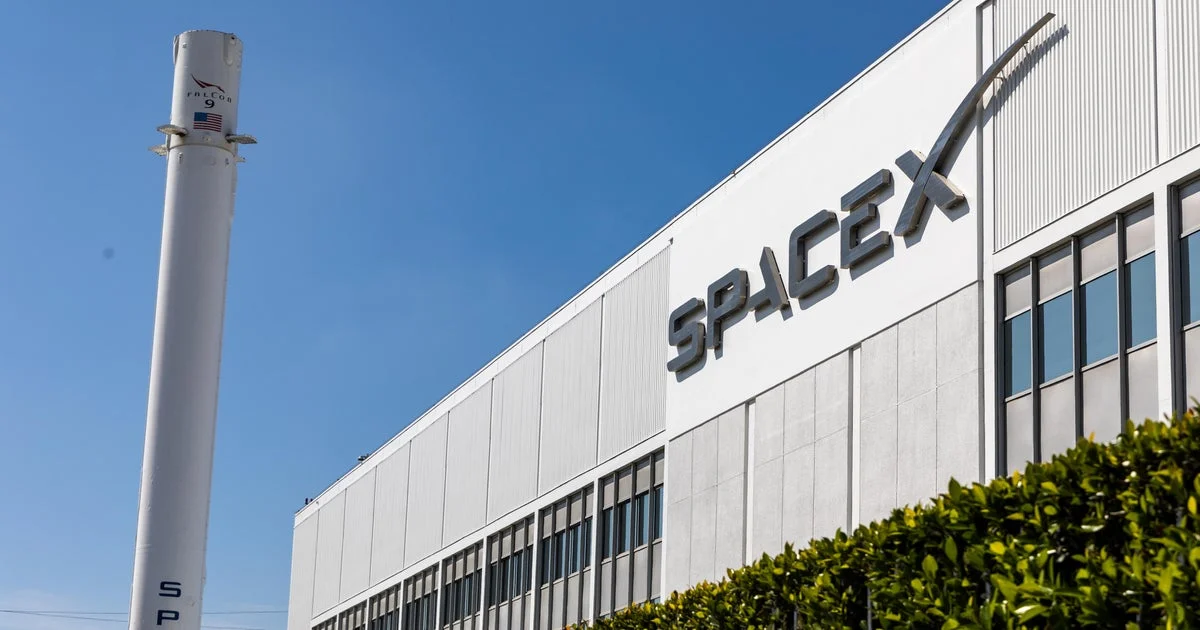
SpaceX filed for an initial public offering (IPO) on Wednesday as the Elon Musk–owned aerospace company seeks capital to accelerate its space exploration, artificial intelligence, and satellite ventures. The filing follows a confidential IPO registration submitted to the Securities and Exchange Commission last month.
Although SpaceX has not disclosed an exact fundraising target, industry estimates suggest it could raise up to $75 billion, potentially making it the largest IPO in history. The current record holder is Saudi Aramco, which raised $25.6 billion in its 2019 offering. SpaceX will list its shares on the Nasdaq Composite exchange under the ticker symbol “SPCX.”
Based in Texas and founded by Musk in 2002, SpaceX develops and launches spacecraft, while also owning related ventures including the AI company xAI and satellite broadband provider Starlink. Its filings reveal a 2025 net operating loss of $2.6 billion on revenues of $18.7 billion. In the first quarter of 2026, SpaceX reported nearly $4.7 billion in revenue. The bulk of this income comes from operating its Falcon 9, Falcon Heavy, and Dragon rockets for commercial and government clients.
The company highlighted its goal of deploying “massive AI compute satellite constellations” via its reusable rockets and satellite manufacturing capabilities, with the prospect of launching millions of satellites to serve as orbital data centers. In its filing, SpaceX estimated an addressable market exceeding $28 trillion across space ventures ($370 billion), broadband services ($1.6 trillion), AI services ($26.5 trillion), enterprise technology ($23 trillion), and digital advertising ($600 billion).
SpaceX’s IPO prospectus also emphasizes its broader ambition to establish space colonies and further humanity’s reach beyond Earth. The company stated its mission as building “systems and technologies necessary to make life multiplanetary, to understand the true nature of the universe, and to extend the light of consciousness to the stars.”
The proceeds from the IPO could support Musk’s vision of space-based data centers and manned missions to Mars, projects regarded by some analysts as operationally and economically challenging in the near term. After the IPO, Musk will retain majority voting control and continue as SpaceX’s CEO, chief technology officer, and chairman.
Some market analysts anticipate Musk may seek closer integration between SpaceX and his electric vehicle company Tesla to synergize their roles in the AI ecosystem. However, key hurdles remain regarding the feasibility and timeline for space-based infrastructure and commercial AI satellite networks.
Why it matters
If successful, SpaceX’s IPO will mark the largest public offering ever, significantly influencing capital flows into space technology and AI sectors. The funding could expedite innovations in satellite broadband, orbital computing, and interplanetary exploration with implications for global communications and scientific research.
Background
SpaceX has been a key disruptor in the aerospace industry, pioneering reusable rockets and reducing launch costs since its founding in 2002. Its Starlink constellation has addressed broadband access gaps worldwide, and its Falcon rockets serve major commercial and government payload launches. The IPO filing signals SpaceX’s shift toward public markets to fuel ambitious expansions amid growing competition in space-based technologies and increasing investor interest in space and AI ventures.
Sources
This article is based on reporting and publicly available information from the following source:
Read more Major Tech Companies stories on Goka World News.