
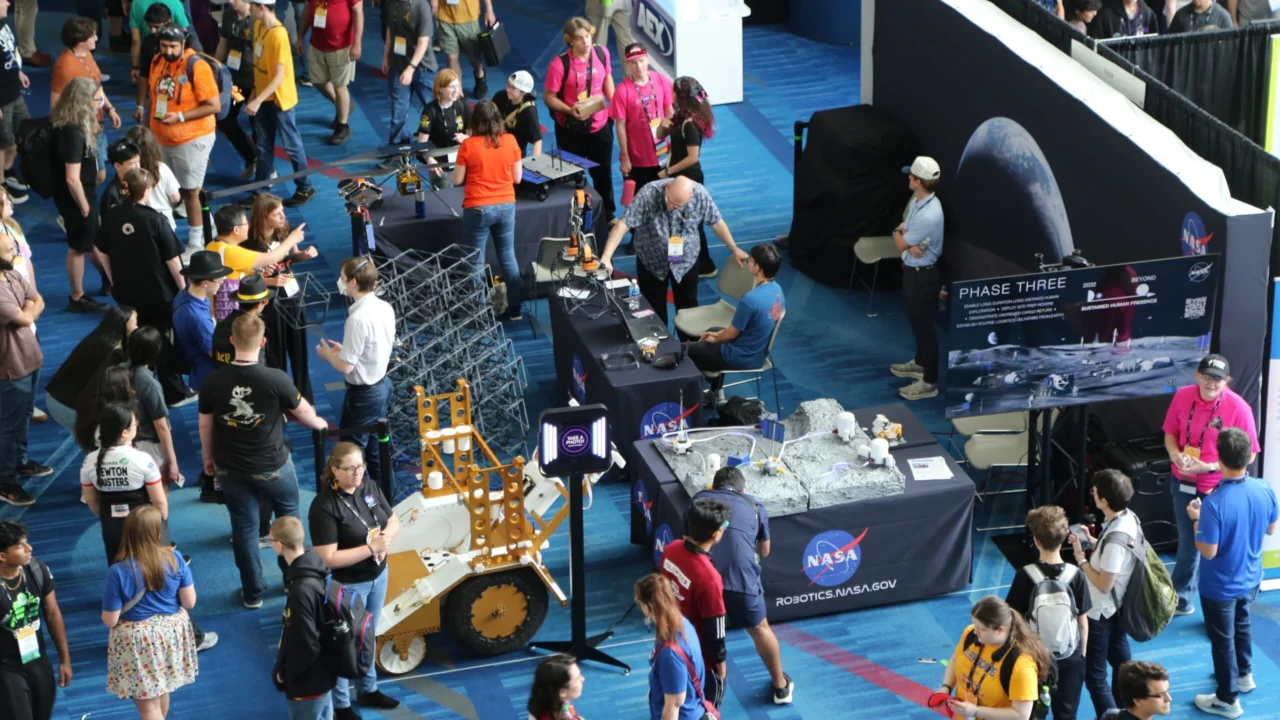
NASA unveiled its plan for a permanent lunar outpost and showcased advanced robotic technologies during the 2026 FIRST Robotics World Championship in Houston, connecting directly with more than 51,000 students, parents, and mentors. The event brought together over 1,000 student teams, providing hands-on experiences and opportunities to engage with NASA’s vision for sustainable lunar exploration and future missions to Mars.
NASA’s Moon Base Vision and Robotic Missions
Central to NASA’s presentation was its plan to establish a Moon Base serving as a hub for exploration, scientific research, and technology testing. The agency outlined a phased approach beginning with rapid robotic and uncrewed missions to prepare the lunar surface ahead of crewed Artemis missions.
Key to this strategy is an accelerated schedule of Commercial Lunar Payload Services (CLPS) flights, aiming for up to 30 robotic lunar landings by 2027. These missions will deliver scientific instruments, rovers, hoppers, and drones to scout and experiment, laying groundwork for permanent surface operations.
Robotic Innovations and Technologies on Display
NASA’s exhibit featured a Moon Base model and several cutting-edge robotic systems designed for extraterrestrial construction and exploration:
- Automated Reconfigurable Mission Adaptive Digital Assembly Systems: Modular small robots equipped with smart algorithms capable of autonomously assembling large-scale infrastructure in space, such as solar power and habitat modules, reducing dependence on Earth-launched hardware.
- Cooperative Autonomous Distributed Robotic Exploration: A group of small lunar rovers programmed to explore collaboratively, collecting data beyond the capability of individual robots, to support science goals and astronaut tasks on the Moon.
- Skyfall Mars Helicopters: Designed as aerial scouts building on the Ingenuity Mars Helicopter’s success, these drones aim to assist scientific exploration and human missions on Mars.
NASA’s Engagement with the Next Generation
The event highlighted NASA’s long-standing commitment to STEM education and workforce development through its support of FIRST Robotics since 1996. This year, NASA sponsored over 160 robotics teams nationwide, including 50 with NASA mentors. The Johnson Space Center alone mentored six teams, two of which advanced to the championship finals.
NASA also operated a Mobile Machine Shop at the venue, providing technical assistance that completed over 600 repair jobs for competing teams, further demonstrating its support for student innovation and problem-solving in robotics.
Why it matters
NASA’s active presence at the FIRST Robotics Championship underscores the agency’s strategy to cultivate future engineers and technologists critical to achieving its ambitious lunar and Mars exploration goals. Engaging youth in robotics aligns workforce development with evolving space mission needs, particularly as robotic precursors pave the way for sustainable human presence on the Moon.
Sources
This article is based on reporting and publicly available information from the following source:
Read more Space & NASA stories on Goka World News.