
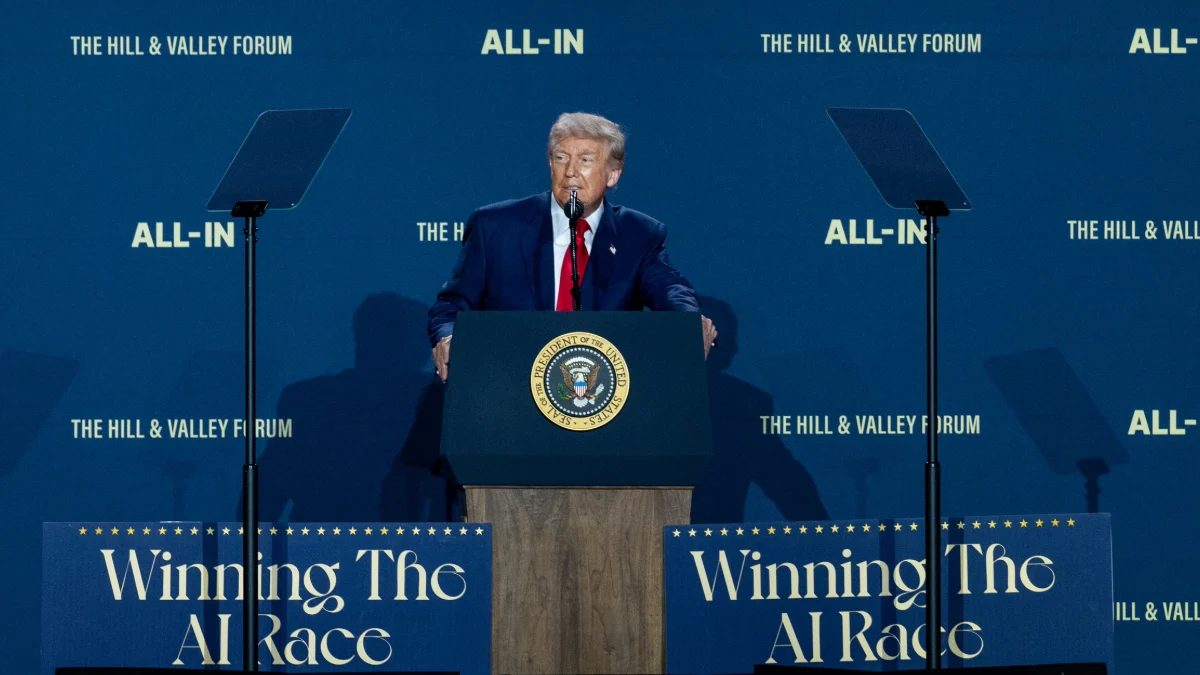
On July 23, 2025, President Donald Trump abruptly withdrew a planned executive order designed to create a voluntary regulatory framework for artificial intelligence (AI) cybersecurity, citing concerns that it could hinder U.S. leadership in AI innovation. The decision came just hours before the signing ceremony, after consultations with several prominent tech executives including Mark Zuckerberg, Elon Musk, and David Sacks.
Details of the Canceled AI Executive Order
The draft executive order proposed establishing a voluntary system encouraging AI companies to share cybersecurity vulnerabilities and provide pre-launch access of advanced AI models to the government for review. It included the Treasury Department setting up a “clearinghouse” for information sharing among AI laboratories and called for increased cybersecurity staffing across agencies.
Importantly, the order’s draft explicitly forbade any mandatory licensing, preclearance, or permitting requirements for AI models, framing compliance as voluntary. The sole compulsory element instructed the Attorney General to enforce existing laws against illegal use of AI to access or harm computers. This asymmetry underscored the administration’s reluctance to impose binding obligations on AI developers.
The decision to halt the order was justified by Trump’s concern that it might act as a “blocker” to American competitiveness against China and other countries, though the draft itself revealed relatively limited regulatory impositions.
Role of Intelligence Agencies in AI Oversight
The proposed framework notably assigned significant monitoring responsibilities to the National Security Agency (NSA) and other intelligence entities. These agencies would conduct classified evaluations of what the order termed “covered frontier models,” while civilian agencies such as the Office of the National Cyber Director, the Cybersecurity and Infrastructure Security Agency (CISA), and the National Institute of Standards and Technology (NIST) would focus on defining the scope of models subject to review.
This arrangement raised concerns about the opacity of oversight processes, as intelligence agencies typically operate under classified constraints exempt from public disclosure and judicial review, unlike civilian regulators such as the Food and Drug Administration (FDA) which function transparently and are accountable to the public.
The draft’s approach diverged from the FDA analogy previously invoked by National Economic Council director Kevin Hassett, revealing instead a system rooted in intelligence community authority rather than civilian regulatory oversight.
Internal Administration Debate and Industry Influence
The cancellation reflected a factional dispute within the administration between officials advocating for national security-driven oversight and those pushing to protect industry innovation from regulatory burdens. Behind-the-scenes, executives from AI companies, venture capitalists, and former administration AI advisors influenced the final outcome through direct calls with the president.
White House chief of staff Susie Wiles and national security advocates reportedly supported stronger controls, while figures like David Sacks and key tech CEOs opposed mandatory or binding evaluations, emphasizing the need to safeguard competitive advantages in AI development.
Despite the pause in the executive order, the underlying governance structure led by intelligence agencies reportedly continues to evolve, with classified interagency working groups forming to assess AI technologies.
Why it matters
The withdrawal of the executive order leaves the U.S. without a transparent, accountable civilian regulatory framework for AI cybersecurity, delegating much of the oversight to the intelligence community. This arrangement poses challenges to public accountability and international trust, as classified assessments predominate over open safety reviews.
As AI models increasingly integrate into global markets, questions remain about how U.S. governance practices will influence international AI safety standards and whether broader public or legislative oversight can be established.
Background
The Trump Administration’s AI Action Plan, announced in July 2024, had assigned significant responsibilities to the National Institute of Standards and Technology’s AI Safety Institute (CAISI). However, recent reports indicate a downward shift of evaluation authority towards intelligence agencies, with CAISI’s public-facing role diminishing.
This shift echoes ongoing tensions between promoting innovation, ensuring national security, and instituting transparent safeguards for emerging AI technologies.
Sources
This article is based on reporting and publicly available information from the following source:
Read more AI Regulation stories on Goka World News.