
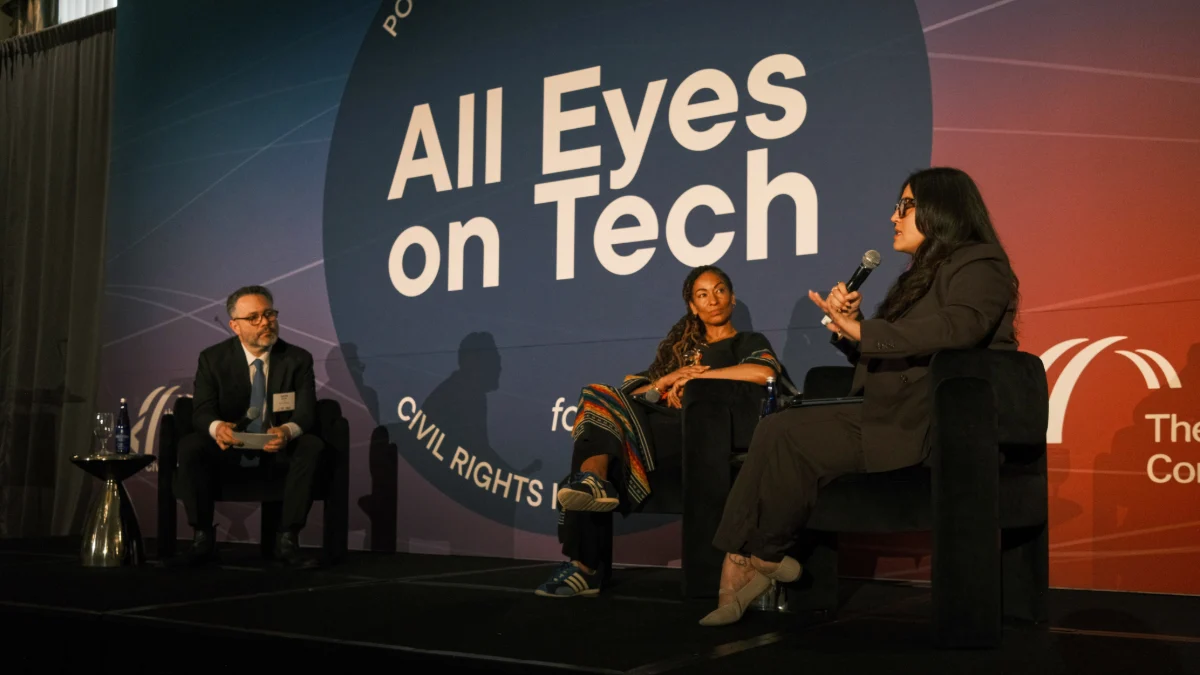
The Center for Civil Rights and Technology hosted its 2026 annual convening, “All Eyes on Tech: Power, Protection, and the Fights for Civil Rights in the Age of AI,” on May 12 at the Mayflower Hotel in Washington, DC. The Center, a collaboration between The Leadership Conference on Civil and Human Rights and The Leadership Conference Education Fund, convened advocates, scholars, and policymakers to address how artificial intelligence intersects with civil rights issues.
During the event, a key conversation was led featuring Dr. Ruha Benjamin, a professor of African American Studies at Princeton University and founding director of the Ida B. Wells Just Data Lab, alongside Alejandra Montoya-Boyer, vice president of the Center for Civil Rights and Technology. They emphasized the critical role of cultural and narrative frameworks as a foundation for effective AI policy development.
Dr. Benjamin and Montoya-Boyer discussed the importance of looking beyond technical regulations to build collective power and alternatives that empower marginalized communities impacted by AI systems. Their dialogue also highlighted the need to focus on the motivations and backgrounds of those who develop and deploy technology, rather than solely on the technology itself.
The Center for Civil Rights and Technology continues to advance advocacy, education, and research addressing the challenges posed by AI and other emerging technologies to civil rights, working to shape policies that protect vulnerable populations in an evolving digital landscape. A transcript of the conversation is expected to be released in the near future.
Why it matters
As artificial intelligence increasingly influences social and economic processes, concerns about bias and inequity in AI systems have grown. The convening underscores the urgency of integrating civil rights perspectives into technology policymaking to prevent discriminatory outcomes and ensure equitable protections.
Background
The Center for Civil Rights and Technology operates at the nexus of technology policy and civil rights advocacy, focusing on how tools like AI impact issues including privacy, discrimination, and social justice. By bringing together experts and community leaders, the Center seeks to inform policy and promote fairness in technological advancements.
Sources
This article is based on reporting and publicly available information from the following source:
Read more AI Regulation stories on Goka World News.