
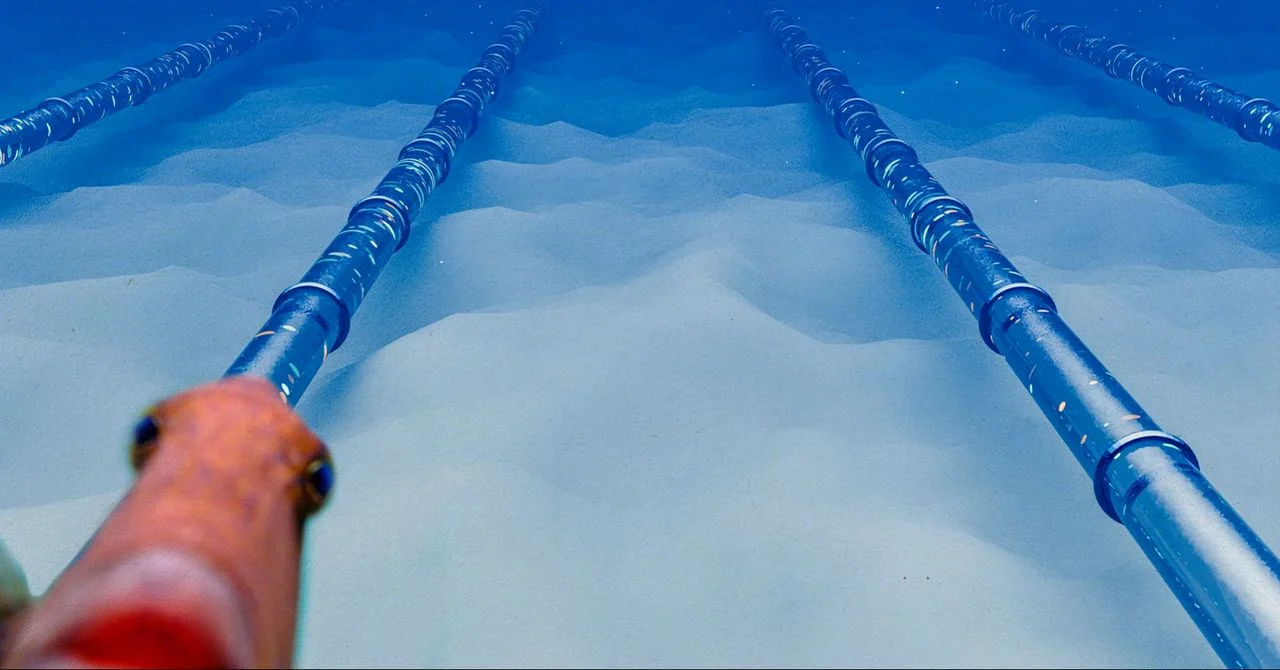
Gulf countries expanding their artificial intelligence (AI) industries are confronting critical vulnerabilities due to their heavy reliance on a small number of undersea internet cables running through politically sensitive waterways like the Strait of Hormuz.
What happened
Saudi Arabia, the United Arab Emirates, and other Gulf states have invested billions to establish AI infrastructure aimed at transforming their economies from oil-based to technology-driven, exporting compute power and cloud services. However, an estimated 95 percent of their international data traffic traverses just a handful of undersea cables in the Red Sea and Strait of Hormuz. This concentration poses a growing risk as recent geopolitical tensions in the region, including escalations between the US, Israel, and Iran, heighten concerns about potential disruption.
In 2025, two cables linking Europe with the Middle East and Asia were severed in the Red Sea, causing days of degraded connectivity and approximately $3.5 billion in estimated economic damage. The introduction of AI increases the stakes, as uninterrupted, high-capacity data flows are essential for hyperscale data centers and cloud providers operating in the Gulf.
To reduce dependence on narrow maritime corridors, regional players are developing diversified infrastructure strategies. These include terrestrial fiber networks connecting Gulf landing stations through Saudi Arabia, the UAE, Oman, Jordan, and the Levant toward Europe and Asia. Additionally, new subsea-terrestrial systems aim to bypass chokepoints near Egypt and Bab el-Mandeb, while proposed northern overland routes through Iraq, Syria, and Turkey offer alternative paths.
Projects like Saudi Arabia’s $800 million SilkLink cable reviving a route through Syria and an Iraqi-Emirati $700 million WorldLink cable to Turkey exemplify efforts to create more resilient east-west connectivity corridors. Despite ongoing regional instability challenges, these initiatives seek to reduce exposure to maritime chokepoints.
Satellite connectivity is also being explored as a supplement for redundancy, though it cannot match the data capacity or latency performance of fiber-optic cables.
Why it matters
The Gulf’s AI-driven economic future depends on stable, high-capacity internet infrastructure. Unlike typical internet traffic, AI workloads require continuous, reliable data transmission between hyperscale data centers and clients to avoid operational disruptions and financial losses. The current overreliance on a few vulnerable undersea cable routes exposes the region to potentially severe disruptions amid geopolitical tensions.
As the Gulf invests heavily in becoming a major global exporter of compute capacity, the resilience and diversification of digital connectivity is increasingly recognized as a national security and economic imperative. How the Gulf addresses these challenges may set precedents for other emerging AI hubs worldwide facing similar infrastructure vulnerabilities.
Background
Undersea cables have long been the backbone of global internet traffic, carrying roughly 95 percent of international data. The Middle East occupies a strategic position at the crossroads of Europe, Asia, and Africa, making it a key transit zone. However, political instability, regulatory hurdles, and conflicts have historically slowed the development of alternative terrestrial and subsea routes in the region.
The Gulf’s recent AI ambitions depend on hyperscale cloud providers that demand multiple independent network paths with predictable latency and resistance to geopolitical stress—conditions difficult to meet with the existing limited cable infrastructure. Past cable cuts in 2025 highlighted the economic vulnerability tied to this infrastructure.
Renewed stability in parts of the region, such as Syria, combined with new investments in fiber networks across politically sensitive corridors, reflects a strategic shift toward expanding physical connectivity options beyond traditional maritime chokepoints.
Sources
This article is based on reporting and publicly available information from the following source:
Read more Digital Policy stories on Goka World News.