
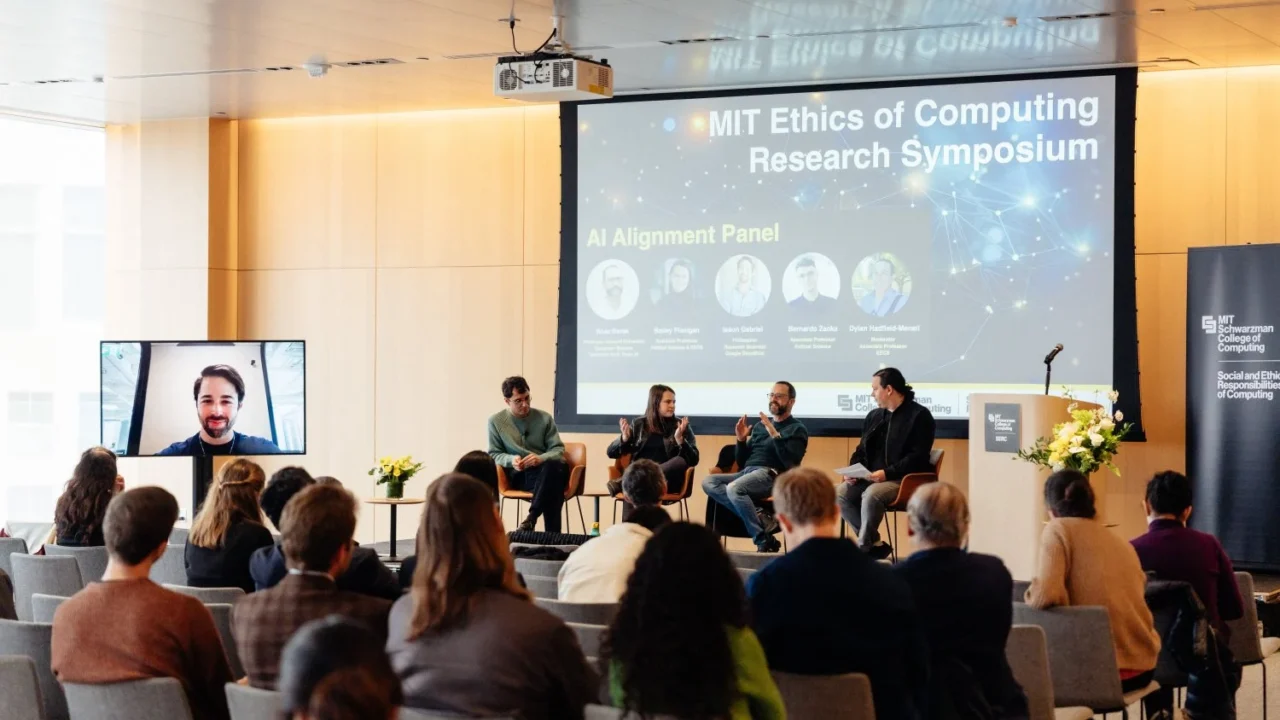
MIT’s Schwarzman College of Computing hosted a full-day symposium on April 30, focusing on the ethical and social responsibilities of artificial intelligence (AI) as it increasingly integrates into society. The event brought together experts from academia and industry to discuss critical challenges in AI alignment, ethical frameworks, and AI’s application in education.
What happened
The Social and Ethical Responsibilities of Computing (SERC) initiative organized the symposium, featuring research presentations from seed grant recipients, panel discussions, and a keynote address by Jon Kleinberg, Tisch University Professor of Computer Science at Cornell University. Topics addressed included air pollution forecasting, responsible computer vision deployment, AI alignment, and AI’s influence in educational settings. The event also showcased year-long research projects by student scholars involved in SERC.
Panelists explored the complex ethical challenges of aligning AI systems with human values, highlighting the difficulty of defining which values to incorporate and how to translate them into machine behavior. Dylan Hadfield-Menell, associate professor at MIT, moderated a discussion that included insights from philosopher and Google DeepMind scientist Iason Gabriel, who compared AI alignment to judicial interpretation — expecting AI to act reasonably but imperfectly within moral frameworks. Political science faculty members Bailey Flanigan and Bernado Zacka emphasized the importance of governance questions around AI systems and understanding the institutional wisdom embedded in existing social systems.
Another panel examined AI’s role in education, where faculty raised concerns about students relying on AI to bypass the essential cognitive struggle involved in learning. Professors Eric Klopfer and Samuel Madden stressed the need to balance AI assistance with maintaining academic rigor and critical thinking. They discussed revising curricula to meet these challenges and encouraged involving students in conversations about ethical AI use.
In his keynote, Kleinberg addressed mismatches between AI’s models of the world and human understanding, using chess and literary examples to illustrate potential failures in human-algorithm collaboration. He highlighted the limits of AI systems’ predictive simulations compared to human experiential knowledge, questioning how well AI truly “understands” its environment.
Why it matters
As AI technologies advance rapidly, integrating them ethically and effectively into society raises substantial challenges. The symposium highlighted that meaningful progress must involve interdisciplinary collaboration and careful reflection on the human values guiding AI development. Ensuring AI systems align with societal norms and educational goals is critical as these technologies become ubiquitous. Addressing governance, transparency, and human-machine interactions is vital to avoid unintended consequences and maintain trust in AI applications.
Background
The MIT Schwarzman College of Computing launched the SERC initiative to promote research at the intersection of technology, ethics, and society. As AI becomes increasingly embedded in daily life, questions about its alignment with human values and the responsibilities of creators gain urgency. This symposium reflects ongoing efforts by leading academic institutions to address these concerns through research, dialogue, and education.
Sources
This article is based on reporting and publicly available information from the following source:
Read more Artificial Intelligence stories on Goka World News.