
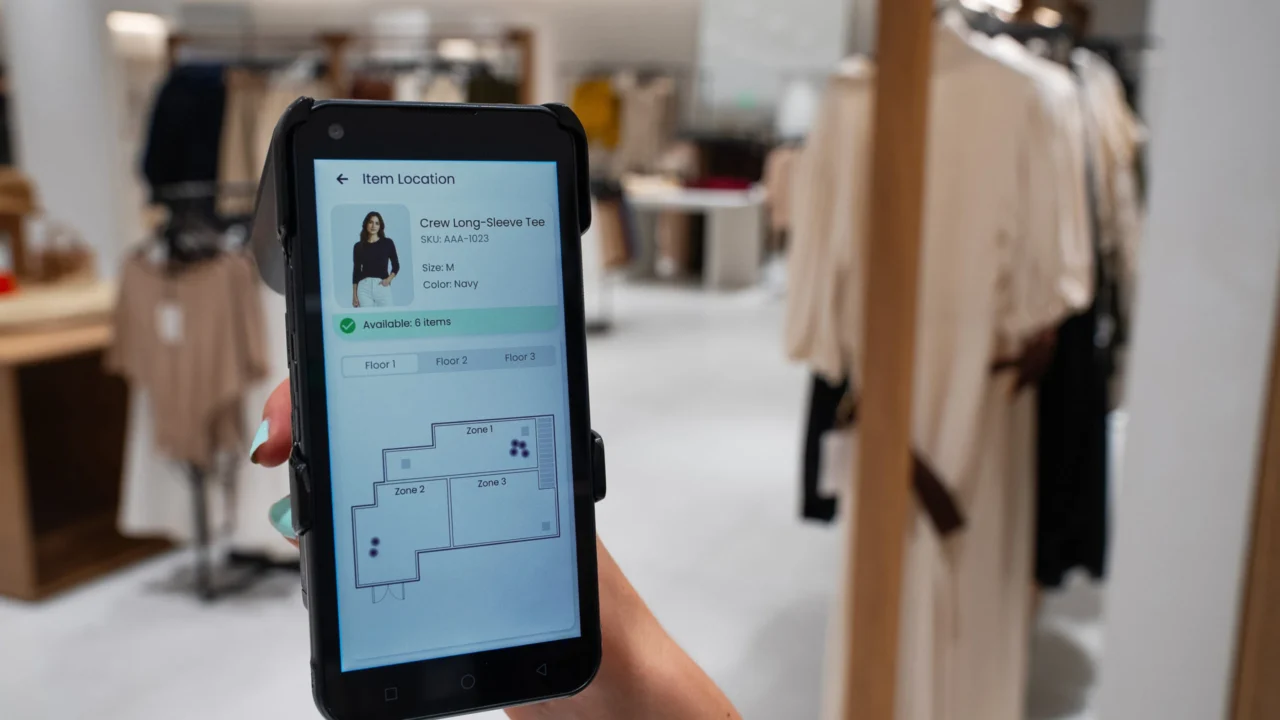
MIT spin-off Cartesian has developed a real-time indoor location tracking system using RFID and machine learning to help retailers locate products quickly and efficiently, cutting significant time wasted on inventory management in stores worldwide.
What happened
Cartesian’s platform leverages wireless signals from RFID tags attached to retail items, enabling precise location tracking from stockrooms to sales floors. Their machine-learning algorithms process existing RFID data from handheld readers to generate detailed maps of inventory locations within stores. The startup is currently deployed in over 700 stores across 15 countries and has partnered with major retail groups including Inditex, the parent company of brands like ZARA.
The technology was created from research led by MIT associate professor Fadel Adib, who has studied wireless signals for over 15 years. Cartesian was officially founded in early 2023 after refining the product through National Science Foundation support and MIT’s venture mentoring. The system integrates with existing retail hardware, requiring no new RFID equipment, making it scalable and easy to deploy. Cartesian reports that their technology can reduce the approximately 50% of retail workers’ time spent managing inventory, translating to billions of dollars in annual savings.
Why it matters
Inventory management inefficiencies cause delays for both store employees and customers, often resulting in frustration and lost sales when products cannot be quickly found. Cartesian’s technology streamlines this process by providing accurate, real-time location data, enabling faster order fulfillment and improved customer experiences. Reducing inventory search times allows store associates to focus on higher-value tasks, potentially transforming retail workflows and profitability.
Beyond retail, Cartesian’s spatial AI platform has potential applications in manufacturing, warehouses, logistics, and robotics, where precise indoor localization is critical. Its ability to operate on existing infrastructure and adapt to different wireless signals broaden its future market reach.
Background
Traditional retail inventory systems rely on manual scanning and barcode tracking, which are often outdated or inaccurate. Retail employees commonly spend hours searching for specific stock to fulfill customer orders or restock shelves. Cartesian builds upon MIT research into using RFID and wireless signals for indoor localization, originally developed for robotics. Its founding team used customer feedback from the NSF I-Corps program to tailor their technology for retail challenges.
The company has rapidly expanded after signing initial contracts, proving its concept through cloud-hosted algorithms that provide location intelligence without needing hardware upgrades. This approach has positioned Cartesian as a notable innovation at the intersection of AI and physical-world data sensing.
Sources
This article is based on reporting and publicly available information from the following source:
Read more Artificial Intelligence stories on Goka World News.