
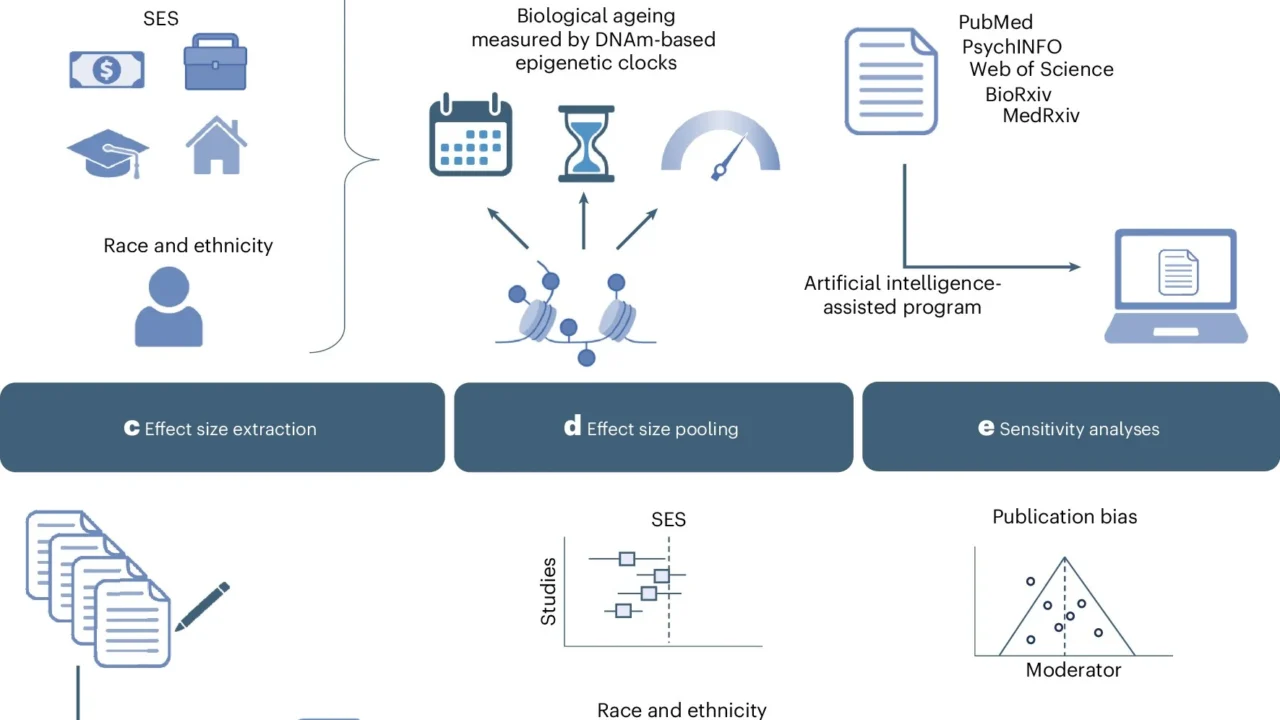
Researchers from the Max Planck Institute for Human Development and Columbia University have reported that lower socioeconomic status and exposure to discrimination are strongly linked to accelerated biological aging, as measured by epigenetic clocks. This finding, derived from a meta-analysis of 140 studies and nearly 66,000 people, was published in Nature Human Behaviour in 2026.
What Happened
The research team synthesized 1,065 effect sizes from 140 independent studies encompassing 65,919 participants aged from birth to 86 years. They analyzed how social inequality, such as poverty and racial discrimination, relates to biological age estimates derived from DNA epigenetic marks, known as epigenetic clocks. The study identified that newer generations of epigenetic clocks, particularly those measuring the pace of aging and health risks, show stronger associations with socioeconomic and racial factors than earlier models.
Key Facts
- The analysis included data from nearly 66,000 individuals across diverse age groups.
- Epigenetic clocks used include first-generation (chronological age estimators), second-generation (health and mortality risk predictors), and third-generation (pace of aging measure) clocks.
- Second- and third-generation clocks show substantially stronger links to social determinants of health than first-generation models.
- Children growing up in disadvantaged socioeconomic environments already show signs of accelerated biological aging.
- Among U.S. studies, Black participants showed faster epigenetic aging than White participants when measured by advanced clocks; Latino participants also showed disparities, though to a lesser extent.
- Findings were published in Nature Human Behaviour under DOI: 10.1038/s41562-026-02477-6.
Why It Matters
This research strengthens evidence that social conditions like poverty and discrimination affect biological aging processes detectable at the molecular level. It underlines the importance of considering socioeconomic factors in public health and aging research. The use of advanced epigenetic clocks potentially provides a biomarker to assess the impact of social and environmental interventions aimed at reducing health disparities and slowing biological aging.
Background
Epigenetic clocks estimate biological age by measuring chemical DNA modifications accumulating with age. Prior studies indicated sensitivity of these clocks to social and environmental factors, but which clocks best capture these effects and at which life stages remained unclear. This meta-analysis integrates extensive prior research to clarify these associations systematically.
Analysis
The study highlights that first-generation clocks, designed mainly to estimate chronological age, are weakly linked to socioeconomic status. In contrast, second- and third-generation clocks, developed to predict disease risk and biological aging pace, are more sensitive to social disadvantage. The researchers suggest these clocks could be valuable tools for evaluating interventions, noting the persistence of accelerated aging effects from childhood into adulthood.
Who Is Affected
Individuals experiencing social disadvantage—including those in lower socioeconomic strata and racially marginalized groups—show consistent patterns of accelerated biological aging. The findings are especially relevant to populations in the United States, where racial disparities in epigenetic aging were examined.
What Remains Unclear
- The effectiveness of interventions to slow epigenetic aging through social policy or health programs has yet to be tested with these biomarkers.
- Long-term clinical implications of accelerated epigenetic aging related to social factors require further investigation.
- Replication of results across more diverse populations and geographic regions remains incomplete.
What Comes Next
The researchers propose that future studies use second- and third-generation epigenetic clocks to evaluate the biological impacts of social interventions such as poverty reduction and educational policies. Further research is expected to establish causality and explore mechanisms underlying these observed associations.
Sources
This article is based on reporting and publicly available information from the following source:
Read more Science Discoveries stories on Goka World News.