
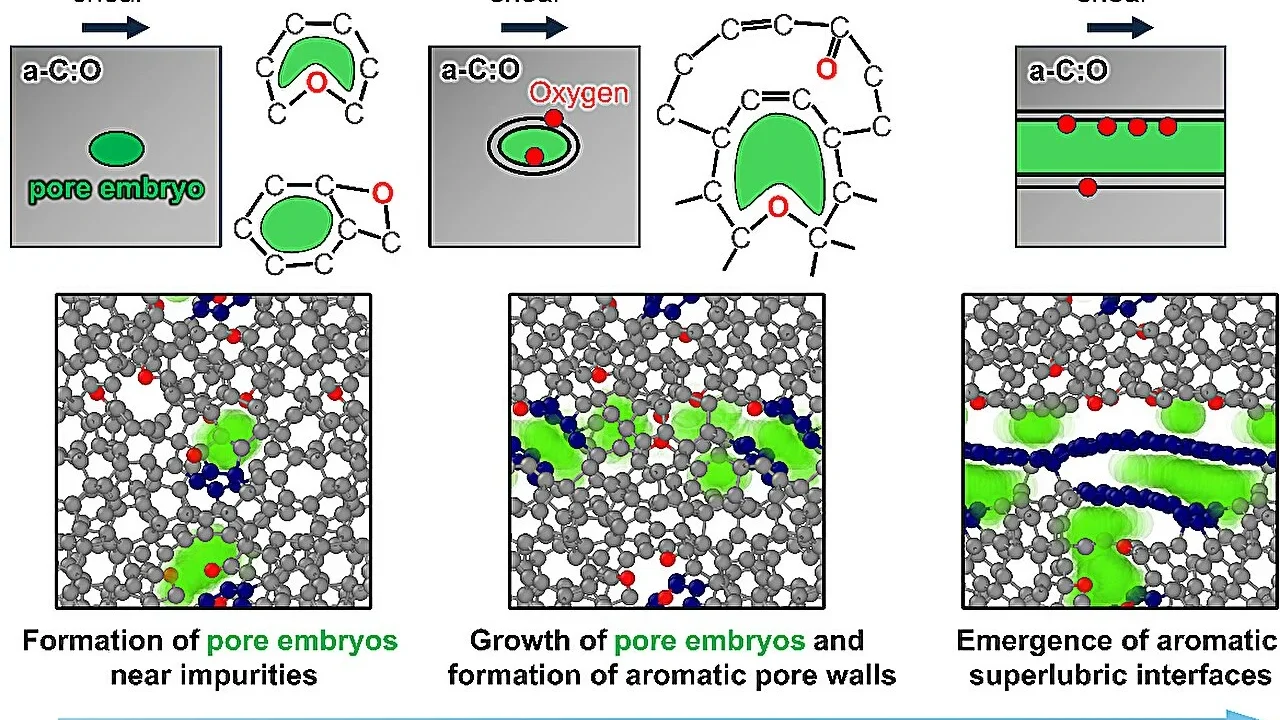
Scientists at Osaka Metropolitan University and the Fraunhofer Institute for Mechanics of Materials IWM have discovered that certain chemical impurities significantly reduce friction on carbon surfaces, enabling the formation of superlow-friction interfaces. Their study, published on June 14, 2026, explores how impurities promote graphitic structures in amorphous carbon, advancing potential applications for durable, low-wear coatings in mechanical systems.
What Happened
Using quantum-mechanical molecular dynamics simulations, the research team conducted 1,000 computational tests on sheared amorphous carbon samples containing various impurity elements. They observed that impurities with low valency, especially hydrogen and oxygen, triggered the formation of aromatic, graphitic structures at the sliding interfaces. These structures generated extremely low friction surfaces, maintaining slipperiness under mechanical stress. The results were published in the journal Advanced Science.
Key Facts
- The study involved 1,000 simulations of amorphous carbon with different chemical impurities.
- Impurities with fewer than four chemical bonds, notably hydrogen and oxygen, promoted graphitic, aromatic ring formation.
- Pure carbon and silicon-doped systems did not develop similar low-friction graphitic structures.
- Simulations revealed that impurities stabilized voids within the carbon network, facilitating atomic reorganization under shear stress.
- Published in Advanced Science on June 14, 2026, by Takuya Kuwahara et al.
Why It Matters
The findings suggest an alternative approach to achieving superlubricity—low friction with minimal wear—through controlled impurity introduction rather than relying solely on external lubricants or pre-made graphitic coatings. This could lead to longer-lasting, more energy-efficient carbon-based coatings for components in machines, reducing maintenance costs and energy waste in various industries.
Background
Prior research established that graphite and graphene structures enable nearly frictionless sliding due to their layered atomic arrangements. However, creating and sustaining such structures in practical applications has posed challenges. Amorphous carbon, an unordered carbon form, was known to transform into graphitic structures at contact points during shear, a process called shear-induced aromatization, but the role of impurities in this mechanism remained unclear.
Analysis
Lead author Takuya Kuwahara states that their results overturn the conventional view that impurities degrade material properties. Instead, impurities like hydrogen and oxygen can promote and stabilize low-friction graphitic interfaces in amorphous carbon coatings. The study highlights the importance of chemical valency in tuning material behavior at the atomic scale during mechanical stress.
Who Is Affected
Mechanical engineers, materials scientists, and industries dependent on moving components—such as automotive, aerospace, and manufacturing—could benefit from coatings that self-generate durable, low-friction surfaces. This development could enhance the lifespan and energy efficiency of machinery globally.
What Remains Unclear
- How multiple impurity elements together influence superlow friction formation under varied real-world environmental conditions.
- Whether these atomic-scale processes observed in simulations can be experimentally validated at larger scales.
- The impact of external factors such as temperature and pressure on the stability of these graphitic interfaces.
What Comes Next
The researchers plan to experimentally test their mechanism under realistic conditions incorporating combinations of multiple impurities and variable environmental parameters. Their goal is to develop design strategies for carbon materials that autonomously form and maintain ultralow-friction interfaces in operational mechanical systems.
Sources
This article is based on reporting and publicly available information from the following source:
Read more Science Discoveries stories on Goka World News.