
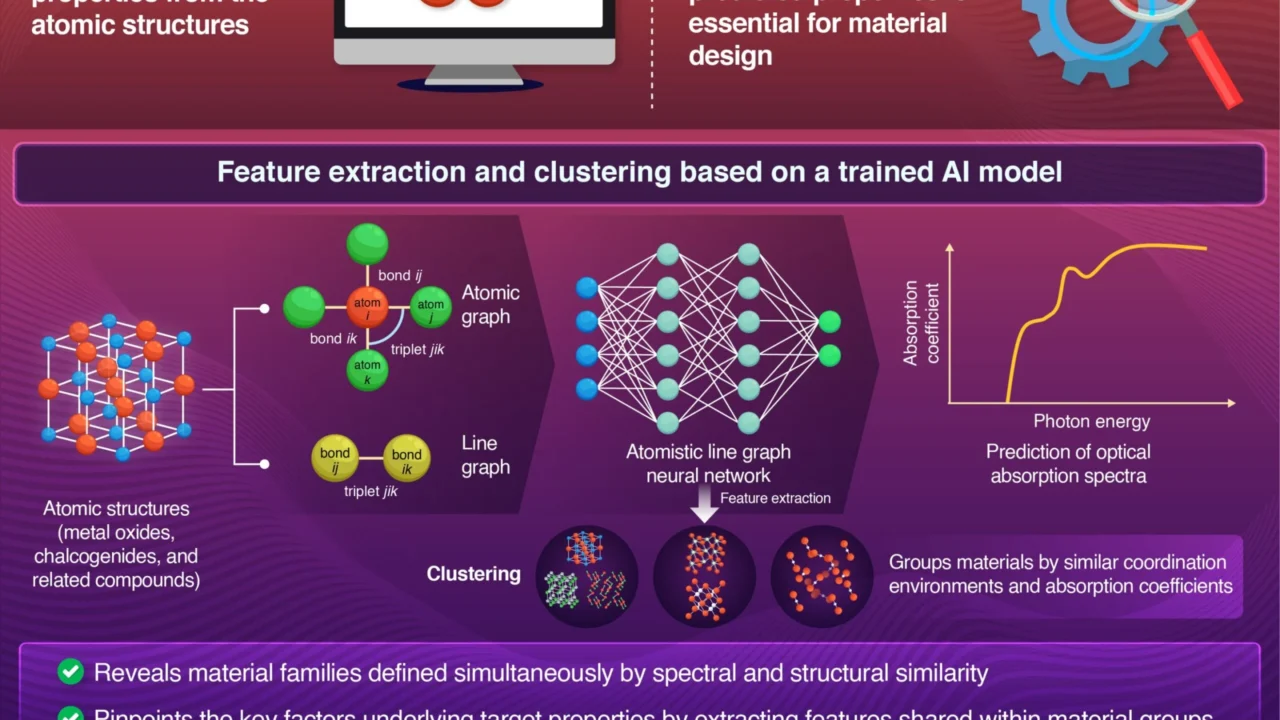
Researchers from the Institute of Science Tokyo in Japan have developed a method to interpret artificial intelligence (AI) models used in materials discovery, focusing on how these models predict optical absorption spectra based on atomic structures. This advancement aims to clarify the relationships between a material’s atomic arrangement and its optical properties, a critical step for more targeted materials design.
What Happened
In a study led by Assistant Professor Akira Takahashi and Professor Fumiyasu Oba, with collaboration from Tohoku University’s Professor Yu Kumagai, the team analyzed an AI model trained on optical absorption data of 2,681 inorganic compounds. They extracted learned features from the model’s internal layers and applied hierarchical clustering to classify materials by shared spectral and structural characteristics. Their findings will be published in the journal Advanced Intelligent Discovery in 2026.
Key Facts
- The AI model used was the atomistic line graph neural network (ALIGNN), targeting prediction of optical absorption spectra from atomic structures.
- Data involved 2,681 metal oxides, chalcogenides, and related compounds.
- Key structural features included elemental composition, atomic coordination, bond lengths, and bond angles.
- The model inferred oxidation states and electronic configurations internally, without explicit input.
- The researchers applied hierarchical clustering to group materials with similar spectral and structural features.
Why It Matters
Optical absorption spectra characterize how materials interact with light, influencing applications such as pigments, solar cells, and photodetectors. By interpreting AI models to reveal which structural factors impact these spectra, this approach improves the ability to design materials with desired optical properties more efficiently compared to trial-and-error experimentation.
Background
Previous AI efforts in materials science have enabled prediction of material properties from atomic structures but typically lacked interpretability, functioning as “black boxes.” Optical spectra present a particularly complex challenge due to their high-dimensional and continuous nature, unlike properties represented by simple numerical values.
Analysis
Assistant Professor Takahashi emphasized that their classification method elucidates how AI models make predictions by extracting key spectral factors, providing useful physical and chemical insights. The success of learning meaningful relationships from structure alone suggests the ALIGNN model’s internal representations capture significant material-property links.
Who Is Affected
The research directly benefits materials scientists and engineers engaged in developing new functional materials, especially those focusing on optical applications such as photovoltaics, photodetection devices, and coloration technology.
What Remains Unclear
- Whether the method can be generalized to other spectral properties and material classes beyond those studied.
- Its scalability and reliability in predicting properties under different environmental conditions like temperature or pressure require further investigation.
- The practical implementation of this interpretable AI framework in industrial material design pipelines remains to be demonstrated.
What Comes Next
The researchers intend to extend their approach to analyze how atomic structures influence other spectral and material properties and to explore applications in broader materials design challenges.
Sources
This article is based on reporting and publicly available information from the following source:
Read more Artificial Intelligence stories on Goka World News.