
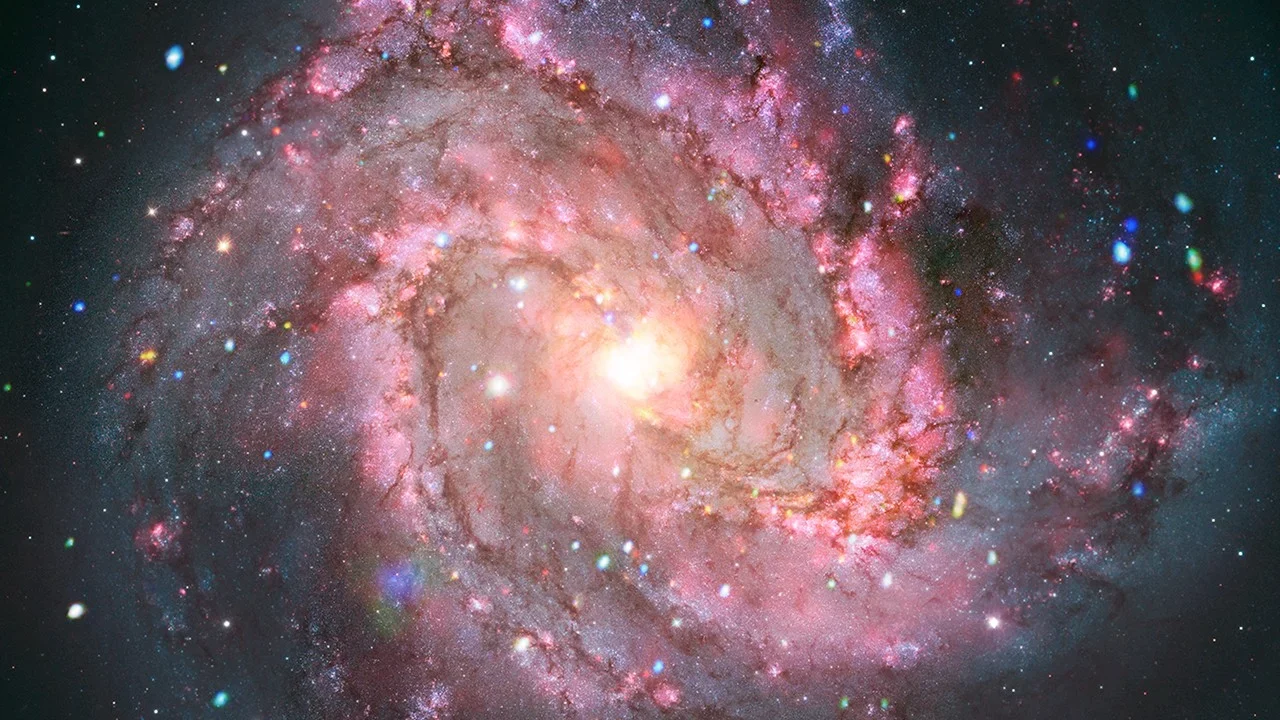
NASA’s Chandra X-ray Observatory has observed unexpected variations in X-ray brightness from supernova remnants in the nearby galaxy Messier 83 (M83), located about 15 million light-years away. The findings, based on 14 years of data, indicate that roughly half of the studied remnants exhibit dramatic changes, challenging prior assumptions about their steady fading post-explosion.
What Happened
Between 2000 and 2014, astronomers conducted multiple observations of M83 using NASA’s Chandra X-ray Observatory. They analyzed 14 years of X-ray data from 22 sources identified as supernova remnants within M83, a galaxy known for its high star formation rate. Contrary to expectations that these remnants fade slowly over time, about half showed significant brightness changes in X-rays, revealing previously unrecognized dynamic processes occurring in these remnants.
Key Facts
- The galaxy M83 is approximately 15 million light-years from Earth.
- Data spanned from 2000 to 2014, including 12 Chandra observations.
- 22 X-ray sources linked to supernova remnants were analyzed.
- About 50% of these sources showed measurable variability in X-ray brightness.
- One well-understood source, SN 1957D, exhibited flaring due to interaction with surrounding material.
- Many variable remnants are located in star-rich regions.
- The study was published in The Astrophysical Journal and presented at the American Astronomical Society meeting.
Why It Matters
This discovery challenges prevailing models of supernova remnant evolution, which predicted a gradual and steady fading of X-ray emissions after the explosion. The variability suggests that a significant subset of these remnants may host stellar survivors orbiting a black hole or neutron star, leading to dynamic high-mass X-ray binary (HMXB) systems. Understanding these systems enhances knowledge of stellar deaths, binary evolution, and the mechanisms powering variable X-ray sources.
Background
Supernova remnants typically appear as slowly fading clouds of hot gas following a stellar explosion. M83 is a spiral galaxy noted for its intense star formation activity. Previous observations had identified only a few supernova remnants associated with HMXBs across all galaxies. Finding over 20 such candidates in one galaxy is unprecedented and hints at a complex population of surviving stars interacting with compact objects post-supernova.
Analysis
Andrea Prestwich from the Catholic University of America, lead author of the study, emphasized the surprising nature of the large fraction of variable remnants. CfA’s Michael McCollough suggested that these systems arise from massive star pairs where one star exploded as a supernova, leaving behind a black hole or neutron star pulling material from the surviving companion. Co-author Roy Kilgard of Wesleyan University proposed that some X-ray variability could result from the compact object recapturing debris from the original explosion, representing a form of cosmic recycling. These interpretations are supported by the clustering of variable remnants in star-rich regions of M83.
Who Is Affected
The findings impact astrophysicists studying stellar life cycles, compact object formation, and X-ray binary phenomena. The study also affects models of galaxy evolution in star-forming environments and informs future observational strategies targeting supernova remnants and compact binaries in nearby galaxies.
What Remains Unclear
- The precise mechanisms causing X-ray variability in all of the observed remnants aside from SN 1957D remain undetermined.
- It is unclear how many remnants contain surviving companion stars versus recycling supernova debris.
- The limited spatial resolution at M83’s distance constrains detailed structural observations of the variable sources.
What Comes Next
Follow-up observations are underway, including studies of the nearby star-forming galaxy M51, which exhibits similar variable supernova remnants. Continued monitoring with Chandra and complementary instruments aims to clarify the nature of these systems and the processes driving their variability.
Sources
This article is based on reporting and publicly available information from the following source:
Read more Space & NASA stories on Goka World News.