
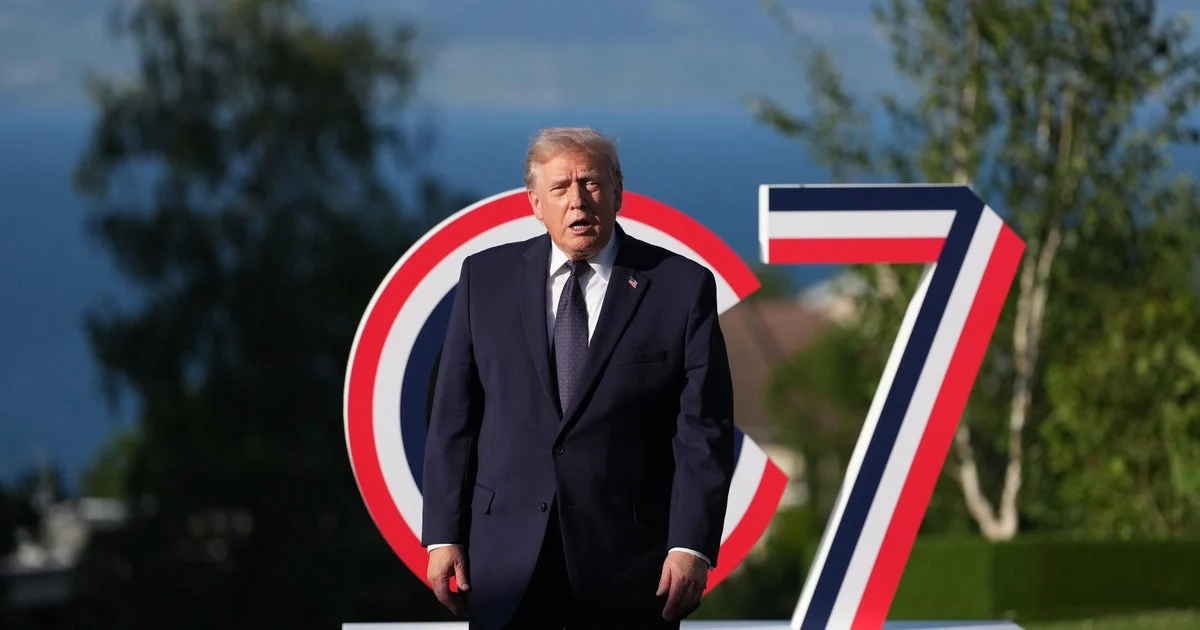
President Donald Trump arrived in Evian-les-Bains, France, on June 15, 2026, to participate in the Group of Seven (G7) summit, where he announced the signing of a memorandum of understanding with Iran. The agreement aims to facilitate the reopening of the Strait of Hormuz, a strategic waterway for global oil shipments.
What Happened
Upon arriving at the G7 summit, President Trump held a bilateral meeting with French President Emmanuel Macron, during which he declared the Iran memorandum “all signed.” The administration confirmed that President Trump, Vice President JD Vance, and Iranian Parliament Speaker Mohammad-Bagher Ghalibaf signed the agreement. Trump stated that the Strait of Hormuz is “already partially opened” and that efforts would commence to clear mines to ensure maritime safety. However, the text of the memorandum may not be publicly released until after Friday, the anticipated date of the formal signing ceremony.
Key Facts
- The memorandum of understanding involves the United States and Iran, signed by Trump, Vance, and Ghalibaf.
- The signing ceremony is expected to take place on Friday, June 19, 2026.
- The Iran memorandum is set to initiate 60 days of negotiations for a comprehensive final deal.
- Secretary of State Marco Rubio stated earlier that the U.S. would assist in clearing mines from the Strait of Hormuz.
- Defense Secretary Pete Hegseth indicated that mine-clearing operations could begin “immediately.”
- The G7 summit is held in Evian-les-Bains, France, and includes leaders from the U.S., France, Canada, Germany, Italy, Japan, and the United Kingdom, with the European Union as a permanent member.
Why It Matters
The Iran memorandum represents a significant diplomatic effort to ease tensions and restore navigation through the Strait of Hormuz, a critical chokepoint for global energy supplies. Its successful implementation could have far-reaching implications for regional security and international maritime trade.
Background
The memorandum follows ongoing U.S. efforts to manage relations with Iran amid longstanding conflict over nuclear enrichment and regional influence. Previous administrations have faced challenges securing stable agreements with Tehran. This memorandum initiates a formal dialogue with a focus on reopening the strategic Strait of Hormuz safely.
Analysis
This information was not confirmed in the reviewed sources.
Who Is Affected
- Countries dependent on oil transported through the Strait of Hormuz.
- G7 member states involved in the summit and regional security dialogues.
- Iran, as a principal party to the memorandum and negotiations.
- The United States, particularly its diplomatic and defense establishments.
What Remains Unclear
- Exact details of the treaty text remain undisclosed pending public release.
- Specific methods for removing enriched uranium held by Iran.
- Safe clearance and mine-removal procedures in the Strait of Hormuz.
- Inspection protocols and enforcement mechanisms for Iran’s compliance.
What Comes Next
- Formal signing ceremony scheduled for Friday, June 19, 2026, possibly in the absence of President Trump.
- A 60-day negotiation period following the memorandum’s signing to finalize the deal.
- Further bilateral meetings during the G7 summit, including sessions with leaders from Qatar, the United Arab Emirates, Egypt, India, and Ukraine.
Sources
This article is based on reporting and publicly available information from the following source:
Read more Politics stories on Goka World News.