
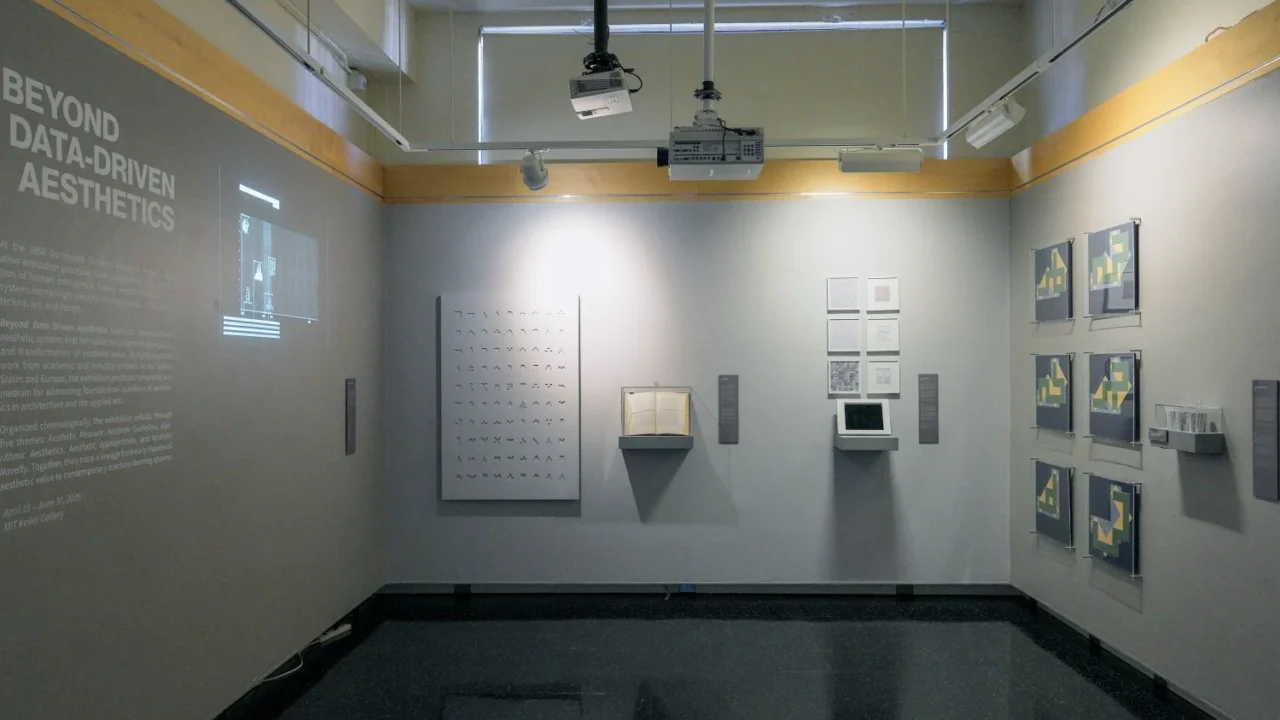
MIT alumnus and researcher Alexandros Haridis is currently presenting “Beyond Data-Driven Aesthetics” at the MIT Keller Gallery, an exhibition running through June 30. The show investigates how computing, artificial intelligence, and design computation influence aesthetic judgment and creative production in architecture and applied arts. The exhibition translates complex algorithms, machine learning models, and theoretical texts into tangible installations and interactive visualizations.
What Happened
The exhibition, curated by Haridis who completed his PhD in design and computation at MIT’s Department of Architecture, launched in early 2024 at the MIT Keller Gallery. It showcases five thematic sections—Aesthetic Measure, Aesthetic Guidelines, Algorithmic Aesthetics, Aesthetic Appropriation, and Aesthetic Novelty—each reflecting computational approaches to aesthetics derived from seminal research papers and books.
Haridis designed the exhibition to interpret dense academic materials, including mathematical formulas and algorithmic models, into visual, spatial, and experiential forms. This effort draws on historical and contemporary studies in aesthetics, AI, and design computation, referencing landmark moments in AI research such as the 1956 Dartmouth Summer Research Project as a conceptual foundation.
Key Facts
Alexandros Haridis, an MIT Architecture alumnus, leads the project, which integrates fields of philosophy, mathematics, computer science, and design. The five thematic areas stem from a range of research including George Birkhoff’s 1930s mathematical quantification of aesthetics and the cognitive aesthetics model underlying the AI system AICAN’s image evaluation. The exhibition uses design methods such as software reconstruction, digital fabrication, and data visualization to interpret “black box” machine-learning systems and algorithmic aesthetics.
The exhibition is part of broader MIT efforts to explore the interpretability of computational systems in creative domains, blurring the boundaries between academic research and public engagement through physical and digital art forms.
What This Means
This exhibition moves beyond abstract academic discourse to make the complexities of computational aesthetics accessible and tangible. For practitioners in architecture and design, it opens new pathways to understanding how AI and algorithmic processes influence creative decisions and aesthetic evaluation beyond mere data-driven metrics. It challenges the notion that AI creativity is a novel concept by tracing longstanding interdisciplinary inquiries into computational creativity and evaluation.
Furthermore, the show serves as a platform to critically reflect on the role of computation in shaping human experiences of space and objects. By translating opaque AI systems into experiential installations, it invites wider public participation and awareness, potentially shifting perceptions around AI’s creative capacities in architecture and the arts. This interpretative approach also signals evolving research communication methods that could reshape how technical knowledge is disseminated beyond traditional academic writing.
Background
The intellectual foundation of “Beyond Data-Driven Aesthetics” traces to key historical moments such as the 1956 Dartmouth conference, which identified creation and evaluation as vital aspects of human intelligence. Haridis’s research also builds on the development of rule-based design computation and aesthetic theory from figures like Samuel Taylor Coleridge and Oscar Wilde, connecting literary and philosophical thought to modern computational methods. Additionally, the exhibition is situated amid growing interdisciplinary efforts to visualize and demystify AI and neural networks across computer science and architectural design.
What Comes Next
The exhibition continues through June 30 at the MIT Keller Gallery. Haridis sees the project as an ongoing research platform to deepen investigations into computational evaluation in design contexts. Future work aims to link these computational insights more directly to practical applications in built environments, enhancing how designers use both rule-based and data-driven computation to improve human experience in architectural spaces.
Sources
This article is based on reporting and publicly available information from the following sources:
Read more Artificial Intelligence stories on Goka World News.