
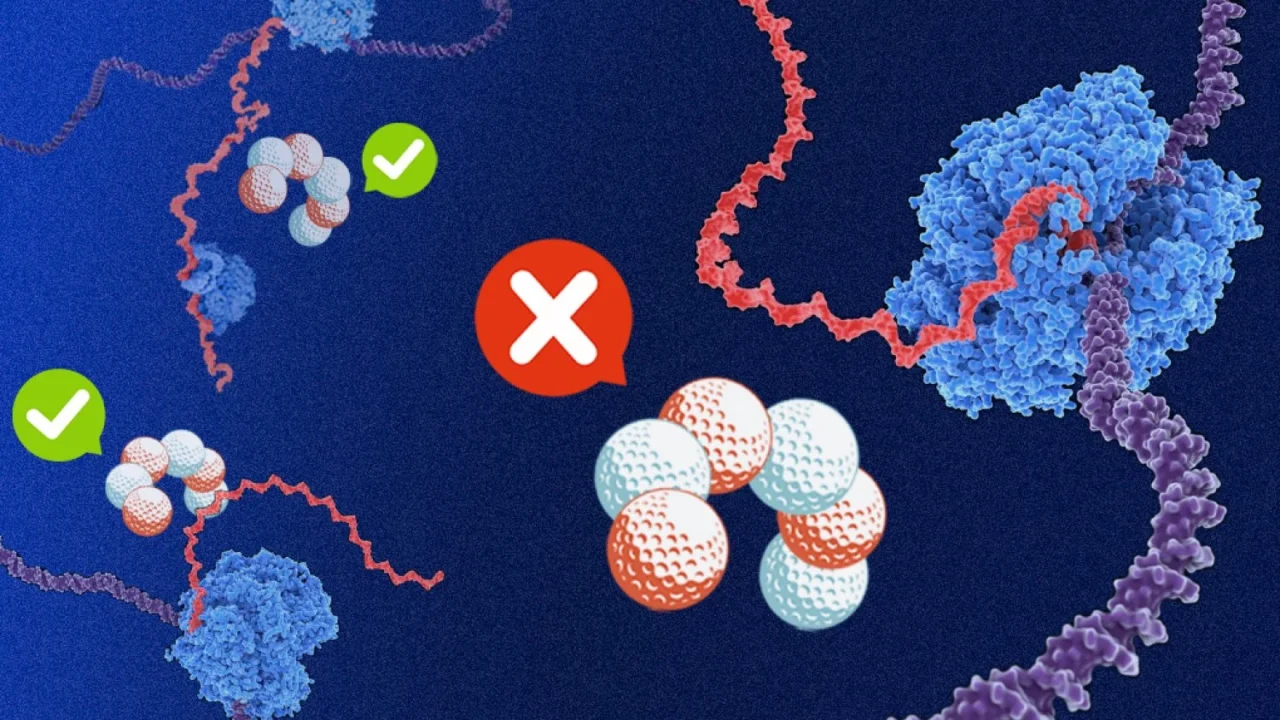
Scientists from Princeton University have uncovered a key molecular mechanism explaining why some bacterial genes are rich in purines, the nucleotide bases guanine and adenine. Their study, published in Nature Microbiology, reveals that this purine bias in the DNA coding strand protects vital messenger RNA (mRNA) transcripts from being prematurely terminated by the quality-control protein Rho in the bacterium Bacillus subtilis.
What Happened
The research, led by Associate Professor Gene-Wei Li and first author Julia Dierksheide, examined how Rho selectively terminates noncoding, nonfunctional RNA transcripts while sparing productive gene transcripts. Unlike the classic model where RNA polymerase and ribosomes remain coupled during transcription and translation, B. subtilis exhibits “runaway transcription” where RNA polymerase moves ahead of ribosomes and becomes vulnerable to Rho action.
Surprisingly, Rho targets primarily the noncoding RNA products despite this uncoupling. The team used genome-wide analyses to discover that coding DNA strands in B. subtilis display a marked purine enrichment compared to the overall genome. This purine-rich sequence composition alone provides a barrier that protects essential mRNA transcripts from Rho-mediated termination, ensuring efficient gene expression.
Key Facts
The study was published in the journal Nature Microbiology. It involved analyzing the entire genome of Bacillus subtilis to compare sequence compositions between coding and noncoding strands. The researchers connected Rho’s termination specificity to the nucleotide composition bias favoring purines in coding regions. They observed that bacterial species that lost Rho during evolution also lack this strong purine bias, underscoring its adaptive role.
Rho also regulates critical biological processes in bacteria, such as motility, biofilm formation, and sporulation, all related to survival and environmental adaptation.
What This Means
This discovery significantly advances understanding of bacterial gene expression regulation by linking DNA sequence composition to transcript quality control. Recognizing the purine bias as a key protective feature reshapes how scientists view the coordination of transcription and translation, especially in bacteria with uncoupled transcription mechanisms like B. subtilis.
Practically, this insight offers important guidance for genetic engineering and synthetic biology. When designing bacterial genes for protein production or therapeutic applications, accounting for purine-rich sequences could improve stability and yield by preventing premature RNA termination. This knowledge opens avenues for optimizing expression systems in diverse bacteria, particularly those with robust secretion pathways suitable for industrial-scale protein manufacturing.
Background
Previously, it was a prevailing view that bacterial RNA polymerase and ribosomes operated so closely during transcription and translation that ribosomes shielded nascent RNAs from Rho. The phenomenon of runaway transcription in B. subtilis challenged this model by showing the polymerase can disconnect from ribosomes. Understanding why Rho then selectively targets certain RNAs remained unclear until now.
What Remains Unclear
Although this study cracked the code linking purine bias to Rho specificity, the exact biochemical mechanism by which Rho distinguishes purine-rich transcripts from others still needs elucidation. The researchers also aim to investigate whether similar rules govern Rho action in other bacteria such as Escherichia coli, which diverged evolutionarily from B. subtilis about two billion years ago and retains coupled transcription-translation.
What Comes Next
Building on these findings, the team plans to perform comparative analyses of Rho specificity in E. coli to uncover how its termination precision differs from that of B. subtilis. This will deepen understanding of evolutionary adaptations in bacterial gene regulation. The results are expected to inform strategies for engineering bacterial strains tailored for pharmaceutical and biotechnological production.
Sources
This article is based on reporting and publicly available information from the following sources:
Read more Science Discoveries stories on Goka World News.