
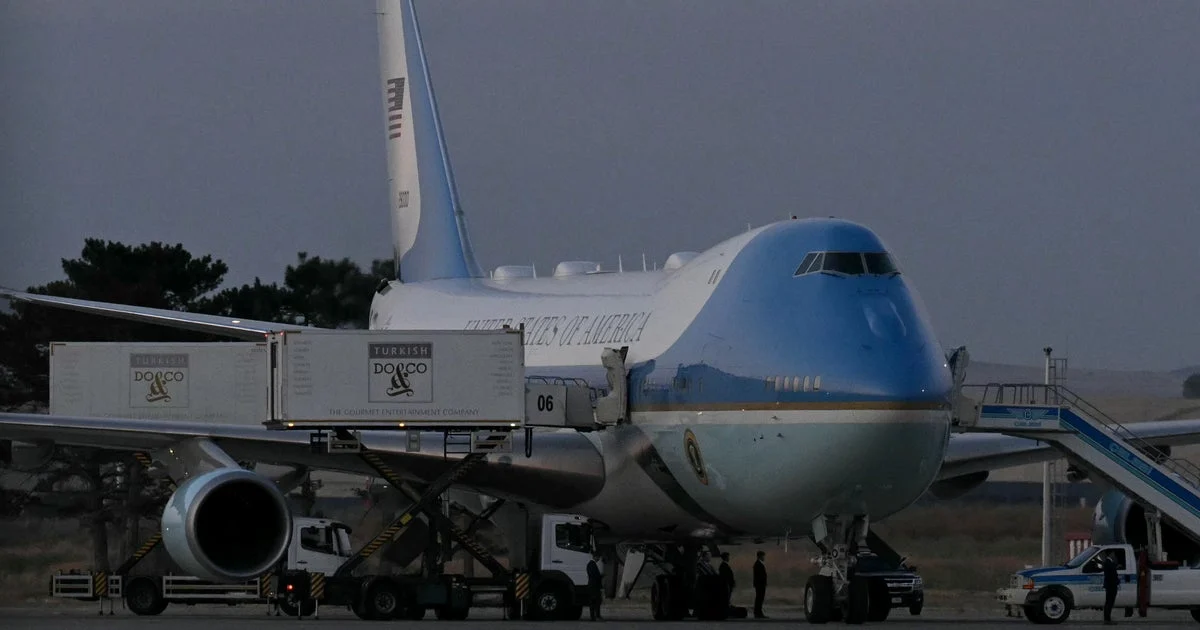
President Donald Trump secretly boarded a different plane during the NATO summit departure in Ankara, Turkey, in early July after U.S. intelligence warned of a credible missile threat originating from Iran and its allied proxies. This covert operation ensured the president’s security while keeping the details tightly controlled until now.
What Happened
On July 8, 2026, just before Air Force One was scheduled to depart Esenboga Airport in Ankara, President Trump slipped away from the presidential jet. U.S. government personnel used an airport catering truck as a cover to discreetly transfer him to another plane, an Air Force C-32A, according to a U.S. official with direct knowledge of the incident. Meanwhile, the press and several staff members remained aboard the older Air Force One, unaware that the president was no longer on that aircraft.
The president’s move was prompted by classified intelligence revealing a credible Iranian missile plot targeting him as he left Ankara. Trump had acknowledged the risk previously during the summit, calling himself Iran’s “number one target.”
After flying to a U.K. refueling stop aboard the decoy plane, the president then switched to the new Air Force One, reportedly donated by Qatar and retrofitted by the U.S. Air Force, before flying on to Washington, D.C. Members of the press on the decoy plane were unaware of the switch until revealed by news reports days later.
Key Facts
- The secret transfer took place at Ankara’s Esenboga Airport on July 8, 2026.
- The decoy aircraft was an Air Force C-32A, used to carry the president separately from the press and staff.
- Intelligence detected a credible missile threat from Iran and its proxies targeting the presidential plane.
- Press members were instructed to keep window shades closed on Air Force One’s press cabin, a precaution that later aligned with the secret operation.
- President Trump publicly claimed the plane switch was “for old time’s sake” and ostensibly to test the new plane during the U.K. refueling stop, although the Secret Service had recommended using the older plane for security concerns.
- White House Communications Director Steven Cheung declined direct comment but emphasized the new Air Force One’s advanced security features.
- The new Air Force One, donated by Qatar and retrofitted by the U.S. Air Force in 2025, was described as outfitted with state-of-the-art technology to meet presidential mission security requirements.
- The details of the operation were first reported by CBS News and The Washington Post.
What This Means
This unusual and secretive maneuver reveals the extent to which threat intelligence shapes protective measures for U.S. presidents, especially amid heightened tensions with Iran. The operation ensured the president’s safety while maintaining secrecy to avoid tipping off potential adversaries about protective tactics.
For the public and media, the episode raises questions about transparency and trust, as even close members of the press and presidential staff were kept in the dark to safeguard security protocols. This incident illustrates the difficult balance between national security and openness that often defines high-profile government operations.
National security teams must continually innovate to counter evolving threats, including the possibility of missile attacks on critical assets such as Air Force One. What occurred in Turkey serves as a reminder that behind-the-scenes measures are repeatedly deployed to protect the commander-in-chief, even at the cost of secrecy for those nearby.
What Remains Unclear
The reviewed sources have not confirmed further details about the nature and scope of the Iranian missile threat, the involvement or extent of allied proxy participation, or the full range of countermeasures taken. It also remains undisclosed whether additional such operations have been executed in other contexts during the president’s travels.
What Comes Next
The White House has not announced specific future steps regarding these protective protocols. However, given the classified nature of such security operations, continued vigilance and similar measures may be expected for future high-risk presidential movements.
Sources
This article is based on reporting and publicly available information from the following sources:
Read more US News stories on Goka World News.