
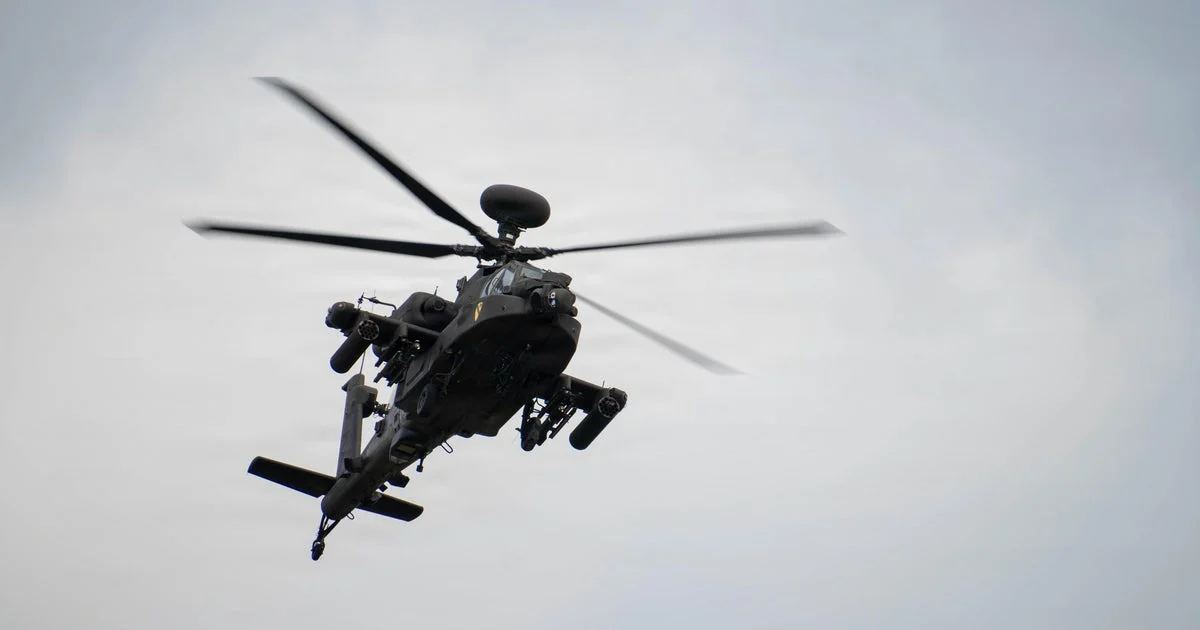
The U.S. Army temporarily suspended Apache helicopter training flights on August 14, 2026, following a deadly crash near Fort Hood, Texas, that claimed the lives of two soldiers. The pause will remain until the Army identifies the root cause of the incident, the service confirmed in an official statement.
What Happened
On August 12, an AH-64 Apache attack helicopter crashed in a field near its base in rural Salado, Texas, just outside Fort Hood. The crash resulted in the deaths of Chief Warrant Officer 2 Deontre T. Huey, age 34, and Warrant Officer Seth L. Olmsted, age 25, both natives of Texas and assigned to the Army. The helicopter did not collide with any structures, but the crash’s violence ignited a wildfire, according to Bell County Sheriff’s Office spokesperson Bill Coleman.
The Army announced a temporary stand-down of Apache training flights on August 14, explaining that the pause will continue until investigators gain a better understanding of what caused the crash. This stand-down is a standard procedure following fatal military aviation accidents when the cause is still unknown.
Key Facts
The deceased soldiers were identified by the Army as Chief Warrant Officer 2 Deontre T. Huey and Warrant Officer Seth L. Olmsted. The AH-64 Apache, produced by Boeing since the late 1990s, is described by the Army as “the most advanced aerial fighting vehicle in the world.” The twin-engine attack helicopter typically carries a pilot and co-pilot gunner, equipped with a rapid-fire gun and Hellfire missiles. The model is widely used by the Army and National Guard and has seen combat deployments, including during the U.S.-Iran conflict.
In a related event in June 2026, an Apache patrolling the Strait of Hormuz was downed by an Iranian drone, but both pilots were rescued by a sea drone, as declared by then-President Trump.
What This Means
The Army’s decision to stand down Apache helicopter training reflects a cautious approach prioritizing safety while the tragic crash is investigated. Such pauses help prevent potential repeat incidents and allow time to analyze whether mechanical failure, human error, or other factors contributed to the accident.
Given the Apache’s critical role in U.S. military aviation and recent combat operations, any findings from the investigation may influence training protocols, aircraft maintenance, and operational procedures going forward. This incident draws attention to the risks involved in maintaining cutting-edge military hardware in active service and underscores the importance of thorough safety reviews.
For soldiers and families connected to the Apache program, as well as local communities near Fort Hood and Salado, the stand-down and investigation period will be one of uncertainty and heightened focus on aviation safety. Military readiness may experience short-term impacts as the Army reviews the cause, but the move signals a commitment to preventing future tragedies.
Background
The AH-64 Apache helicopter has been a mainstay in Army aviation since the late 1990s, serving as a versatile and heavily armed attack platform. Its advanced weaponry and twin-engine design have made it a key asset in various conflicts globally. The Army and National Guard operate hundreds of Apaches across numerous units.
Temporary flight suspensions after fatal crashes are common as part of military aviation safety protocols. These actions ensure thorough investigation and possible modifications before resuming normal operations.
Sources
This article is based on reporting and publicly available information from the following sources:
Read more US News stories on Goka World News.