
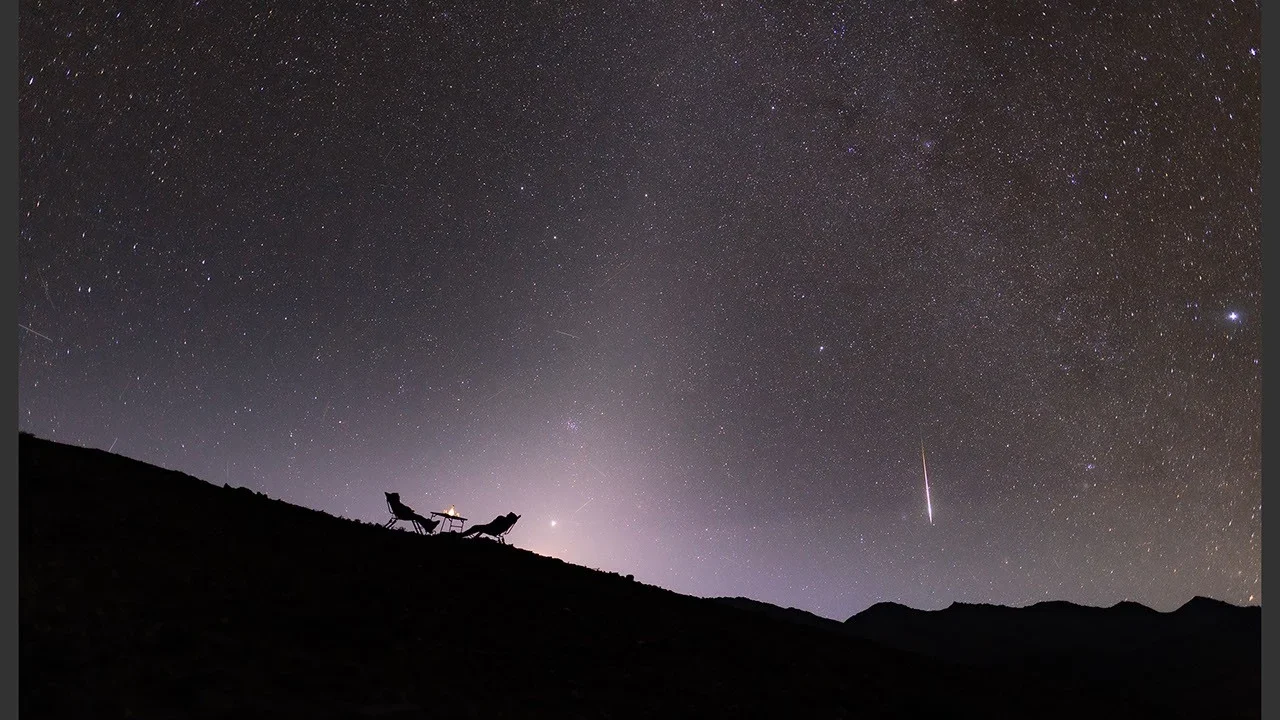
A radiant display of zodiacal light, also known as the false dawn, was captured in a dark night sky over the Hanle Dark Sky Reserve in Ladakh, India. This serene skyscape, taken just before astronomical twilight during the September star party, reveals a faint luminous band formed by sunlight scattered off interplanetary dust.
What Happened
Photographers and stargazing enthusiasts recorded the zodiacal light from the Hanle Dark Sky Reserve, a high-altitude location about 4,500 meters above sea level known for exceptional dark skies. The image features the glowing zodiacal band stretching toward the zenith, where the open star cluster M44 is visible. Near the eastern horizon, bright Jupiter emerges amid the faint glow, while the yellowish planet Mars appears close to the cluster’s center. Meteors also streaked through the scene, enhancing the cosmic atmosphere. This nighttime phenomenon was documented during September’s star party at this remote Earth location.
Key Facts
The zodiacal light is caused by sunlight scattering off fine particles of interplanetary dust concentrated in the plane of the solar system. NASA’s Juno spacecraft has provided data suggesting that Mars itself may contribute to this dust, with particles that backscatter sunlight to create the observed glow from Earth’s vantage point. The Hanle Dark Sky Reserve’s exceptional darkness at 4,500 meters altitude provides an ideal setting for observing such faint celestial phenomena. Visible celestial features include the bright planets Jupiter and Mars, the star cluster M44, and occasional meteors against the backdrop of zodiacal light.
What This Means
The vivid appearance of zodiacal light at Hanle underscores the importance of preserving dark sky locations for astronomical observation. Such sites allow both amateur and professional astronomers to study faint interplanetary phenomena that are invisible in light-polluted environments. The connection identified by NASA’s Juno mission between Mars and the interplanetary dust offering this glow enriches our understanding of the sources of zodiacal light and the dynamics within the inner solar system. For the general public, this dazzling display represents a rare natural spectacle, highlighting the complex interactions between our planet, its neighbors, and the sun. It also raises awareness of the fragile conditions needed to observe faint cosmic features, encouraging support for dark sky preservation worldwide.
Background
Zodiacal light has long been observed as a faint, elongated glow along the ecliptic—the plane of the solar system—visible under very dark conditions. Historically dubbed “false dawn,” it is caused by sunlight scattering from dust particles left over from comet tails and asteroid collisions distributed throughout the inner solar system. NASA’s ongoing exploration missions, such as Juno, have recently added new insights by pinpointing sources of this dust, refining scientific models of solar system dust dynamics.
What Comes Next
Continued monitoring of zodiacal light from dark sky reserves worldwide, coupled with spacecraft observations like those from Juno, will further clarify the contributions of various solar system bodies to interplanetary dust populations. Scheduled astrophotography gatherings, such as Hanle’s star parties, remain essential for accumulating observational data and public engagement in astronomy.
Sources
This article is based on reporting and publicly available information from the following sources:
Read more Science & Technology stories on Goka World News.