
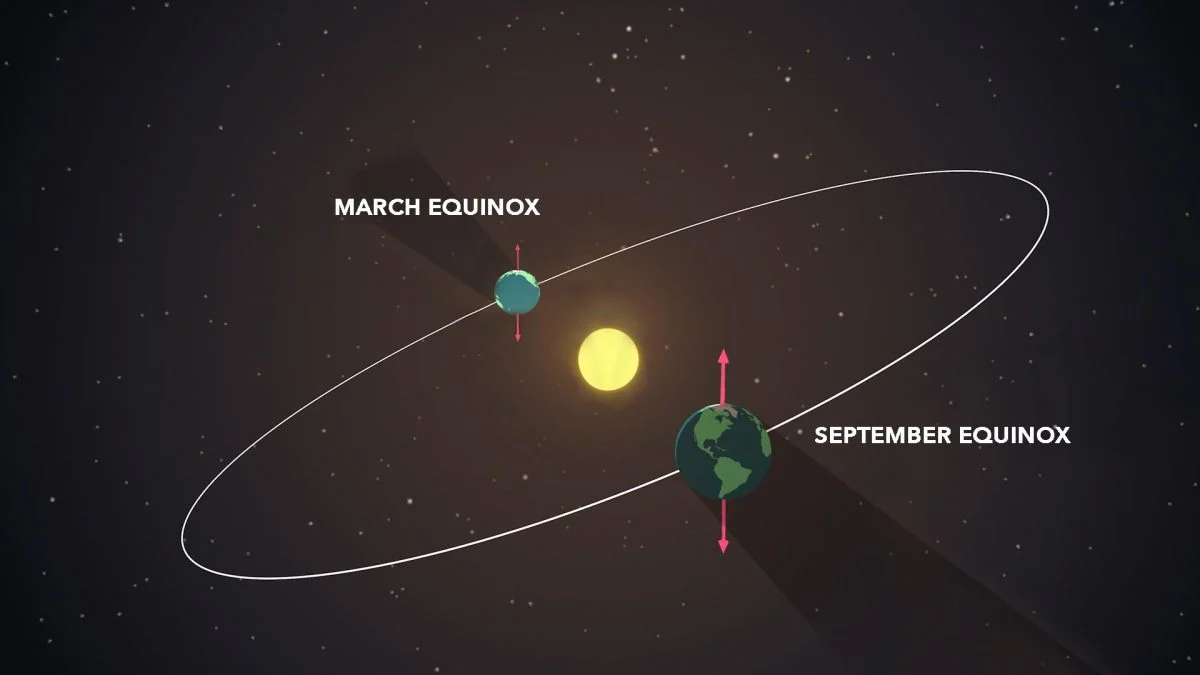
Every year, the equinox signals a pivotal moment when the Sun crosses Earth’s equator, creating nearly equal day and night across the globe. This celestial event, occurring twice annually, marks the changing of seasons and has long been noted by civilizations worldwide.
What Happened
The equinox happens twice each year—in March and September—when the center of the Sun appears to cross the plane of Earth’s equator. In 2026, the March equinox will occur on March 20 at 14:46 Coordinated Universal Time (UTC), corresponding to 7:46 a.m. Eastern Daylight Time (EDT). The September equinox will fall on September 23 at 00:05 UTC, or September 22 at 5:05 p.m. Pacific Daylight Time (PDT).
On these days, observers located at the equator witness the Sun directly overhead at noon. Following the March equinox, the Sun’s apparent path in the sky shifts northward until the June solstice, after which it moves south again. It crosses the equator once more at the September equinox, continuing southward until the December solstice, then reverses direction toward the north.
Key Facts
The term “equinox” derives from Latin, meaning “equal night,” but the lengths of day and night on equinox days are not perfectly equal everywhere due to atmospheric effects and the Sun’s spherical shape. These factors cause sunlight to refract and extend daylight by several minutes around sunrise and sunset, which means the actual balance of day and night can shift depending on one’s latitude and may occur a few days before or after the equinox.
During equinoxes, both Earth’s Northern and Southern Hemispheres receive nearly equal sunlight. This unique moment also results in the simultaneous illumination of both the North and South Poles, a phenomenon unseen at other times of the year.
In the Northern Hemisphere, the March equinox heralds the onset of spring, bringing longer, warmer days. Meanwhile, in the Southern Hemisphere, this period marks the arrival of fall with shorter days and cooler nights. The roles then reverse around the September equinox.
What This Means
The equinox is a crucial astronomical marker that defines seasonal cycles critical to ecosystems, agriculture, and human activities worldwide. Its predictability helped ancient cultures develop calendars and farming schedules, a legacy still reflected in modern timekeeping.
Understanding the equinox also deepens public appreciation for Earth’s complex relationship with the Sun, as it highlights the planet’s axial tilt and orbital dynamics. For many, the equinox represents a natural rhythm that influences weather patterns, daylight hours, and the gradual progression through the seasons—factors that impact daily life from gardening to energy consumption.
Moreover, recognizing that the length of day and night is not exactly equal during the equinox underscores the subtleties of atmospheric physics and celestial mechanics, which play vital roles in Earth science and climate research.
Background
Humanity has observed equinoxes for millennia, with numerous ancient observatories and archaeological sites aligned to these events. Ancient astronomers tracked the equinoxes alongside solstices as fundamental temporal markers guiding agricultural and religious practices.
Today, the equinox remains a key aspect of astronomy education and cultural observance, connecting people to planetary motions long before technology allowed precise measurement.
What Remains Unclear
While the overall timing and phenomena of equinoxes are well understood, precise moments of day-night equalization vary locally and depend on observational factors such as horizon shape and atmospheric conditions. Ongoing observations refine understanding of these variations but no fundamental uncertainties remain concerning the equinox’s cause or timing.
Sources
This article is based on reporting and publicly available information from the following sources:
Read more Science & Technology stories on Goka World News.