
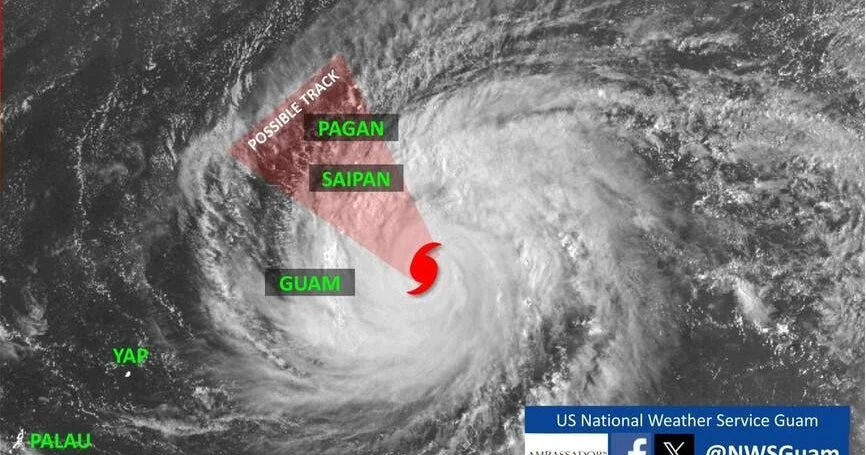
U.S. territories in the western Pacific, including Guam and other islands in the Marianas archipelago, are bracing for Super Typhoon Sinlaku, which is forecasted to bring severe weather conditions including violent winds and heavy rainfall in the coming days.
As of Monday morning, Sinlaku was moving west-northwest toward the Marianas Islands, maintaining maximum sustained winds of 175 mph after previously peaking at 180 mph on Sunday. This makes Sinlaku the most powerful storm recorded this year, exceeding earlier typhoons Narelle and Dudzai, which reached peak winds of 149 mph and 147 mph respectively.
The Marianas Islands, comprising 15 islands about 1,500 miles east of the Philippines, are U.S.-administered territories home to strategic military bases, particularly on Guam. The National Weather Service office in Guam has issued multiple warnings and watches in preparation for the storm. Typhoon warnings cover Rota, Tinian, and Saipan, while tropical storm warnings are in effect for Guam, Pagan, and Alamagan, alongside a tropical storm watch for Agrihan and a typhoon watch for Guam.
Although Sinlaku is expected to weaken before reaching the islands, forecasters warn it may still strike with wind speeds equivalent to a Category 4 or 5 hurricane. Typhoon-force winds extend up to 80 miles from the storm’s center, and tropical-storm-force winds reach 275 miles outward. Residents have been advised to prepare for severe thunderstorms, heavy rain, and the potential for flooding in addition to the already dangerous winds.
Guam’s Joint Information Center emphasized that despite some reduction in typhoon-force wind threats, Sinlaku remains a serious hazard capable of sustaining tropical-storm-force winds between 39 and 73 mph from Monday night through Wednesday. Officials have urged residents to stay indoors and remain away from water activities during the storm.
Why it matters
Super Typhoon Sinlaku poses a significant threat to life, property, and infrastructure in the U.S. territories of the Marianas, highlighting vulnerabilities in these remote but strategically important regions. The storm’s intensity underscores the ongoing risk of powerful tropical cyclones in the Pacific, necessitating careful preparation and emergency response efforts to mitigate damage and protect residents.
Background
In the western Pacific, the term “typhoon” applies to storms similar to U.S. hurricanes. Super typhoons have sustained winds exceeding 150 mph, comparable to Category 4 or 5 hurricane classifications in the Atlantic basin. The Marianas Islands, including Guam, are frequently in the path of these storms due to their location. The islands support several U.S. military bases, which require heightened readiness during such natural disasters.
Read more US News stories on Goka World News.