
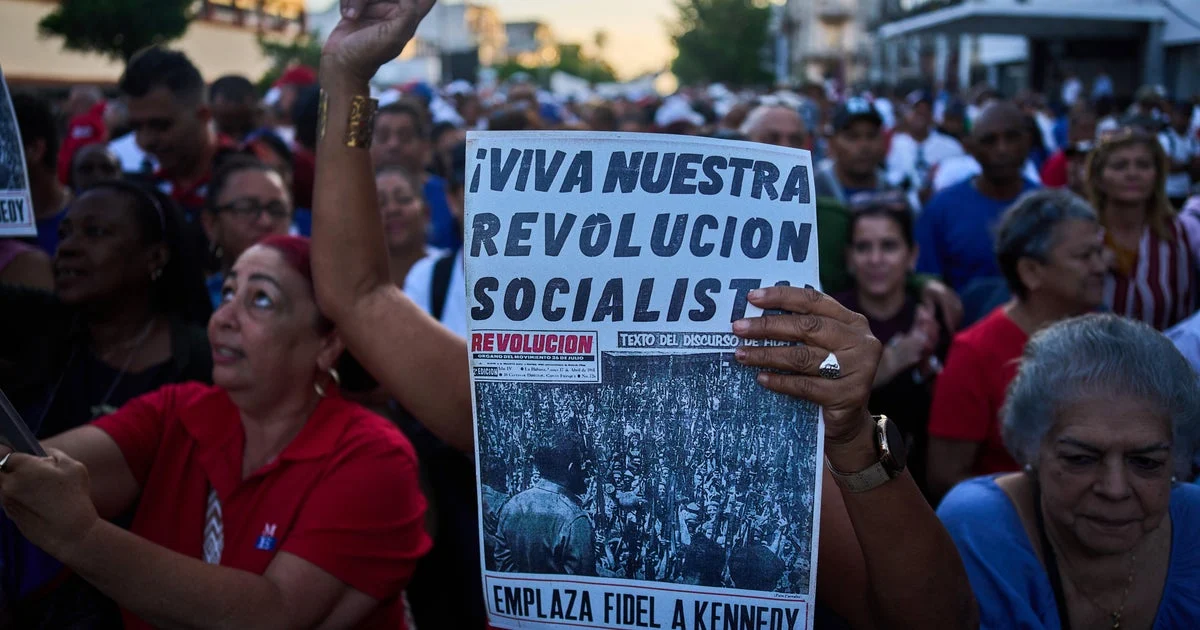
Cuban President Miguel Díaz-Canel declared on April 16, 2026, that Cuba will be prepared to confront any possible attack from the United States amid escalating rhetoric from President Donald Trump. Speaking at a rally in Havana commemorating the 65th anniversary of a historic speech by Fidel Castro, Díaz-Canel emphasized that while Cuba does not seek military conflict, it is ready to defend its sovereignty if necessary.
Escalating U.S. Threats Against Cuba
President Trump has recently intensified his threats against Cuba, describing the island nation as a “failing country” and signaling potential U.S. focus on Cuba after the conflict in Iran ends. Earlier this month, Trump said, “We may stop by Cuba after we finish with this,” referencing ongoing U.S. military actions elsewhere. His administration has imposed a stringent energy embargo on Cuba, restricting its access to oil supplies from countries like Venezuela, Mexico, and Russia.
Trump’s rhetoric has included warnings that Cuba should be “concerned,” notably during discussions of the U.S. military’s capture of Venezuelan President Nicolás Maduro in January, and statements in March asserting he expected to have “the honor of taking Cuba” in some form. Alongside Trump, U.S. Secretary of State Marco Rubio has criticized Cuba’s government as ineffective and abusive.
Díaz-Canel’s Response and Cuban Resilience
In his remarks, Díaz-Canel condemned what he described as “multidimensional aggression” against Cuba, including economic and energy blockades, which have intensified an ongoing five-year economic crisis exacerbated by the COVID-19 pandemic and U.S. sanctions. He rejected the characterization of Cuba as a failed state, instead calling it a “besieged state” that continues to resist and create thanks to its socialist system.
The president highlighted Cuba’s social welfare achievements, including free education that has trained thousands of professionals, many of whom have emigrated due to worsening conditions. He framed the current challenges as a test comparable to previous historical crises, underscoring the island’s determination not to surrender.
Humanitarian Impact of U.S. Sanctions
The U.S. energy embargo in particular has contributed to severe fuel shortages and prolonged blackouts, deepening hardships for the Cuban population. Experts have warned that the ongoing blockade risks triggering a humanitarian crisis on the island. Both Cuban and U.S. officials have acknowledged talks aimed at de-escalating tensions, though no details have been publicly released.
Why it matters
The situation heightens the risk of direct conflict in a region with historic U.S.-Cuba tensions, while the energy embargo compounds humanitarian suffering amid an already fragile economy. The developments also occur against the backdrop of broader U.S. foreign policy shifts following the conflict in Iran.
Read more World News stories on Goka World News.