
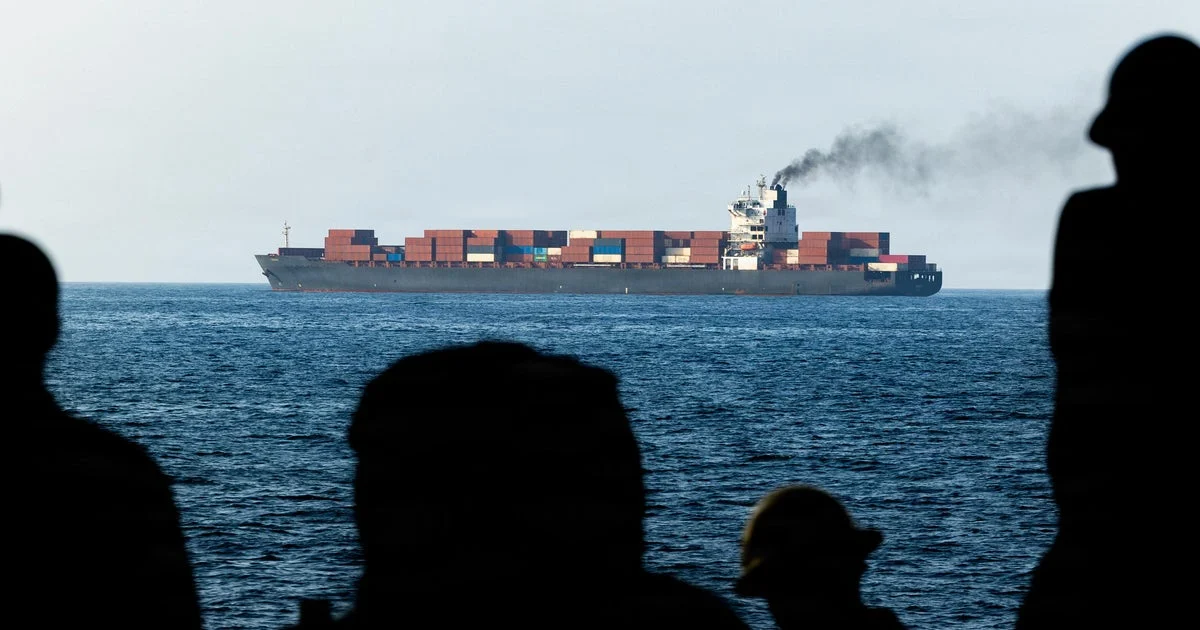
Iran renewed attacks on commercial ships passing through the strategic Strait of Hormuz on Wednesday, challenging the ongoing ceasefire with the United States. This escalation occurred shortly after President Donald Trump announced an indefinite extension of the ceasefire, which had been established two weeks earlier to ease tensions between the two countries.
The Iranian government denounced the U.S. naval blockade of Iranian ports as a breach of the ceasefire agreement. Iranian Parliament Speaker Mohammad-Bagher Ghalibaf emphasized that Iran would not accept a lasting ceasefire while the blockade remains in place, calling it an act of “hostage-taking” of the global economy. The speaker stated that military aggression and intimidation had failed to achieve U.S. objectives and insisted that the way forward involves recognizing the rights of the Iranian people.
Despite the ceasefire extension, President Trump confirmed that the United States intends to maintain the blockade as a condition for longer-term peace negotiations. On his social media platform, Truth Social, he asserted that reopening the Strait of Hormuz without exacting terms from Iran would jeopardize any prospective deal unless the U.S. took severe military action against Iranian leadership.
Meanwhile, the U.S. military continues to reinforce its presence in the Middle East, deploying thousands of additional troops. The ongoing conflict, referred to by the U.S. as Operation Epic Fury, has resulted in approximately 400 American service members injured and 13 killed, all early in the conflict. U.S. officials also indicate that Iran retains significant military capabilities: roughly half of its ballistic missile stockpile and launch systems are intact, as well as 60% of the Islamic Revolutionary Guard Corps naval assets and about two-thirds of its air force.
The escalation has affected global oil prices, which rose following the attacks amid growing uncertainty over an imminent peace agreement. The strategic importance of the Strait of Hormuz, a key global oil transit chokepoint, underscores the broader economic ramifications of the conflict.
Why it matters
The Strait of Hormuz is a critical maritime passage for global energy exports, with a significant portion of the world’s oil supply transiting the narrow waterway. Iran’s attacks on commercial vessels threaten international shipping security and energy markets, risking further economic disruption worldwide. The continuation of the U.S. naval blockade complicates prospects for lasting peace, while heightened military activity raises concerns about expanded conflict in an already volatile region.
Background
The ceasefire between the U.S. and Iran was established following intensified hostilities that included missile strikes, naval confrontations, and sanctions. Diplomatic efforts brokered by Pakistan led to the initial agreement, but disagreements over the U.S. blockade and demands for Iranian concessions have stalled progress. The U.S. and its allies have focused on restricting Iran’s oil exports to diminish revenues used to fund military and terrorist activities. Despite the ceasefire, intermittent attacks and military build-ups have continued, contributing to a fragile and unstable truce.
Read more World News stories on Goka World News.