
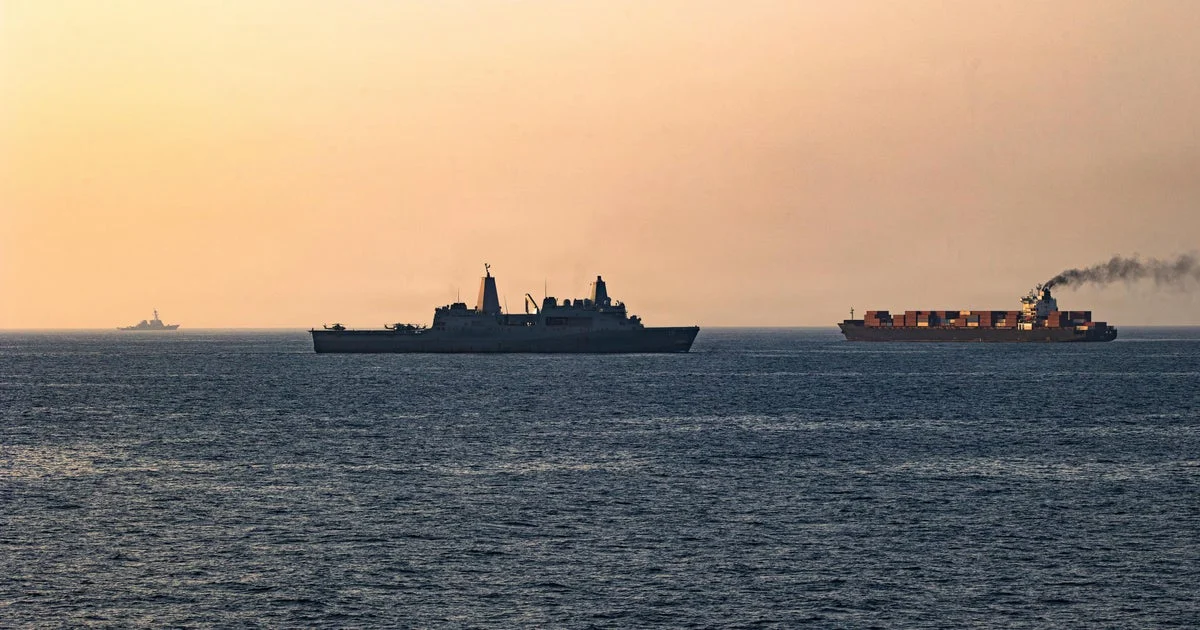
At least two ships were attacked in the Strait of Hormuz on Wednesday, escalating tensions just as efforts to resume peace negotiations between the United States and Iran remain stalled. The incidents, reported by the British military, involved an Iranian Revolutionary Guard Corps (IRGC) gunboat firing on a container ship and a subsequent attack on a cargo ship.
The U.K. Maritime Trade Operations Centre (UKMTO) detailed that the first attack occurred approximately 15 nautical miles northeast of Oman. The IRGC gunboat fired on a container ship without issuing any radio warning, causing heavy damage to the ship’s bridge. Despite the damage, all crew members on board were reported safe. About three hours later, a second attack occurred 8 nautical miles west of Iran. A cargo ship reported being fired upon and became stopped in the water, with its crew accounted for and unharmed. The source of the second attack was not confirmed by UKMTO.
MarineTraffic data showed two container ships, the Panama-flagged MSC Francesca and the Greek-operated Epaminondas, stopped off the coast of Iran near the Strait of Hormuz on Wednesday morning. The IRGC later confirmed that these ships were intercepted by their Navy and escorted to Iran, alleging that both had entered the area without proper authorization and had tampered with their navigation systems. CBS News verified that the ships attempted to pass through the strait with their Automatic Identification Systems (AIS) turned off. The IRGC characterized the interference with the Strait of Hormuz as a “red line” in their statement.
There are unconfirmed reports of a third ship hit by gunfire in the area, but the UKMTO did not verify this. Several other vessels approaching the strait from the Persian Gulf reportedly turned back following the attacks.
The incidents come shortly after President Donald Trump announced an indefinite extension of the ceasefire between the U.S. and Iran on Tuesday to allow more time for peace talks. The ceasefire extension was made at Pakistan’s request, the host of earlier talks, and despite Tehran denying any request for its continuation. Trump’s administration accused Iran’s government of being fractured and delayed, while Iranian officials dismissed the ceasefire extension as ineffective and described ongoing U.S. military actions, including a blockade, as tantamount to bombardment.
Recent escalations include U.S. forces firing on and seizing an Iranian container ship and boarding an oil tanker linked to Iran’s oil trade in the Indian Ocean over the past weekend.
Why it matters
The attacks heighten tensions in the strategically critical Strait of Hormuz, a key maritime chokepoint for global oil shipments. These developments threaten to further destabilize an already fragile ceasefire and complicate ongoing diplomatic efforts to resolve the conflict between the U.S. and Iran. Disruptions in the strait could impact international shipping security and global energy markets.
Background
The Strait of Hormuz is one of the most vital waterways for global oil transit, with approximately one-fifth of the world’s petroleum passing through it daily. Tensions between the U.S. and Iran have periodically escalated in this region, involving naval confrontations and attacks on commercial vessels, especially since the imposition of U.S. sanctions on Iran and related military blockades. The IRGC frequently patrols these waters asserting control and enforcing Iran’s maritime claims.
Read more World News stories on Goka World News.