
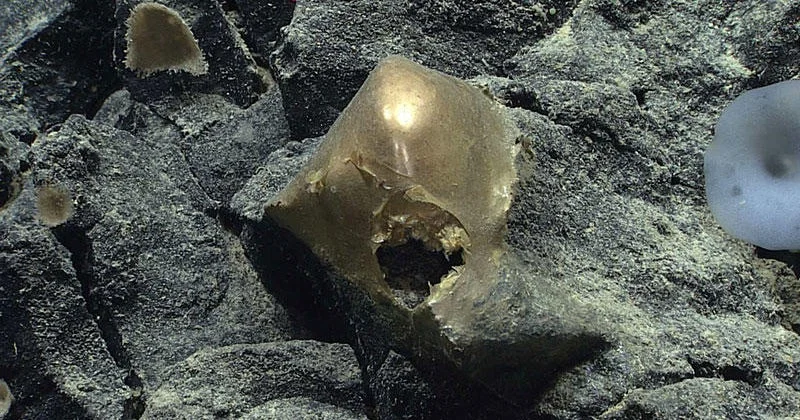
Researchers from the National Oceanic and Atmospheric Administration (NOAA) have identified a mysterious golden orb discovered in 2023 during a deep-sea expedition off the coast of Alaska. The orb, spotted more than two miles below the ocean surface by a remotely operated vehicle, was found attached to a rock in the Gulf of Alaska and later sent to the Smithsonian National Museum of Natural History for detailed study.
Initially, NOAA scientists believed the object could be identified through routine examination, but it soon became clear the orb was an unusual discovery that demanded cross-disciplinary expertise. Allen Collins, director of NOAA Fisheries’ National Systematics Laboratory, noted that morphological, genetic, deep-sea, and bioinformatics analyses were all required to solve the puzzle.
Physical examination revealed that the golden orb was not an animal itself but composed of “fibrous material” covered with stinging cells known as spirocysts—specialized structures unique to aquatic invertebrates called cnidarians, which include corals and sea anemones. Comparisons with a specimen collected in 2021 showed that both belonged to the same species.
Initial DNA tests were inconclusive, but subsequent whole-genome sequencing demonstrated that the orb was genetically nearly identical to Relicanthus daphneae, a type of deep-sea cnidarian. Further analysis indicated that the orb was once part of the base of a giant sea anemone, with most of the organism missing. NOAA scientists believe the anemone’s upper portion either died or migrated to a new location.
The fully intact giant anemone has a pink-colored, cylindrical body that can grow up to three feet wide, with tentacles that may extend as far as six feet. Its spirocysts are the largest among all known cnidarians, highlighting its remarkable biology.
William Mowitt, acting director of NOAA Ocean Exploration, emphasized the significance of such discoveries in expanding understanding of deep ocean ecosystems. He noted that tools like DNA sequencing are pivotal in decoding deep-sea mysteries, which contribute to broader knowledge about the ocean’s role in economic growth, national security, and environmental sustainability.
Why it matters
This discovery underscores the value of advanced genetic and morphological techniques in exploring the largely uncharted deep ocean. Identifying new or unusual deep-sea species enhances scientific knowledge that can inform marine conservation, biodiversity assessments, and the sustainable management of ocean resources important to environmental health and economic interests.
Background
The Gulf of Alaska is a region known for its deep and complex marine ecosystems. Deep-sea exploration using remotely operated vehicles has increasingly revealed unknown life forms and habitats that challenge conventional understanding of ocean biology. The genus Relicanthus, to which the giant anemone base belongs, was first described relatively recently, and remains a subject of ongoing scientific study.
Read more Science Discoveries stories on Goka World News.