
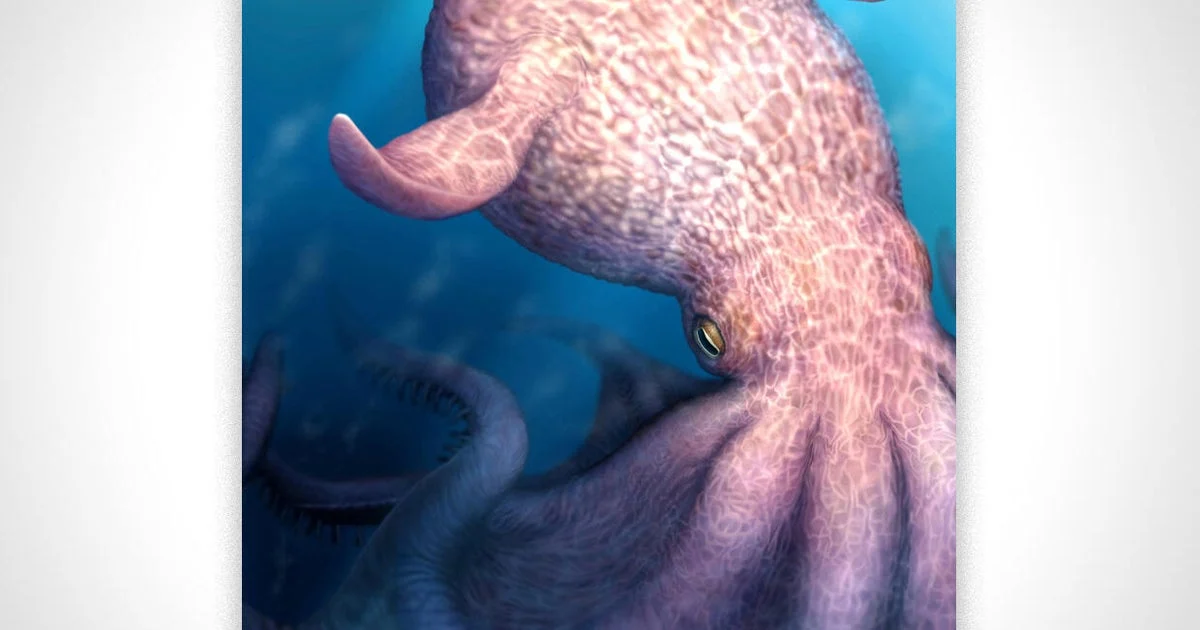
Fossilized jaws of ancient octopuses reveal that these creatures, some exceeding 60 feet in length, were among the dominant predators in the seas during the late Cretaceous period, about 100 million years ago. This finding challenges the prevailing view that soft-bodied invertebrates were minor players in prehistoric marine ecosystems.
Scientists analyzed 15 fossilized octopus jaws previously unearthed in Japan and Vancouver Island, Canada, and identified 12 additional jaws using a digital fossil mining technique that scans rocks in cross-section to detect hidden remains. Comparisons with modern octopus jaws allowed researchers to estimate the size of these extinct cephalopods, which ranged from approximately 23 to 62 feet.
The largest fossil jaw studied was significantly bigger than that of any living octopus, making these ancient octopuses possibly the largest invertebrate predators on record. Paleontologist Yasuhiro Iba of Hokkaido University, a co-author of the study, noted that these creatures surpassed the giant squid, which reaches up to 39 feet, in total length.
Wear patterns on the fossilized jaws, including scratches and chips, suggest repeated crushing of hard-shelled and bony prey. Although direct evidence of their diet is lacking, these octopuses likely fed on fish, snails, and other marine animals, using their flexible arms and powerful beaks to capture and break down prey.
The study, published in the journal Science, highlights convergent evolutionary traits between cephalopods and marine vertebrates, such as robust jaws and the loss of external skeletons, which enabled them to become large, intelligent predators in their environments.
Why it matters
This discovery reshapes understanding of ancient marine food webs by identifying giant octopuses as key apex predators during the age of dinosaurs. It suggests that invertebrates played a more significant role in prehistoric marine ecosystems than previously recognized. The research also demonstrates the value of advanced fossil detection methods like digital fossil mining in uncovering hidden evidence from soft-bodied animals that rarely fossilize well.
Background
During the late Cretaceous period, oceans were known to be dominated by large predatory reptiles such as mosasaurs and plesiosaurs, alongside sharp-toothed sharks. Octopuses were often overlooked due to their soft bodies and poor fossil preservation. Previously, the largest known invertebrate predator was considered the modern giant squid. This study builds on a growing appreciation of cephalopod diversity and evolution, aided by improving technologies that allow scientists to examine previously inaccessible fossil evidence.
Read more Science Discoveries stories on Goka World News.