
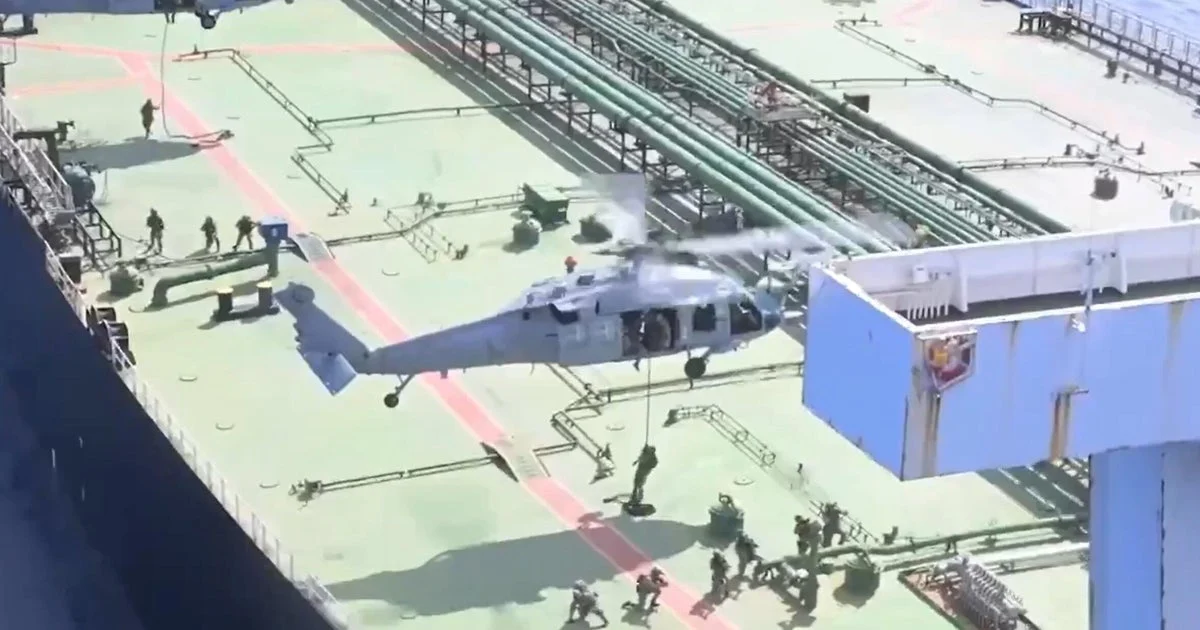
The U.S. military intercepted and boarded the stateless tanker M/T Majestic X, linked to Iran and carrying Iranian oil, in the Indian Ocean on Thursday. The operation marks the latest episode in a series of maritime interdictions involving U.S. and Iranian forces amid escalating tensions over shipping routes and sanctions enforcement.
The Defense Department confirmed via social media that U.S. forces executed a “maritime interdiction and right-of-visit boarding” of the sanctioned vessel. Video footage released by the military showed U.S. personnel descending from a helicopter onto the tanker during the operation. The military emphasized its commitment to disrupting illicit maritime networks supporting Iran globally.
This interdiction followed Iran’s seizure of two commercial ships in the strategically significant Strait of Hormuz on Wednesday. Videos posted by Iran’s Islamic Revolutionary Guard Corps (IRGC) showed armed personnel boarding the container ships MSC Francesca and Epaminondas after reportedly apprehending them for violating Iran’s blockade of the waterway.
Separately, the Philippine Department of Migrant Workers confirmed that 15 Filipino seafarers aboard the two Iran-seized vessels were “safe and unharmed,” adding that families have been notified and are receiving government support. Ten crew members were on the Epaminondas and five on the MSC Francesca.
The U.S. interdiction of the M/T Majestic X in the Indian Ocean coincided with a similar operation the previous day, when U.S. forces boarded another Iran-linked vessel, the M/T Tifani, in the Indo-Pacific Command’s area. These actions contribute to a growing pattern of retaliatory maritime enforcement between the United States and Iran.
Why it matters
The interdictions highlight the ongoing contest over maritime control and economic pressure tactics between the U.S. and Iran, particularly concerning oil shipments circumventing sanctions. The Strait of Hormuz remains a critical chokepoint for global energy supplies, and Iran’s seizure of commercial ships there intensifies risks to international shipping security.
The U.S. operations beyond the Strait of Hormuz, including in the Indian Ocean, signal Washington’s broader strategy to enforce sanctions against Iran’s oil exports and disrupt networks allegedly providing material support to Tehran. These actions occur amid a fragile ceasefire between the two countries and contribute to continuing instability in the region’s maritime domain.
Background
Iran has maintained a blockade of the Strait of Hormuz, a vital shipping lane for global oil exports, in opposition to U.S. naval operations it considers a blockade of its ports. The tit-for-tat seizures of commercial vessels reflect this ongoing dispute, with both sides citing violations of their respective operational controls.
The U.S. has repeatedly interdicted vessels suspected of transporting Iranian oil in violation of sanctions, while Iran has similarly detained ships for allegedly breaching its territorial waters. These maritime confrontations are part of the broader geopolitical tensions surrounding Iran’s nuclear program, regional influence, and U.S. sanctions enforcement efforts.
Read more US News stories on Goka World News.