
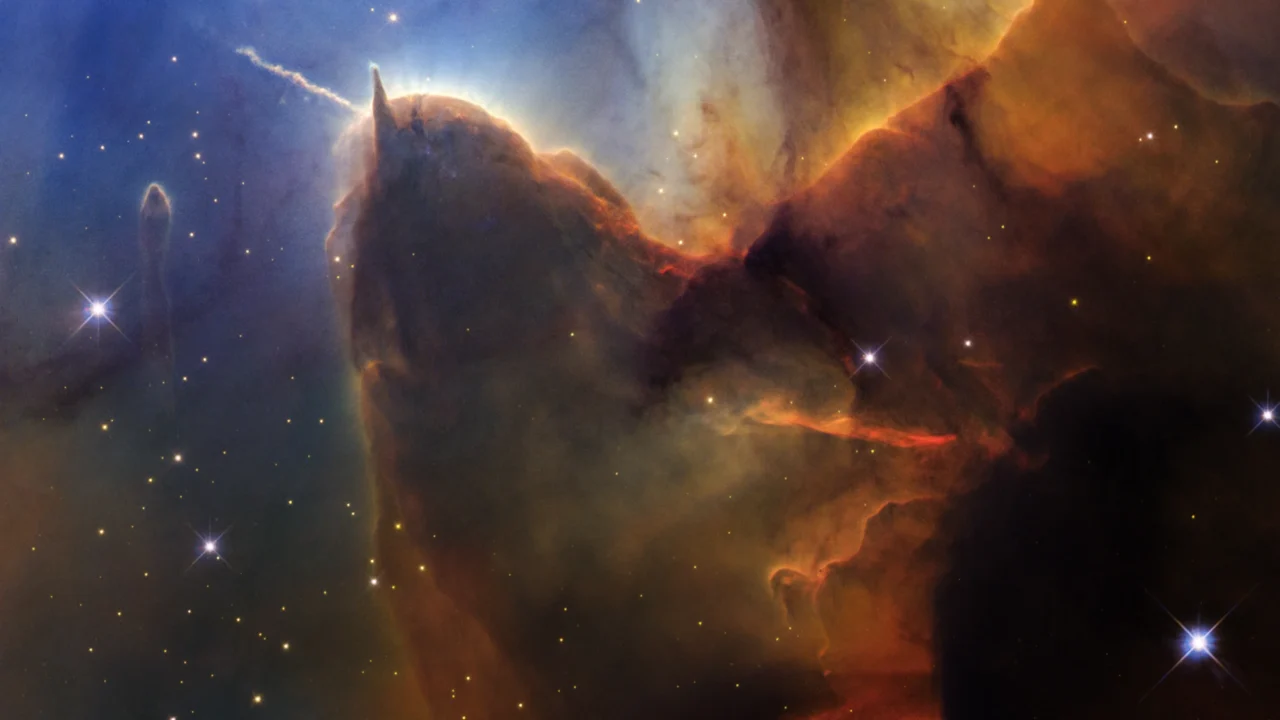
NASA’s Hubble Space Telescope provided a detailed visible-light image of the Trifid Nebula, a well-known star-forming region located about 5,000 light-years from Earth. The image was released on April 20, 2026, coinciding with the mission’s 36th launch anniversary on April 24.
This close-up view reveals intricate details of the nebula’s gas and dust, displaying colors that resemble fine-grained sediments in an underwater scene. The captured portion is only a fraction of an enormous bubble formed and shaped over at least 300,000 years by powerful winds from several massive stars located outside the visible field.
These stellar winds continue to push and compress the surrounding clouds, initiating successive waves of star formation within the nebula. The forces at work demonstrate the ongoing dynamic processes that govern stellar birth in such regions.
Why it matters
Images like this provide crucial insight into the mechanisms of star formation by showing how interactions between massive stars and their environments shape the birth of new stars. Understanding these processes helps astronomers trace the lifecycle of stars and the evolution of galaxies.
Background
The Trifid Nebula, also known as Messier 20, is an iconic nebula recognizable by its distinct three-lobed appearance caused by dark dust lanes. The Hubble Space Telescope has been instrumental in capturing high-resolution images of such nebulae since its launch in 1990, enabling detailed studies of cosmic structures and phenomena.
Read more Space & NASA stories on Goka World News.
Sources
This article is based on reporting and publicly available information from the following source: