
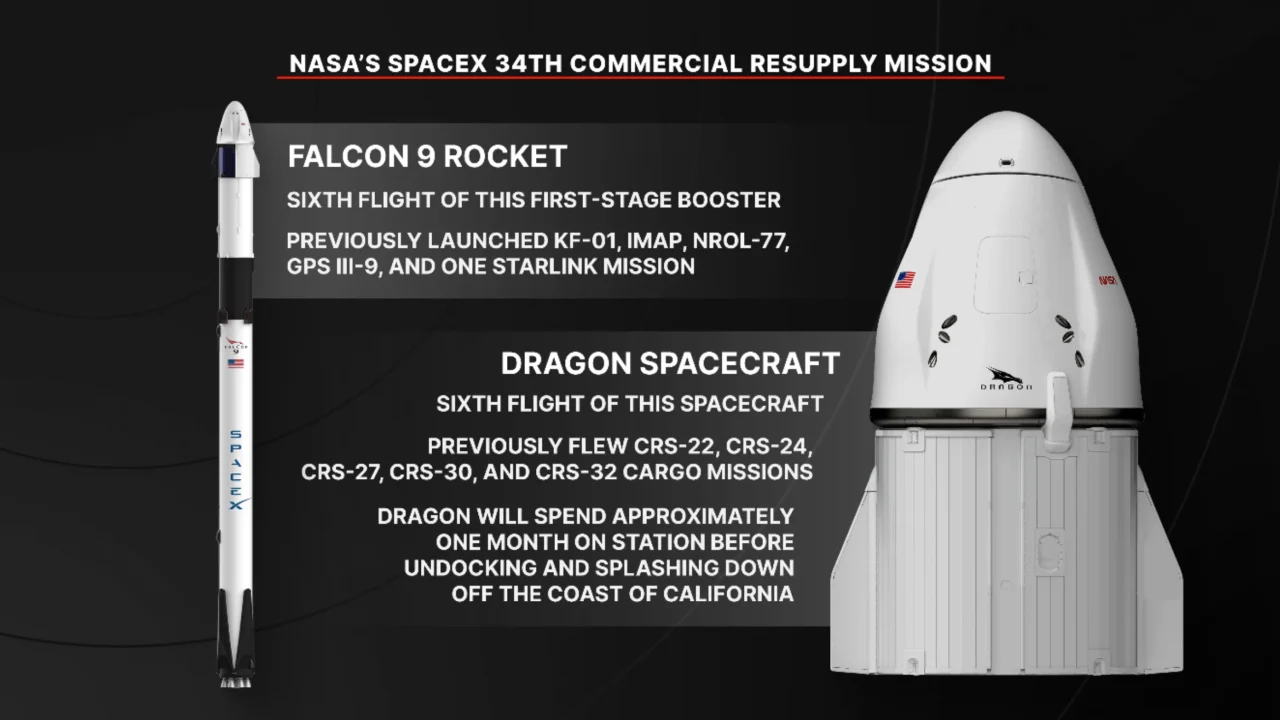
NASA and SpaceX are preparing for the 34th Commercial Resupply Mission to the International Space Station (ISS), targeting a mid-May launch from Cape Canaveral Space Force Station in Florida. The SpaceX Dragon spacecraft will carry approximately 6,500 pounds of cargo, including scientific investigations, crew supplies, and station hardware, launching atop a Falcon 9 rocket from Launch Complex 40.
Upon reaching orbit, the Dragon will autonomously dock to the forward port of the ISS’s Harmony module, where NASA astronaut Jack Hathaway and ESA astronaut Sophie Adenot will monitor the spacecraft’s arrival. The Dragon spacecraft is scheduled to remain attached to the station for roughly one month before returning to Earth with critical science samples and hardware via a splashdown in the Pacific Ocean.
Scientific Experiments Onboard
This mission will deliver several key scientific experiments aimed at advancing space research and supporting future exploration efforts. Notable studies include:
- ODYSSEY: This experiment will assess the accuracy of Earth-based microgravity simulators by comparing bacterial behavior in space with results from terrestrial simulators.
- STORIE: An instrument designed to monitor charged particles in Earth orbit that respond to space weather, helping improve predictions and mitigate impacts on satellites and power grids.
- Laplace: Investigates dust particle movement and collisions in microgravity to enhance understanding of planetary formation in our solar system and beyond.
- Green Bone: Observes bone cell growth on wood-based scaffolds in space to inform treatments for bone diseases such as osteoporosis.
- SPARK: Studies changes in red blood cells and spleen function during spaceflight to safeguard astronaut health on long-duration missions.
Essential Hardware and Equipment
In addition to experiments, the cargo includes critical replacement parts and equipment to maintain station systems:
- A replacement power cable for the European Enhanced Exploration Exercise Device.
- A catalytic reactor component vital to the Water Recovery and Management System, responsible for oxidizing volatile organics in wastewater.
- Two Universal Pretreat Concentrate Tanks with adapters compatible with Russian systems to maintain waste management functionality.
- Tools and spares such as an Ultraprobe ultrasonic inspection device, Remote Sensor Unit for vibration monitoring, and flexible repair patches for station hull maintenance.
- Upgraded ARMADILLO cartridge and hose assemblies to improve water processing for oxygen generation.
- A nitrogen recharge tank to help sustain the station’s gas reserves.
Return Cargo
When Dragon returns in mid-June, it will bring back a variety of hardware and research materials, including:
- An ocular imaging device used to monitor crew eye health.
- A sorbent bed that filters trace contaminants from the station’s cabin air.
- A separator pump from the Waste and Hygiene Compartment.
- The Advanced Plant Habitat, which hosted long-duration plant biology experiments and will be returned for museum display.
- A pressure management device used to recycle vestibule air during depressurization, returned for repair and ground storage.
Why it matters
The 34th SpaceX resupply mission supports the ISS’s ongoing role as a unique microgravity laboratory used by scientists from over 110 countries for more than 4,000 experiments. These investigations aid NASA’s Artemis program efforts to return humans to the Moon and plan future crewed missions to Mars while delivering practical benefits for health, technology, and Earth applications.
Sources
This article is based on reporting and publicly available information from the following source:
Read more Space & NASA stories on Goka World News.