
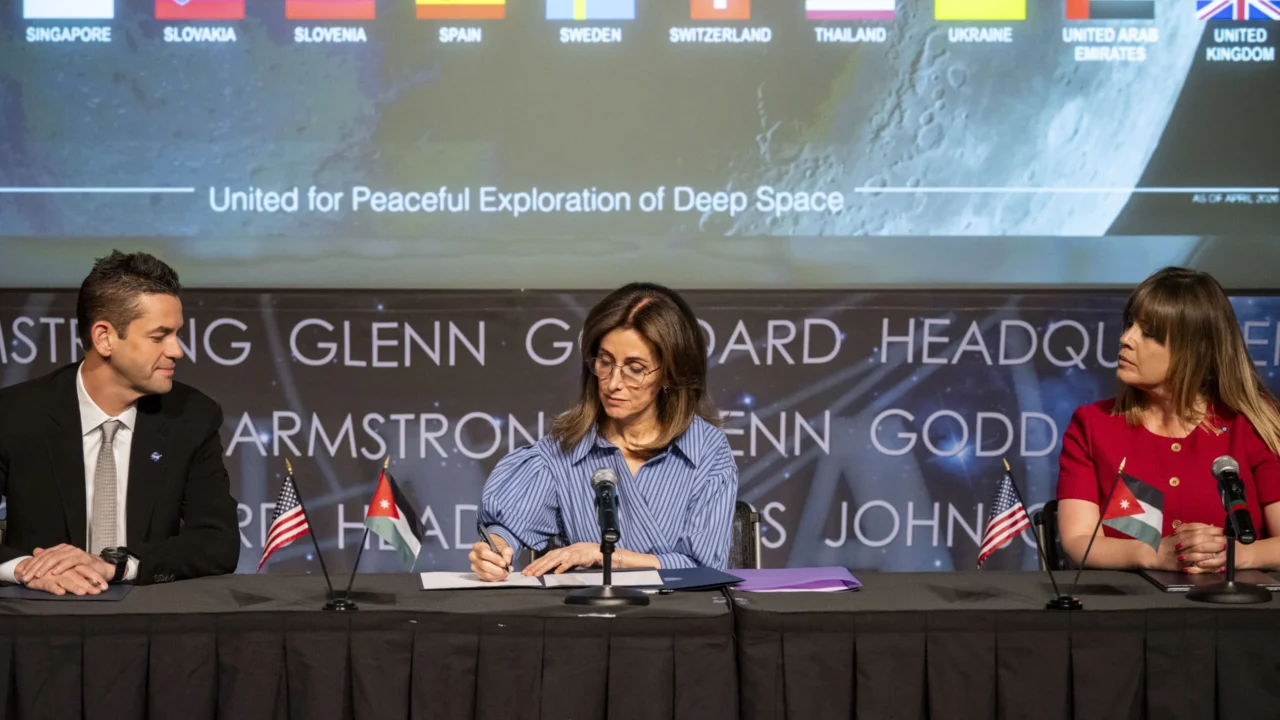
Jordan Signs Artemis Accords at NASA Headquarters
The Hashemite Kingdom of Jordan officially became the 63rd signatory of the Artemis Accords during a ceremony at NASA’s headquarters in Washington, D.C., on Thursday, joining an international effort to promote responsible and cooperative space exploration.
NASA Administrator Jared Isaacman welcomed Jordan’s participation, highlighting the value of Jordan’s contributions as humanity works toward returning to the Moon. “Jordan brings valuable perspective and capabilities that will help expand the Golden Age of exploration for all mankind,” Isaacman said.
Ambassador Dina Kawar signed the accords on behalf of Jordan, emphasizing the country’s technological ambitions. She noted Jordan’s high number of engineers per capita and the leadership of His Royal Highness Crown Prince Al Hussein in directing national focus toward emerging technologies, including artificial intelligence, digital infrastructure, advanced manufacturing, and space exploration.
Kawar also invited American partners to collaborate on future projects, underscoring Jordan’s intent to establish itself as a regional and global technology hub.
Jordan’s Emerging Role in Space Technology
Jordan’s interest in space science and technology has grown in recent years. In 2018, Jordan launched its first satellite, JY1, a CubeSat developed by university students that transmitted images and audio from orbit after being launched on a SpaceX Falcon 9 rocket.
Additionally, Jordan hosts a privately operated analog space research facility in Wadi Rum. The Jordan Space Research Initiative conducted PETRA1 and PETRA2 missions in 2024 and 2025 respectively, aimed at advancing human spaceflight and planetary research with practical applications on Earth.
Principles and Expansion of the Artemis Accords
Established in 2020 by the United States alongside seven founding nations, the Artemis Accords set forth practical principles guiding peaceful space exploration. These principles include commitments to transparency, peaceful activities, rendering aid to astronauts in need, sharing scientific data for humanity’s benefit, avoiding interference with other missions, and preserving historical sites and artifacts in space.
As the Artemis program prepares for sustained lunar exploration, including the construction of a Moon Base, the Accords serve to coordinate efforts among government agencies and private companies worldwide.
Jordan’s accession to the Artemis Accords reflects the country’s growing engagement in space exploration and its desire to participate in international space cooperation.
Why it matters
Jordan’s signing of the Artemis Accords expands the international partnership aimed at establishing a stable and cooperative framework for space exploration beyond Earth orbit. This commitment supports NASA’s goal of building a sustainable human presence on the Moon and ensuring space activities are conducted peacefully and transparently for all humankind.
Read more Space & NASA stories on Goka World News.
Sources
This article is based on reporting and publicly available information from the following source: