
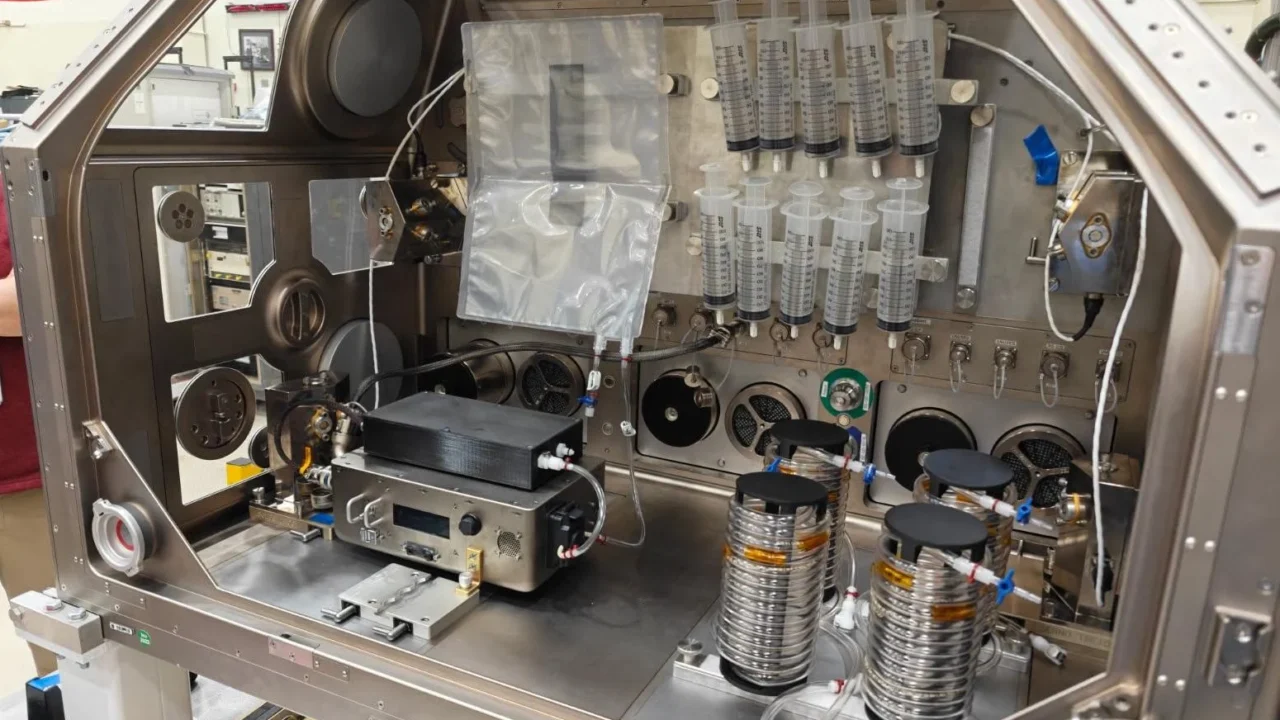
NASA has begun testing a new technology aboard the International Space Station (ISS) designed to produce intravenous (IV) fluid on demand in space. The device, called IntraVenous Fluid GENeration Miniaturized (IVGEN Mini), aims to overcome challenges posed by the limited shelf life and volume of prepackaged IV fluids currently used in space missions.
IV fluid, a sterile solution primarily of sodium chloride and purified water, is essential for treating up to 30% of medical conditions encountered during crewed space missions, such as dehydration and burns. However, the fluid’s shelf life is limited to about 16 months, creating logistical challenges for longer missions beyond low Earth orbit that could last up to three years.
How IVGEN Mini Works in Space
IVGEN Mini was delivered to the ISS on April 11 via NASA’s Northrop Grumman Commercial Resupply Services 24 mission. It operates by processing station drinking water, filtering it to remove particulates and mineral ions before mixing it with premeasured sodium chloride in a sterile output bag. This process produces medical-grade IV fluid that meets United States Pharmacopeia standards for purity, pH, and salinity.
The crew plans to operate IVGEN Mini in May to generate approximately 10 liters of IV fluid over two days. Samples will then be returned to Earth for safety and quality analysis. Although the fluid generated will not be used on board, successful testing will demonstrate the system’s potential to support long-duration crewed missions.
Advantages for Deep Space Missions
IVGEN Mini represents a miniaturized version of a larger system first tested on the ISS in 2010. The new device is smaller, lighter, and more efficient, featuring miniaturized pumps instead of gaseous nitrogen to circulate fluids. This reduction in size and mass is significant for deep space missions where cargo space and weight are critically limited.
“On a mission to Mars, flying large quantities of prepackaged IV fluid would be impractical due to space and expiration concerns,” said NASA engineers. IVGEN Mini enables production as needed, extending supply longevity and reducing mission risk by ensuring fresh IV fluid is always available during extended space travel.
The system can currently produce 1.2 liters of IV fluid per hour, meeting medical requirements for treating potential emergencies during mission timelines. Future plans include shelf-life testing of the fluid produced in space to fully validate the technology.
Why it matters
As NASA prepares for crewed missions to the Moon and Mars lasting several years, sustaining astronaut health with reliable medical supplies is essential. IVGEN Mini addresses a critical need by providing a lightweight, on-demand source of IV fluid, reducing cargo mass and mitigating risks associated with storage and expiration. This technology enhances mission resilience and supports longer human exploration beyond low Earth orbit.
Background
Intravenous fluid is a staple medical resource on spaceflights, used to treat a variety of conditions. Previous versions of IV production systems were tested aboard the ISS but were bulkier and less efficient. IVGEN Mini builds on these earlier successes by refining the design to be more compact and suitable for long-duration missions. This development is part of NASA’s broader Mars Campaign Office efforts to develop technologies that enable sustained human presence on the Moon and Mars.
Read more Space & NASA stories on Goka World News.
Sources
This article is based on reporting and publicly available information from the following source: