
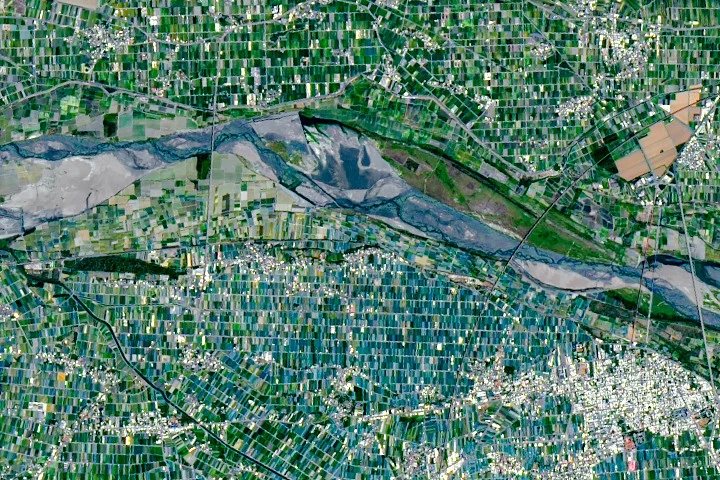
Yunlin County, located on Taiwan’s southwestern Chianan Plain, is a major agricultural hub characterized by numerous small farms cultivating a wide range of crops. This region’s farmland is shaped by both historical policies and Taiwan’s mountainous geography, resulting in a unique agricultural mosaic.
Small Farm Plots and Diverse Crops
Taiwan’s average farm size is less than one hectare, significantly smaller than farms in the United Kingdom and the United States, where averages are 87 hectares and 187 hectares respectively. Partly because of these small individual holdings—driven by past government limits on farm size and the division of land across generations—the farmland in Yunlin is divided into many small rectangular plots. These are bounded by roadways and irrigation canals, optimizing the use of the region’s fertile soil and abundant water from the Zhoushui and Beigang rivers.
Yunlin’s farms produce a broad array of crops including rice, sweet potatoes, peanuts, corn, sugarcane, garlic, scallions, coffee, fruit, and leafy greens. The county also leads Taiwan in pig farming, raising millions annually.
Legacy of Sugarcane Plantations
Large-scale sugarcane cultivation in Yunlin dates back to the early 20th century when Taiwan was under Japanese colonial rule. The Japanese established extensive sugarcane plantations, including a consolidated Taiwan Sugar Corporation after World War II. The plantation fields, particularly near Baozhong, remain larger than typical farm plots and stand out as a legacy of this era. Although sugarcane acreage has decreased in recent decades and many fields have been converted to other crops, Taiwan Sugar Corporation continues to grow sugarcane in the region.
The company operates the island’s only active sugarcane railway, which transports harvested cane to a refinery in Huwei. This railway is a remnant of a once extensive sugar transport network that serviced dozens of refineries across Taiwan.
Modern Agricultural Practices
Around Xiluo, another part of Yunlin County, the use of shade nets gives fields a distinct greenish-blue color visible from satellite images. These nets protect specialty crops such as vegetables, fruits, and flowers from excessive sun, heat, rain, and pests. This contrasts with the darker green rice fields seen in other parts of Yunlin, illustrating varied farming techniques adapted to different crop requirements.
Why it matters
Yunlin County’s agricultural diversity on small-scale farms exemplifies how land use and cultural practices influence food production in densely populated and geographically constrained areas. Understanding these patterns is vital for Taiwan’s food security and offers insight into sustainable farming practices suited to limited arable land.
Background
Taiwan, with a population of about 23 million and land area similar to Maryland, allocates only a quarter of its territory to agriculture due to mountainous terrain. This limited arable land, averaging just 0.03 hectares per person, far less than in Western countries, has shaped an agriculture sector reliant on intensive cultivation of small plots. Historical land policies and traditional inheritance patterns have compounded the fragmentation, maintaining farm sizes that contrast sharply with large-scale agricultural systems elsewhere.
Read more World News stories on Goka World News.
Sources
This article is based on reporting and publicly available information from the following source: