
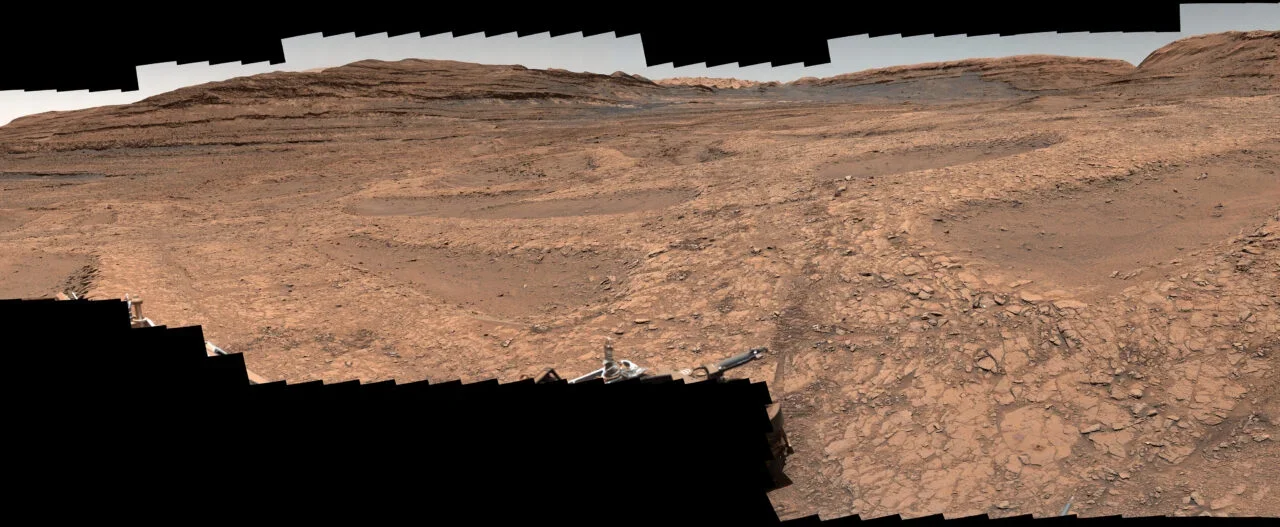
NASA’s Mars rovers Curiosity and Perseverance have each captured detailed 360-degree panoramic images from locations more than 2,300 miles apart on the Red Planet, advancing scientific understanding of Mars’ ancient landscape and climate. These panoramas provide complementary views of regions formed billions of years ago, reflecting distinct geological and environmental histories.
Curiosity, nearly 15 years into its mission, took 1,031 images between November 9 and December 7, 2025, to create a panorama of the Gale Crater region near Mount Sharp. This area features a network of erosion-resistant ridges called boxwork formations, created by groundwater mineral deposits along fractures in the bedrock. Since landing on Gale Crater’s floor in 2012, Curiosity has explored diverse terrains, recently ascending Mount Sharp, a 3-mile-high mountain shaped by ancient lakes and sediments.
Perseverance, now five years on Mars, produced a 360-degree panorama using 980 images between December 18, 2025, and January 25, 2026, at “Lac de Charmes” near the rim of Jezero Crater. This site contains some of the oldest known Martian rock formations. Perseverance’s mission focuses on uncovering clues to microbial life and geological processes from a lake-fed river system that once filled Jezero Crater.
Scientific findings from both missions
Curiosity’s investigations have uncovered key evidence of Mars’ habitability. Early mission results confirmed ancient lakebed sediments contained the chemical elements and nutrients necessary to support microbial life. The rover has also detected significant organic molecules in rock samples, including the largest and most diverse assemblages found on Mars to date. These discoveries include seven organic compounds identified for the first time on the planet.
Perseverance’s sample collection strategy differs by extracting intact rock cores for eventual return to Earth laboratories, where more sophisticated analyses are possible. Notably, the rover identified a rock with “leopard spot” chemistry potentially linked to microbial activity. Additionally, Perseverance recorded the first electrical sparks from dust devils and captured visible auroras from the Martian surface, phenomena previously hypothesized but never observed.
Why it matters
The contrasting geological settings of the two rovers—Curiosity moving into younger sedimentary layers of Mount Sharp and Perseverance investigating some of the solar system’s oldest terrains—offer a broader timeline of Mars’ history. These studies contribute critical data about whether Mars ever supported life and how its climate evolved from wetter environments to the cold desert seen today.
NASA manages both rover missions through the Jet Propulsion Laboratory in Pasadena, California. The continued exploration by Curiosity and Perseverance promises further revelations about Mars’ formation, climate shifts, and potential biosignatures as they explore new terrains in the coming years.
Read more Space & NASA stories on Goka World News.
Sources
This article is based on reporting and publicly available information from the following source: