
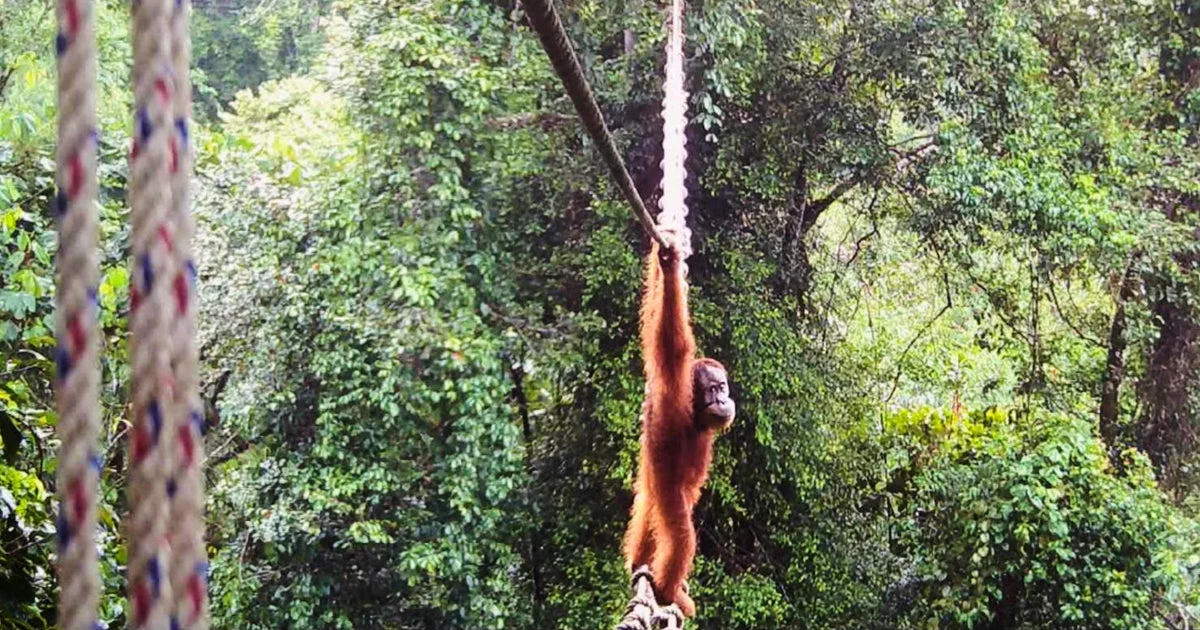
A critically endangered Sumatran orangutan has been recorded crossing a public road on the Indonesian island of Sumatra using an artificial canopy bridge, marking a global first for the species, conservationists announced on Monday.
The footage, captured by a motion-activated camera, shows a young orangutan cautiously gripping a rope bridge installed over the Lagan-Pagindar road in Pakpak Bharat district. The bridge spans a critical wildlife corridor, linking two fragmented forest areas that house an estimated 350 orangutans.
Bridge installation to reconnect isolated habitats
The Lagan-Pagindar road, a vital route providing access to villages, schools, and healthcare, divides the Siranggas Wildlife Reserve and the Sikulaping Protection Forest. Upgrades to the road in 2024 expanded the gap in the forest canopy, eliminating natural arboreal crossings for wildlife.
In response, the Indonesian conservation group Tangguh Hutan Khatulistiwa (TaHuKah), together with the Sumatran Orangutan Society (SOS) and government partners, installed five rope canopy bridges equipped with camera traps. The bridges were carefully designed to support the weight of orangutans, the largest tree-dwelling mammals, and positioned following surveys of orangutan nests and movement patterns.
First orangutan crossing signals conservation milestone
This young male orangutan’s successful crossing is the first documented instance of the species navigating a public road via an artificial canopy bridge. Prior to this, only smaller animals such as squirrels, macaques, and gibbons had used these bridges. Conservationists say the orangutan’s cautious behavior—building nests near the bridge and testing the ropes over two years—demonstrates careful adaptation.
Erwin Alamsyah Siregar, executive director of TaHuKah, described the crossing as “the moment we had been waiting for” and emphasized how the intervention helps orangutans avoid being trapped in isolated forest fragments.
Why it matters
Roads fragmenting orangutan habitats increase risks of fatal conflicts between wildlife and humans. Habitat isolation can lead to inbreeding and threaten the species’ survival. The canopy bridges enable genetic exchange by reconnecting fragmented populations, reducing the risk of extinction for a species with fewer than 14,000 individuals in the wild.
While similar bridges have been used elsewhere over rivers or private roads, the use of such a structure over a busy, public road represents a significant challenge and conservation achievement.
The program continues to be closely monitored, with hopes that more orangutans will follow the pioneering individual in safely crossing between forest patches.
Read more Science Discoveries stories on Goka World News.
Sources
This article is based on reporting and publicly available information from the following source: