
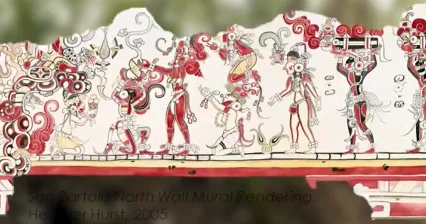
Researchers from Guatemala’s Ministry of Culture have for the first time deciphered the name of an ancient Mayan astronomer and mathematician from mural symbols at the San Bartolo-Xultun archaeological site on the Guatemala-Mexico border. The name, White-chested Fox (Sak Tahn Waax), is linked to a “complete mathematical and astronomical formula” created by the scholar during the Maya Classic period, the peak of this Mesoamerican civilization.
What Happened
In a discovery announced on July 14, 2026, researchers revealed they had transcribed more than 50 mathematical and astronomical microtexts inscribed on murals at the San Bartolo-Xultun ruins. These inscriptions date from between 400 BC and 900 AD, the era spanning the height of Maya civilization. By analyzing drawings, photographs, and scans of the murals—which were digitally enhanced—scientists were able to identify 11 glyphs that clearly convey the name of the astronomer, White-chested Fox, along with tables and calculations based on astronomical and calendrical units of time.
Key Facts
The findings, confirmed by Guatemala’s Ministry of Culture, include:
- The name Sak Tahn Waax, meaning White-chested Fox, deciphered from mural glyphs.
- An attributed “complete mathematical and astronomical formula” linked to this named scholar.
- The inscriptions originate from the Maya Classic period (circa 400 BC to 900 AD), marking the civilization’s peak.
- Over 50 microtexts on walls combine art and scientific calculations, indicating an intertwining of astronomy, mathematics, and daily life in Maya culture.
- The San Bartolo-Xultun site lies on the border between Guatemala and Mexico and has received international archaeological attention for its rich murals and inscriptions.
What This Means
This discovery sheds new light on the scientific sophistication of the Maya, specifically their advanced understanding of astronomy and mathematics, which were essential for their calendar systems, agricultural cycles, and ritual life. Identifying an individual astronomer by name humanizes the achievements recorded in these ruins, linking highly abstract knowledge to a historical figure. For contemporary readers and scientists, it emphasizes the deep empirical engagement indigenous cultures had with their environment and celestial phenomena, insights that remain relevant to understanding preindustrial ecological knowledge systems. This find also encourages renewed archaeological focus on combining epigraphy with digital imaging to uncover further hidden scientific knowledge from ancient civilizations.
Background
The Maya civilization reached its zenith during the Classic period before entering decline around 900 AD. Much of its rich history, including hieroglyphic texts conveying astronomical calculations, has survived in archaeological sites like San Bartolo-Xultun. Previous discoveries include the remains of an ancient Mayan city in northern Guatemala dating back nearly 3,000 years and recent finds of sprawling cities in Mexico’s dense jungle using lidar technology. These efforts continue to reveal the complexity of Maya urban life and their scientific achievements.
What Comes Next
Researchers will likely continue epigraphic analyses with enhanced imaging techniques to decode further inscriptions at the San Bartolo-Xultun site and others, aiming to deepen understanding of how Mayan astronomical science shaped their society. This discovery may also influence how Maya knowledge is integrated into broader studies of ancient environmental science and cultural heritage preservation in Central America.
Sources
This article is based on reporting and publicly available information from the following source:
Read more Science Discoveries stories on Goka World News.