
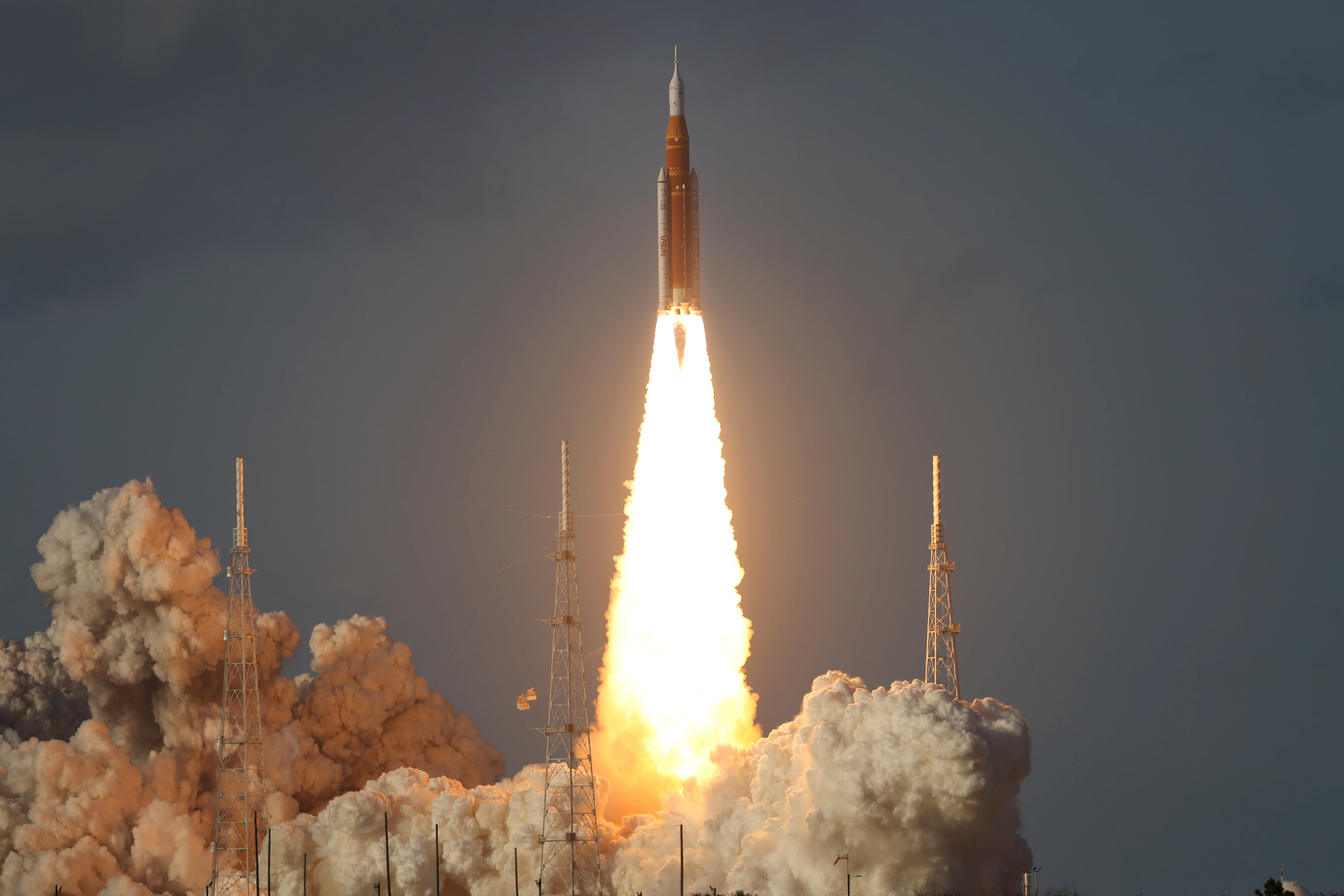
Following the successful splashdown of NASA’s Artemis II mission on April 10, engineers have begun in-depth analysis of the Orion spacecraft, Space Launch System (SLS) rocket, and Kennedy Space Center launch pad systems to evaluate their performance in preparation for Artemis III and future lunar missions.
Orion Spacecraft Performance
The Orion spacecraft completed a 694,481-mile journey around the Moon and back, safely reentering Earth’s atmosphere at nearly 35 times the speed of sound before splashing down off the coast of San Diego. Its thermal protection system protected the crew and the vehicle as expected, with no unusual conditions detected during initial inspections.
Diver inspections immediately following splashdown and subsequent assessments aboard the recovery ship showed significantly reduced char loss on the heat shield compared to the Artemis I mission, both in size and quantity. This performance aligned with ground testing conducted in arc jet facilities after Artemis I. Additional airborne imagery captured during reentry will be analyzed to refine understanding of the heat shield’s behavior and timing of char loss.
The crew module, which is scheduled to return to NASA’s Kennedy Space Center later this month, will undergo further examination and servicing including removal of reusable components and hazard mitigation. This summer, the heat shield will be transported to NASA’s Marshall Space Flight Center for detailed material inspection, including sample extraction and internal X-ray scans.
The ceramic tiles on the upper conical backshell and the reflective thermal tape used for thermal control during spaceflight also performed as expected. Orion’s splashdown was highly accurate, landing within 2.9 miles of the targeted zone, with entry velocity closely matching predictions.
Post-flight hardware removed in San Diego includes seats, camera controllers, and life-support suit connections. Teams are actively investigating a urine vent line issue experienced during the mission with plans to identify the root cause and corrective actions before Artemis III.
SLS Rocket and Launch Pad Evaluation
The SLS rocket successfully fulfilled its test flight objectives by precisely delivering Orion to its intended orbit. At main engine cutoff, the core stage engines shut down with the spacecraft traveling over 18,000 miles per hour, achieving the target insertion velocity.
Exploration Ground Systems engineers also completed a detailed assessment of the launch pad and mobile launcher, which sustained minimal damage thanks to upgrades and reinforcements made after Artemis I. Enhancements include rigidifying elevator doors, adding flexible components to gaseous distribution panels, and installing blast-resistant walls or covers to maintain pneumatic operations and cooling water flows during launch.
The mobile launcher has returned to the Vehicle Assembly Building for repairs and preparations to support future missions.
Recovery and Future Missions
NASA recovery teams, supported by military partners, safely retrieved the Artemis II crew and Orion spacecraft in coordinated operations off the coast of San Diego. Crew members were brought aboard the USS John P. Murtha, and the spacecraft was returned to Naval Base San Diego.
Data gathered from Artemis II is instrumental in preparing for Artemis III, scheduled for 2027, which aims to land astronauts on the Moon’s surface. This mission will set the stage for establishing sustained lunar exploration, including plans for a lunar base and future crewed missions to Mars.
Why it matters
Artemis II’s successful test flight and subsequent detailed assessments provide critical validation of spacecraft, rocket, and ground systems as NASA advances toward crewed lunar landings. Addressing any technical issues ahead of Artemis III ensures mission safety and reliability, reinforcing progress toward sustainable exploration of the Moon and beyond.
Background
The Artemis program is NASA’s initiative to return humans to the Moon for long-term exploration, with Artemis II marking the first crewed test flight of the Orion spacecraft coupled with the SLS rocket. The mission’s data and operational experience are essential for overcoming the complex challenges of deep space travel and establishing a foothold for future Mars expeditions.
Read more Space & NASA stories on Goka World News.
Sources
This article is based on reporting and publicly available information from the following source: