
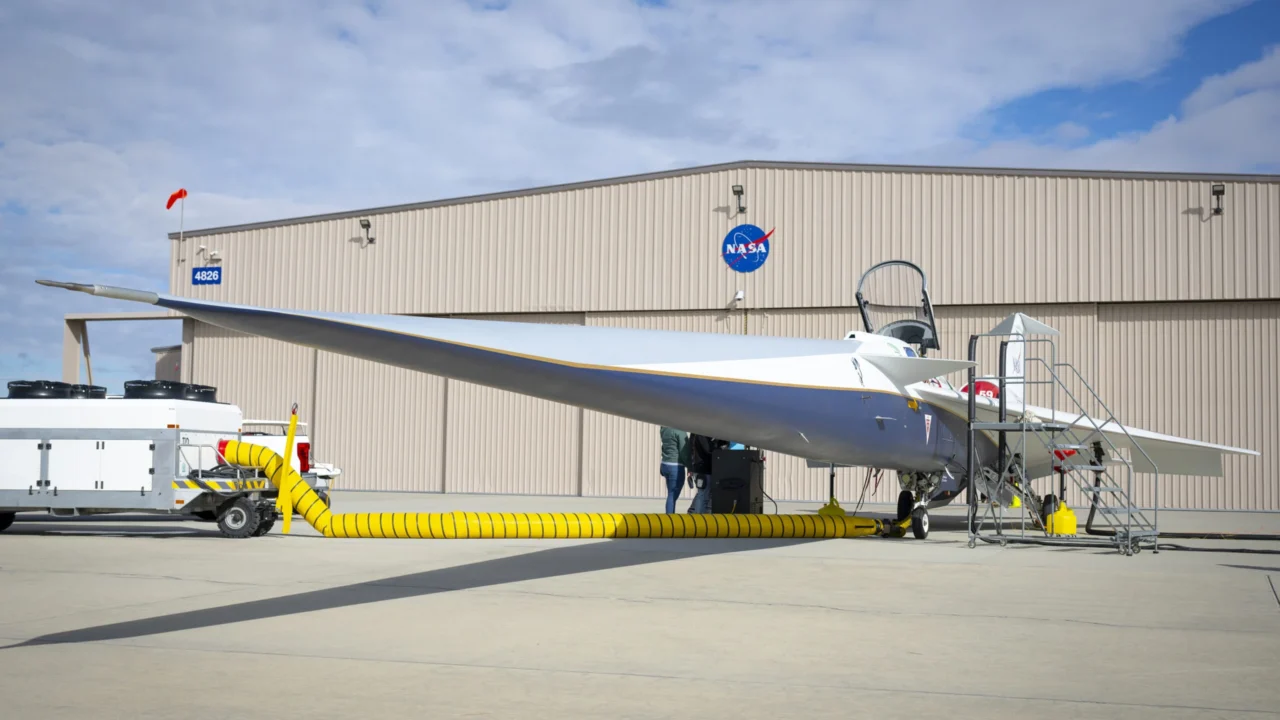
NASA’s Armstrong Flight Research Center in Edwards, California, has fully renovated a 1960s-era hangar to serve as the new home for the X-59 Quiet Supersonic Technology (QueSST) aircraft. The modernization effort was completed to accommodate the experimental supersonic jet, which aims to demonstrate quieter sonic booms and pave the way for commercial supersonic flight over land.
The hangar, officially known as Building 4826, underwent extensive upgrades while the X-59 was being assembled in Palmdale. Renovations included installing new electrical wiring, a fire suppression system, air conditioning, expanded office space, and incorporating enhanced safety features. The floors cover more than 32,000 square feet and feature an epoxy coating to prevent spills from seeping into the concrete.
NASA project manager Bryan Watters, who led the renovation, highlighted that the team transformed what was essentially an empty steel structure into a modern facility suitable for a 2020s-era experimental aircraft. Particular attention was given to size requirements, as the X-59 measures nearly 100 feet long with a 30-foot wingspan, necessitating a hangar spacious enough to house the jet without exposing it to the elements.
Since the X-59’s first flight on October 28, 2025, from Lockheed Martin’s Skunk Works in Palmdale to its newly renovated hangar at Armstrong, the aircraft has continued ongoing test flights. From its new base, the X-59 project team monitors its progress toward achieving the mission’s goal of enabling quieter supersonic travel.
Cathy Bahm, NASA’s Low Boom Flight Demonstrator project manager, remarked on the milestone of having the actual aircraft in the renovated hangar, illustrating the project’s advancement from models to a fully operational supersonic jet.
Why it matters
The X-59’s quieter sonic boom technology could revolutionize supersonic air travel, allowing commercial planes to safely fly at supersonic speeds over land without the noise disturbance that led to previous restrictions. The completion of the hangar renovation supports ongoing flight tests critical for validating this new technology.
Background
The X-59 is part of NASA’s QueSST mission under the Aeronautics Research Mission Directorate. Its goal is to demonstrate technology that reduces the loud sonic booms of supersonic flight into a quieter “thump,” potentially lifting current bans on supersonic passenger flights over populated areas. Lockheed Martin constructed the aircraft at its Skunk Works facility before delivering it to Edwards for flight testing.
Read more Space & NASA stories on Goka World News.
Sources
This article is based on reporting and publicly available information from the following source: