
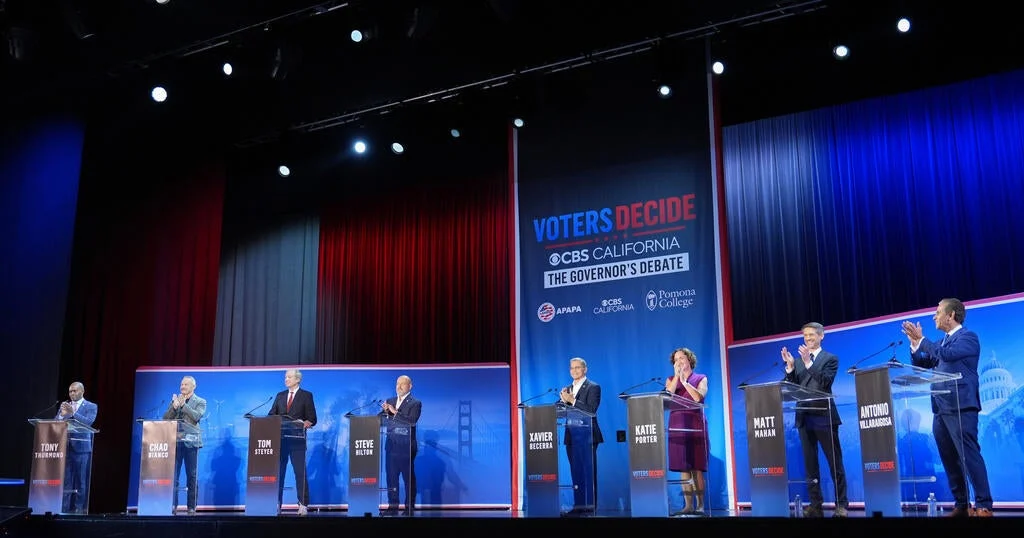
The California gubernatorial race remains unsettled as the June 2 primary approaches, with a recent debate revealing sharp divisions among Democratic candidates and pointed criticism from Republicans. The debate, featuring six Democrats and two Republicans, addressed key voter concerns including healthcare, housing affordability, and education.
Democratic Candidates Present Diverging Visions
The debate brought forward progressive and moderate Democrats offering contrasting approaches for the state’s future. Leading the pack in recent polls is billionaire Tom Steyer, who described himself as the campaign’s only “change agent” willing to challenge special interests driving up costs. Steyer, with a background in hedge funds and environmental activism, has faced criticism for his past investments in fossil fuel companies.
Democratic front-runner Xavier Becerra, a former California attorney general and federal health secretary, appealed to moderates by emphasizing his government experience and positioning himself against the Trump-endorsed Republican Steve Hilton. Becerra’s campaign momentum increased after former candidate Eric Swalwell’s exit amid controversy.
Katie Porter, the only female front-runner and a former congresswoman, focused on affordability and family concerns, sharing personal perspectives as a single mother. She supports progressive policies such as single-payer healthcare but has faced declining poll numbers and scrutiny over past staff interactions.
Other Democratic candidates including Antonio Villaraigosa and Tony Thurmond participated but had less visible impact in the debate.
Republican Candidates Criticize Democratic Leadership
The debate featured two Republicans: Steve Hilton, formerly a Fox News host and endorsed by Donald Trump, currently leading the GOP field in polls, and Riverside County Sheriff Chad Bianco. Both blamed California’s high costs and economic challenges on Democratic state leadership and progressive policies.
Both Hilton and Bianco pledged to cut taxes, including eliminating the state’s gas tax, which they argue burdens residents. Democratic candidates uniformly opposed repealing the gas tax.
Billionaire Tax and Voter Uncertainty
A major issue in the race is a proposed one-time 5% tax on billionaires’ assets, appearing on the November ballot. Polling indicates majority voter support, though Republicans uniformly oppose it. Among Democrats, positions vary: Steyer supports higher billionaire taxes generally but expressed caution about this measure’s design; Becerra, Porter, and Villaraigosa oppose it, while Thurmond supports it. Current Governor Gavin Newsom also opposes the tax, citing potential economic risks.
The race remains highly competitive with Hilton and Steyer polling in the mid-teens and nearly 25% of voters still undecided, highlighting the volatile nature of California’s “jungle primary,” where the top two candidates—regardless of party—advance to the general election.
Why it matters
California’s governorship will shape state policy on housing, healthcare, taxation, and climate regulation amid ongoing affordability crises. The primary’s outcome will influence whether Democrats maintain control or if Republicans capture a rare statewide office in the heavily Democratic state. The divided Democratic field raises concerns about vote splitting and the risk of Republicans advancing to the general election. The billionaire tax question also sets the stage for major fiscal debates impacting California’s economy and social programs.
Background
California’s nonpartisan “jungle primary” system allows the top two vote-getters in the June primary to move on to November’s general election regardless of party affiliation. The state’s high living costs, homelessness, and debates over taxation have made the governor’s race one of the most closely watched contests ahead of the midterm cycle. Gavin Newsom, the current governor, is term-limited out of the race, prompting a wide field vying to succeed him.
Read more Politics stories on Goka World News.
Sources
This article is based on reporting and publicly available information from the following source: