
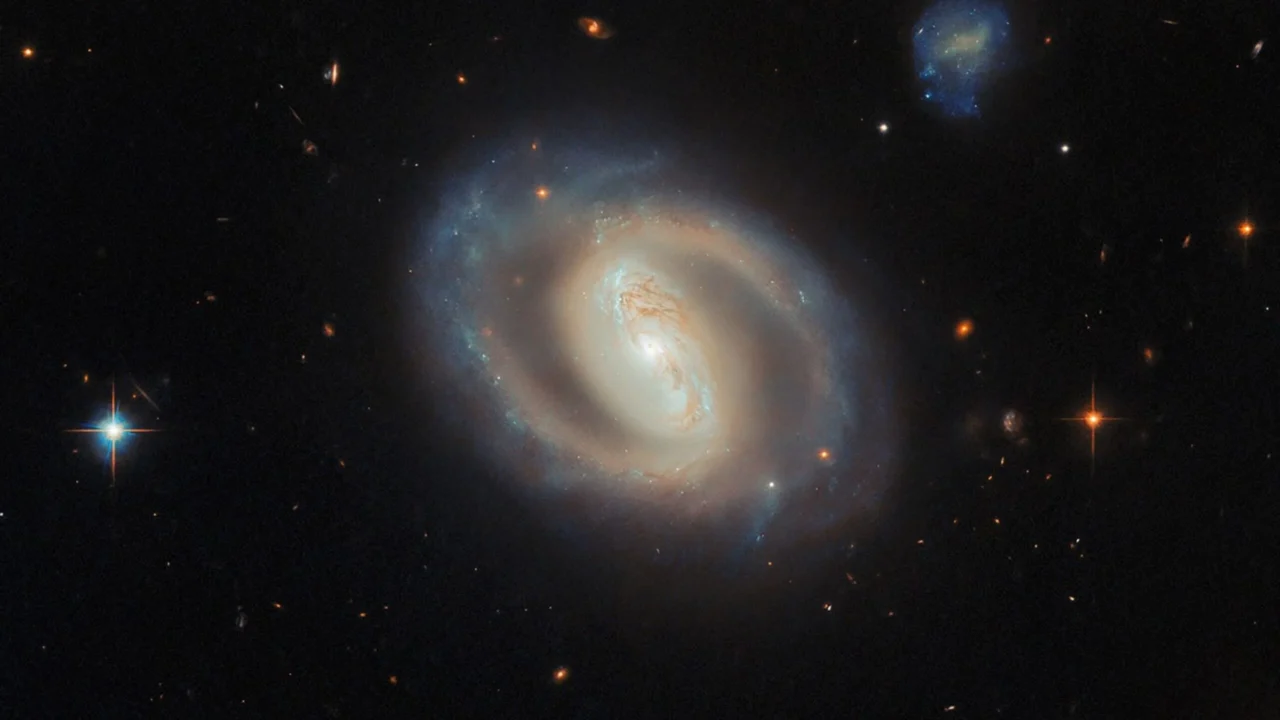
The NASA Hubble Space Telescope captured a detailed image of the barred spiral galaxy IC 486 on April 13, 2026, showcasing its luminous structure against the dark expanse of space. IC 486 is situated approximately 380 million light-years from Earth on the edge of the constellation Gemini.
IC 486 is classified as a barred spiral galaxy, characterized by a prominent central bar-shaped feature from which its spiral arms extend. These arms unfurl smoothly around the galaxy’s core, forming a nearly ring-like pattern, contributing to the galaxy’s ethereal glow observed in the image.
Why it matters
Imaging galaxies like IC 486 helps astronomers understand the formation and evolution of barred spiral galaxies, a common galaxy type in the universe. The clear observation of IC 486’s structure provides insights into how stellar bars influence the distribution of stars and gas within galaxies, which can affect star formation and galactic dynamics.
Background
Barred spiral galaxies contain a central bar of stars extending from the nucleus, which can funnel gas inward and impact star formation patterns. Such galaxies represent about two-thirds of all spiral galaxies, including the Milky Way. Detailed images from space telescopes like Hubble have been instrumental in studying these structures beyond our local cosmic neighborhood.
The image credits go to ESA/Hubble & NASA, with contributions from astronomers M. J. Koss and A. J. Barth, who support ongoing research utilizing observations of distant galaxies to enhance our understanding of cosmic phenomena.
Read more Space & NASA stories on Goka World News.
Sources
This article is based on reporting and publicly available information from the following source: