
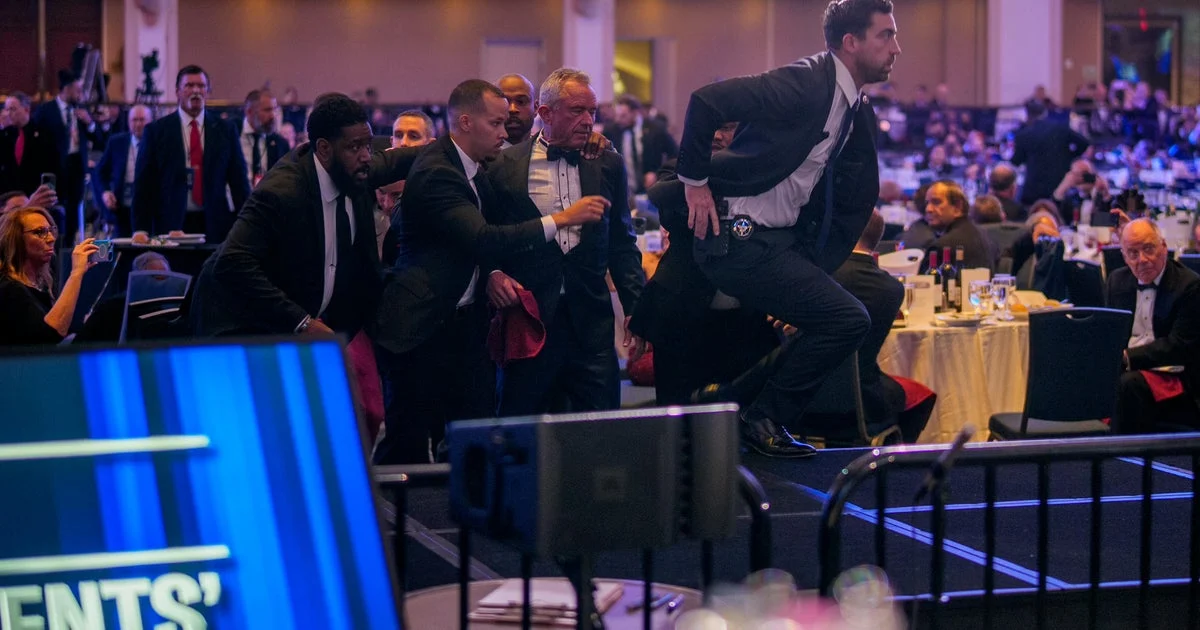
A shooting occurred at the 2026 White House Correspondents’ Dinner held at the Washington Hilton on April 25, putting a spotlight on the resurgence of political violence in the United States. Robert F. Kennedy Jr., secretary of health and human services and son of the assassinated Robert F. Kennedy, was present when gunfire erupted, prompting his security detail to quickly evacuate him from the ballroom.
Shooting Incident and Immediate Response
The alleged shooter, Cole Tomas Allen, was apprehended following the attack. Court documents reveal Allen traveled cross-country by train before the event, reportedly intending to target President Donald Trump and members of his cabinet. President Trump, also in attendance, was swiftly escorted to safety. This event marks at least the third assassination attempt against Trump, a record number compared to previous U.S. presidents.
Historical Parallels to the 1960s and 1970s
The violent episode recalls a turbulent era in American history marked by the assassinations of John F. Kennedy, Martin Luther King Jr., Malcolm X, and Robert F. Kennedy himself, whose death occurred after delivering a victory speech in a hotel ballroom in 1968. The late 1960s and 1970s witnessed widespread political violence fueled by deep social divisions, distrust in government following Vietnam and Watergate, and economic struggles.
Historians note disturbing similarities today as the nation confronts a polarized political climate, economic challenges such as inflation, and ongoing conflicts abroad. Unlike the past, political violence now often emerges from lone actors influenced by online extremist movements rather than organized militant groups, reflecting a normalization of violent rhetoric in political discourse.
Political Climate and Security Concerns
Experts highlight how America’s current political polarization has eroded trust in institutions and contributed to the rise of violent extremism. Unlike the 1970s when most elected officials sought to bridge divides, today’s political environment is marked by entrenched partisanship and an adversarial view of opponents. This has been exacerbated by digital media landscapes that promote anger and conspiracy theories.
The shooting also brought into focus recent victims of political violence, including House Majority Leader Steve Scalise and Representative Jared Moskowitz, both of whom were in attendance and have survived assassination attempts. The trauma was further underscored by the presence of Erika Kirk, widow of Charlie Kirk who was assassinated last year, who was visibly distressed during evacuation.
Why it matters
This incident underscores the persistent threat of politically motivated violence in the United States and raises urgent questions about the stability of democratic institutions amid extreme polarization. With multiple attempts on high-profile political figures’ lives in recent years, the event highlights the need for both enhanced security measures and a broader societal reckoning with rising political hostility and violence normalization.
Read more Politics stories on Goka World News.
Sources
This article is based on reporting and publicly available information from the following source: