
A remotely operated underwater robot has successfully explored the deepest known shipwreck within French territorial waters, uncovering cannons, ceramics, and other artifacts from a merchant vessel that sank more than 500 years ago.
The shipwreck, located off the coast of Ramatuelle near Saint-Tropez in the Mediterranean Sea, was discovered last year during a routine French navy seabed survey. The vessel is believed to have been sailing from northern Italy, likely from Ligurian ports such as Genoa or Savona, carrying glazed pottery and metal cargo when it went down.
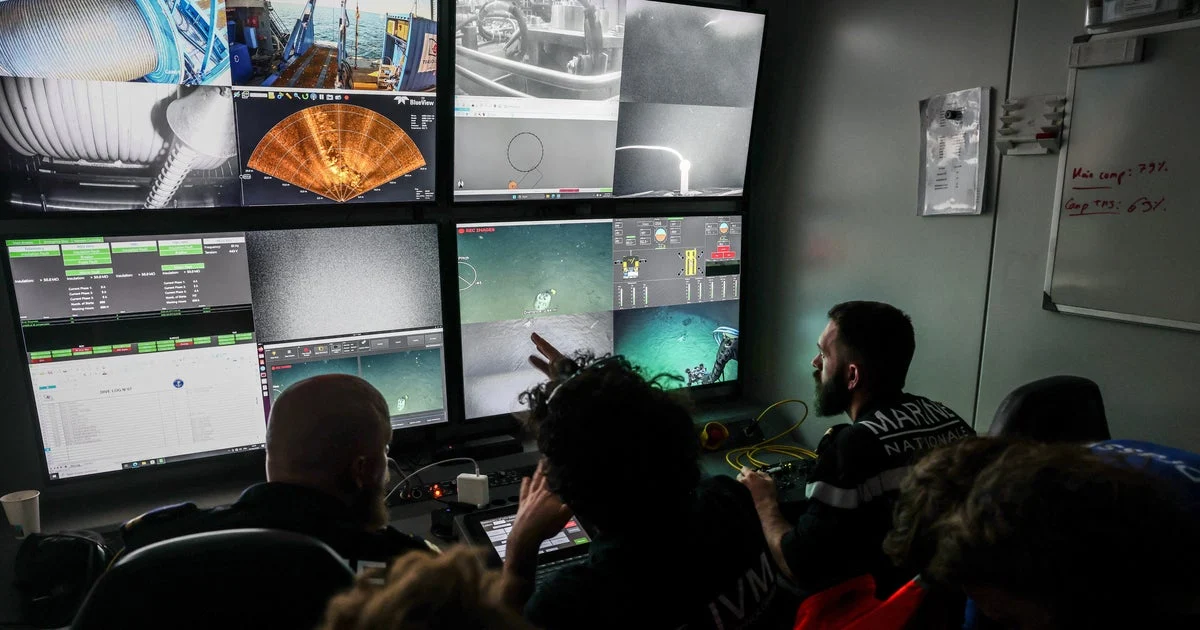
Known by the codename “Camarat 4,” the site rests more than 1.5 miles (approximately 2,400 meters) below the sea surface, making it the deepest French shipwreck discovered to date. The French Navy in conjunction with the Ministry of Culture’s underwater archaeology department deployed the remotely operated vehicle (ROV C 4000) to capture detailed imagery and collect artifacts delicately without disturbing the sediment.
Equipped with cameras and robotic pincers, the underwater robot spent three hours photographing the wreck, capturing over 86,000 images at a rate of eight frames per second. These images will aid researchers in creating a precise three-dimensional model of the site. The device revealed numerous decorated ceramic pitchers, plates adorned with floral motifs, crosses, and fish, alongside cannons and an anchor.
Archaeologist Franca Cibecchini noted the exceptional underwater visibility despite the extreme depth, stating that the ceramics likely originated from Liguria and were part of merchant trade goods. Marine archaeologist Marine Sadania, leading the excavation, highlighted the rarity of such well-preserved 16th-century merchant ships and the value of these findings for understanding maritime trade in that era. She emphasized the delicate nature of the operation, as a third of ceramics recovered from underwater sites often suffer damage during retrieval.
Recovered ceramic jugs display intricate dark blue lines bordered by turquoise and saffron-yellow decorations. The artifacts were carefully transported to a laboratory in Marseille for conservation and further study.
This discovery surpasses previous French shipwreck records, with the prior deepest wreck found off Toulon at 1.4 miles depth being a 1968 submarine disaster site. The Navy has kept the exact location of Camarat 4 confidential to protect the archaeological integrity of the site.
Why it matters
This discovery provides rare physical evidence of 16th-century maritime commerce and the types of goods traded between northern Italy and France, offering insights unavailable through historical documents alone. The exceptional depth and preservation of the wrecksite also demonstrate advances in underwater archaeological techniques and technology, expanding possibilities for deep-sea cultural heritage exploration.
Background
France’s underwater archaeology department frequently collaborates with the Navy to explore and document submerged heritage sites. The use of remotely operated vehicles capable of diving to depths up to 4,000 meters allows exploration of shipwrecks previously inaccessible to divers, revealing unique underwater cultural assets while minimizing damage to fragile sites.
Read more Science Discoveries stories on Goka World News.
Sources
This article is based on reporting and publicly available information from the following source: