
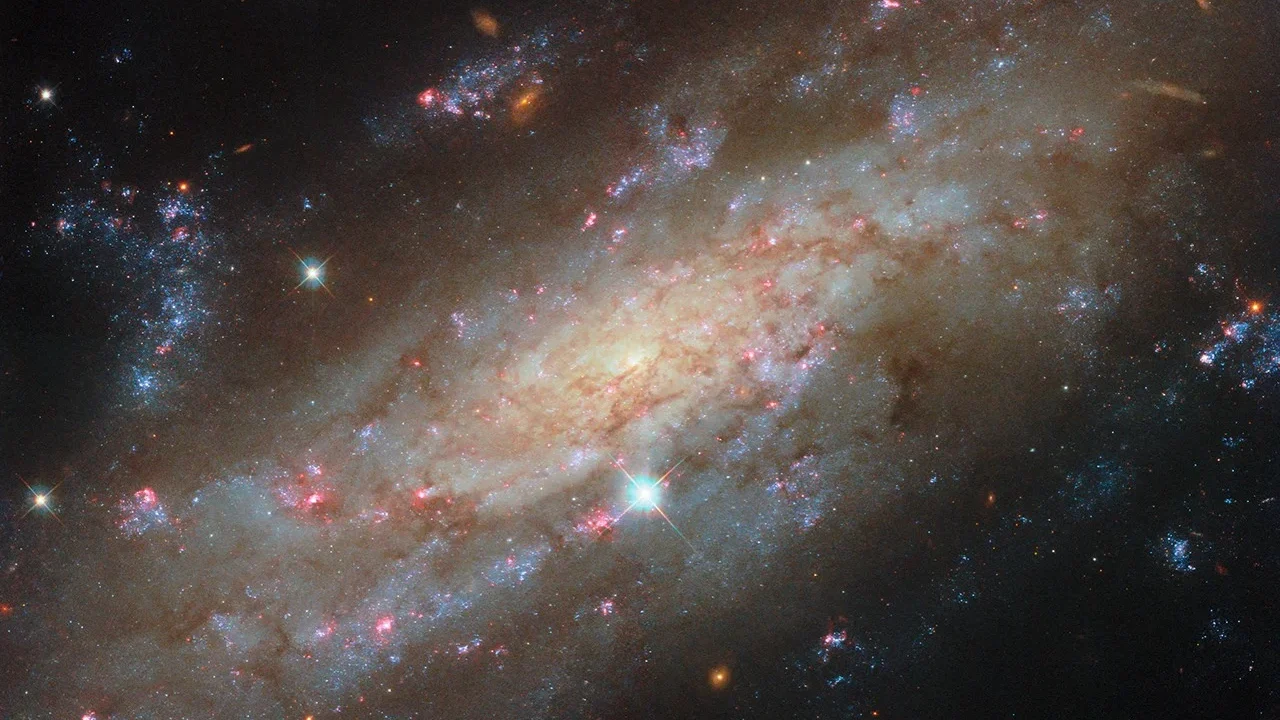
NASA’s Hubble Space Telescope has provided a detailed image of the spiral galaxy NGC 3137, located approximately 53 million light-years away in the constellation Antlia. The image reveals bright star clusters and intricate features of the galaxy’s structure, offering valuable insight into the processes of star birth and galactic dynamics.
NGC 3137 is part of the NGC 3175 galaxy group, which, like the Local Group that contains the Milky Way, hosts two large spiral galaxies alongside numerous smaller dwarf galaxies. Along with NGC 3175, also observed by Hubble, NGC 3137 provides astronomers a comparative environment to study how galaxies and their star populations evolve within similar groups.
Hubble’s image of NGC 3137 was created using observations across six different color bands, highlighting distinct features such as the galaxy’s dusty central region. Its core is notable for containing a supermassive black hole estimated to be 60 million times the mass of the Sun. The galaxy is highly inclined from Earth’s vantage point, showcasing its loose, feathered spiral arms.
The star clusters within NGC 3137 are a primary focus, featuring dense groups of bright blue stars and glowing red nebulae where new stars are forming. These young stars remain partially embedded in their birth clouds, making the galaxy a prime target for studying stellar formation and evolution.
This imaging is part of Hubble’s observing program led by principal investigator D. Thilker, which targets star clusters across 55 nearby galaxies to measure star ages and better understand stellar life cycles in spiral galaxies. The program supports the wider PHANGS-HST project, a collaborative effort integrating data from Hubble, the James Webb Space Telescope, and the Atacama Large Millimeter/submillimeter Array (ALMA). This multi-observatory approach offers a comprehensive view of star formation in the nearby universe by combining optical, ultraviolet, infrared, and radio observations.
Why it matters
Studying galaxies like NGC 3137 within groups similar to our own Local Group helps astronomers understand the environmental factors affecting galaxy evolution and star formation. Insights gained from such observations contribute to broader knowledge of the lifecycle of stars and the growth of galactic structures, deepening comprehension of our cosmic neighborhood.
Background
Since its launch in 1990, the Hubble Space Telescope has significantly expanded our understanding of the universe by delivering detailed observations of galaxies, stars, and other celestial phenomena. Its participation in coordinated programs with other observatories such as James Webb and ALMA allows for multi-wavelength studies, advancing research on the complex processes shaping galaxies over time.
Sources
This article is based on reporting and publicly available information from the following source:
Read more Space & NASA stories on Goka World News.