
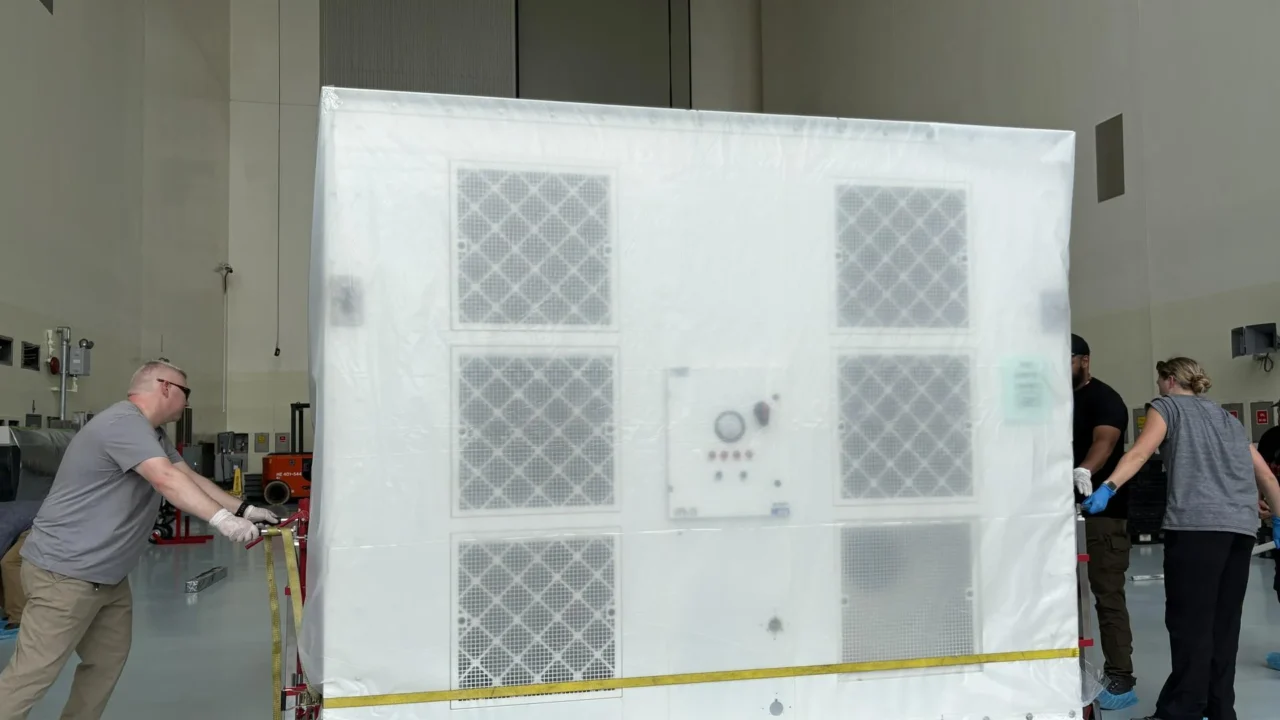
NASA technicians at the Payload Hazardous Servicing Facility (PHSF) at Kennedy Space Center offloaded eight high-efficiency particulate air (HEPA) wall modules and other ground support equipment on April 27, enhancing the facility’s clean room environment for the Nancy Grace Roman Space Telescope.
Each HEPA module weighs approximately 1,800 pounds and is designed to improve air filtration systems within the PHSF, helping meet the telescope’s stringent cleanliness standards. These measures are crucial as the Roman Space Telescope undergoes final critical procedures, including spacecraft fueling, before launch.
The Roman Space Telescope will observe the universe in infrared light through its Wide Field Instrument and a Coronagraph Instrument technology demonstration. Its wide field of view will generate panoramic images allowing astronomers to explore fundamental cosmic mysteries such as the cause of the universe’s accelerating expansion.
By employing multiple complementary observational techniques, the mission aims to chart the evolution of the universe over time and enhance scientific understanding of dark energy. The telescope will also contribute to exoplanet research and mapping the distribution of normal and dark matter across cosmic history.
Launch preparations are underway for a flight targeted as early as September 2024. The mission will lift off aboard a SpaceX Falcon Heavy rocket from Launch Complex 39A at Kennedy Space Center.
Why it matters
The delivery of advanced clean room equipment is vital to ensuring the Roman Space Telescope remains free of contamination, preserving its ability to capture precise infrared observations. These observations are expected to significantly advance astrophysics by addressing key questions about dark energy, cosmic evolution, and exoplanetary science.
Background
The Nancy Grace Roman Space Telescope, named after NASA’s first chief astronomer, has been developed to build upon the discoveries of previous missions like the Hubble and the James Webb Space Telescopes. Its technology demonstration of a Coronagraph Instrument represents a major step forward in directly imaging exoplanets and studying their atmospheres.
The telescope’s integration and testing phase occurs at NASA’s Kennedy Space Center, where maintaining a contaminant-free environment is essential due to the sensitivity of its instruments.
Sources
This article is based on reporting and publicly available information from the following source:
Read more Space & NASA stories on Goka World News.