
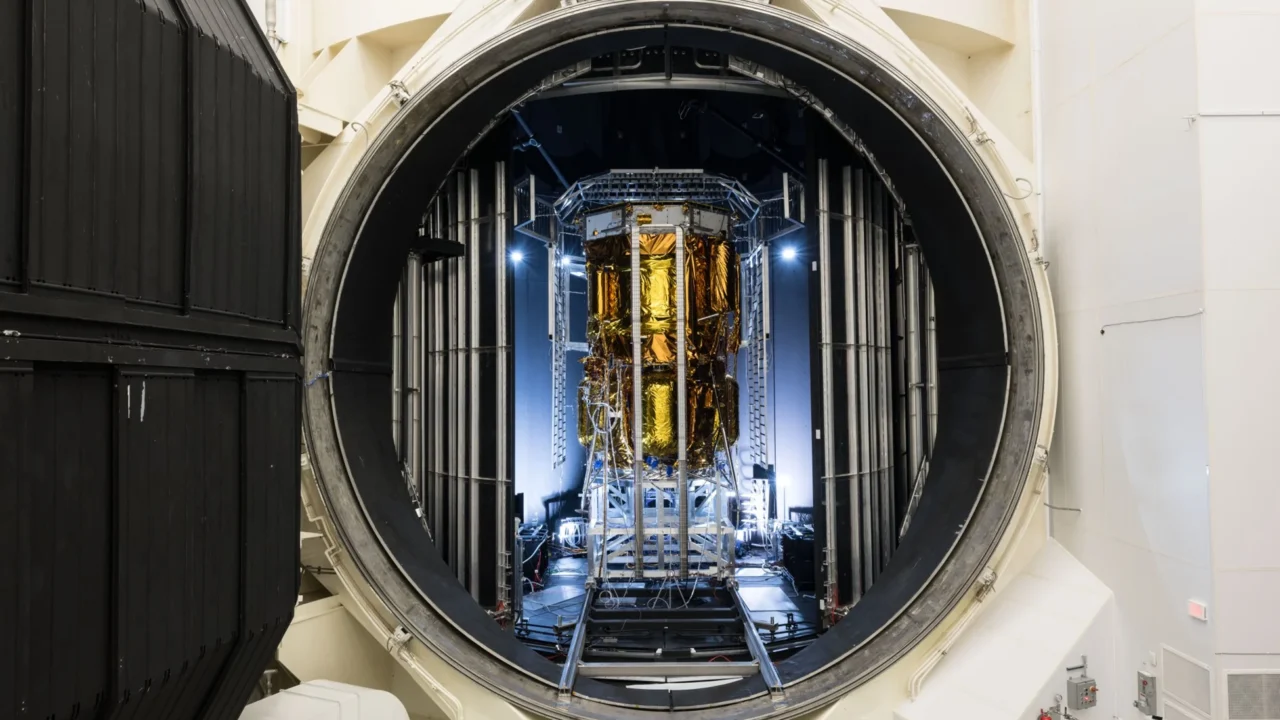
Blue Origin’s uncrewed cargo lander MK1, also known as Endurance, has completed a series of thermal vacuum tests at NASA’s Johnson Space Center as part of preparations to support future lunar missions under NASA’s Artemis program. The testing took place in Chamber A, one of the world’s largest thermal vacuum test facilities, designed to simulate the vacuum and temperature extremes of space environments.
The MK1 lander is a commercial demonstration mission funded by Blue Origin through a reimbursable Space Act Agreement with NASA. Its objectives include demonstrating precision landing, cryogenic propulsion, and autonomous guidance, navigation, and control capabilities necessary for future lunar surface operations. These tests evaluated MK1’s system performance and verified its structural and thermal integrity before launch.
Alongside its primary mission objectives, MK1 will carry two NASA scientific payloads this year to the lunar South Pole under the Commercial Lunar Payload Services (CLPS) initiative. These include the Stereo Cameras for Lunar Plume-Surface Studies, which will capture high-resolution images of how the lander’s engine plume interacts with the lunar surface during descent, and the Laser Retroreflective Array, which will enhance the precision of locating landing sites from orbit via reflected laser light.
The CLPS program partners with U.S. commercial companies to deliver scientific investigations and technology demonstrations to the Moon. These efforts support NASA’s broader goal of advancing lunar science and enabling human missions as part of the Artemis campaign.
MK1’s testing and development contribute to maturing critical technologies and reducing risks for future human-class lunar landers. This includes Blue Origin’s planned Blue Moon Mark 2 (MK2) vehicle, a larger spacecraft designed to transport astronauts between lunar orbit and the surface for sustained exploration of the Moon’s South Pole region.
The collaboration between Blue Origin and NASA exemplifies the agency’s “front door” approach, which facilitates commercial access to NASA facilities and expertise while ensuring alignment with safety and mission objectives. Lessons learned from MK1’s testing will inform design improvements and preparations for upcoming Artemis missions that aim to return astronauts to the lunar surface.
Why it matters
Testing MK1 at NASA’s thermal vacuum chamber advances key lunar landing technologies critical to the Artemis program’s goal of sustainable human exploration of the Moon. Demonstrating autonomous landing precision, propulsion systems, and handling extreme space environments reduces mission risk as NASA partners with private companies to develop crewed and uncrewed lunar landers. The inclusion of scientific instruments also enhances lunar surface research and lays groundwork for future crewed missions at the lunar South Pole.
Background
NASA’s Commercial Lunar Payload Services program enables partnerships with private companies to deliver payloads to the Moon, accelerating technology development for lunar surface exploration. Thermal vacuum chambers, such as Johnson Space Center’s Chamber A, replicate space conditions on Earth for rigorous spacecraft testing. Blue Origin’s MK1 is a precursor to its crewed Blue Moon Mark 2 lander, designed to support long-duration astronaut missions under Artemis, NASA’s ongoing lunar exploration effort.
Sources
This article is based on reporting and publicly available information from the following source:
Read more Space & NASA stories on Goka World News.