
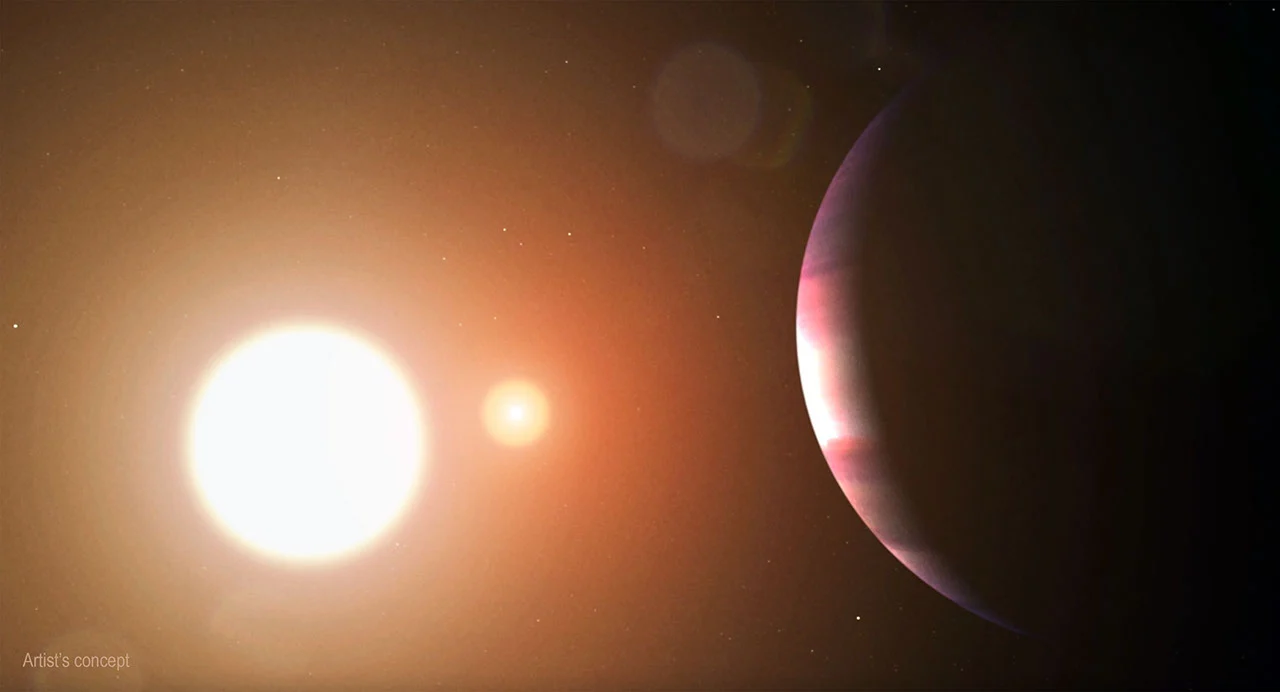
NASA’s Transiting Exoplanet Survey Satellite (TESS) has revealed 27 new candidate exoplanets by studying the subtle timing shifts in stellar eclipses within binary star systems. This approach expands TESS’s ability to detect planets beyond traditional transit observations, which rely on planets crossing in front of their stars and causing dips in brightness.
Since its launch in 2018, TESS has confirmed 885 exoplanets and cataloged over 7,900 additional candidates mostly by monitoring transits in single-star systems. However, the newly developed technique focuses on eclipsing binaries—systems where two stars orbit each other and periodically block each other’s light from Earth’s viewpoint. Careful measurement of the precise timing of these stellar eclipses can reveal the gravitational influence of orbiting planets, even if these planets do not transit the stars themselves.
Lead researcher Margo Thornton, a doctoral candidate at the University of New South Wales (UNSW) in Sydney, explained that this method is not restricted by the orientation of the planet’s orbit, a key limitation in traditional transit searches around binaries. Before this study, only 18 planets had been found orbiting binary stars through transits, including 16 by NASA’s retired Kepler mission and 2 by TESS.
The presence and orbital characteristics of planets around binary stars provide insights into planet formation theories. Some models suggest planets generally form close to the orbital plane of the two stars, increasing transit detection chances. Other theories propose a more complex formation process where stellar gravitational interactions scatter planets into tilted orbits, making transits less frequent and harder to observe.
By analyzing 1,590 eclipsing binary systems with at least two years of TESS data, researchers identified 27 candidates exhibiting orbital timing variations consistent with planetary companions. The inferred masses of these candidates range from about 12 Earth masses up to approximately 3,200 Earth masses, roughly ten times Jupiter’s mass. Confirming their planetary status will require follow-up ground-based radial velocity measurements to detect the stars’ wobble caused by orbiting planets.
Benjamin Montet, co-author and Scientia associate professor at UNSW Sydney, highlighted the importance of TESS’s extensive observational dataset, which allowed the team to account for multiple factors affecting eclipse timing, including tidal forces, rotation, general relativity, and gravitational effects from unseen companions.
According to Allison Youngblood, NASA’s TESS project scientist, the mission’s versatile data has enabled discoveries beyond its original goal of finding transiting planets. Ongoing observations continue to provide valuable information across various astronomical phenomena, from minor solar system bodies to distant active galaxies.
Why it matters
This breakthrough demonstrates a new technique to detect exoplanets in challenging environments like binary star systems, which offer critical tests for planet formation and evolution models. By identifying planets that do not transit their host stars, the method broadens the range of detectable worlds and enriches understanding of planetary system architectures in diverse star systems.
Background
TESS conducts a wide-field survey of the sky by observing sectors that span 24 by 96 degrees for about one month each, capturing images every few minutes. It primarily searches for exoplanets through the transit method, detecting periodic brightness dips when planets cross their host stars. Eclipsing binaries, however, provide an alternative indirect detection method by showing variations in the timing of the stars’ mutual eclipses caused by the gravitational pull of orbiting planets. Prior missions like Kepler pioneered planet discoveries in binary systems, but their numbers remain small compared to single-star systems due to observational and methodological limitations.
Sources
This article is based on reporting and publicly available information from the following source:
Read more Space & NASA stories on Goka World News.