
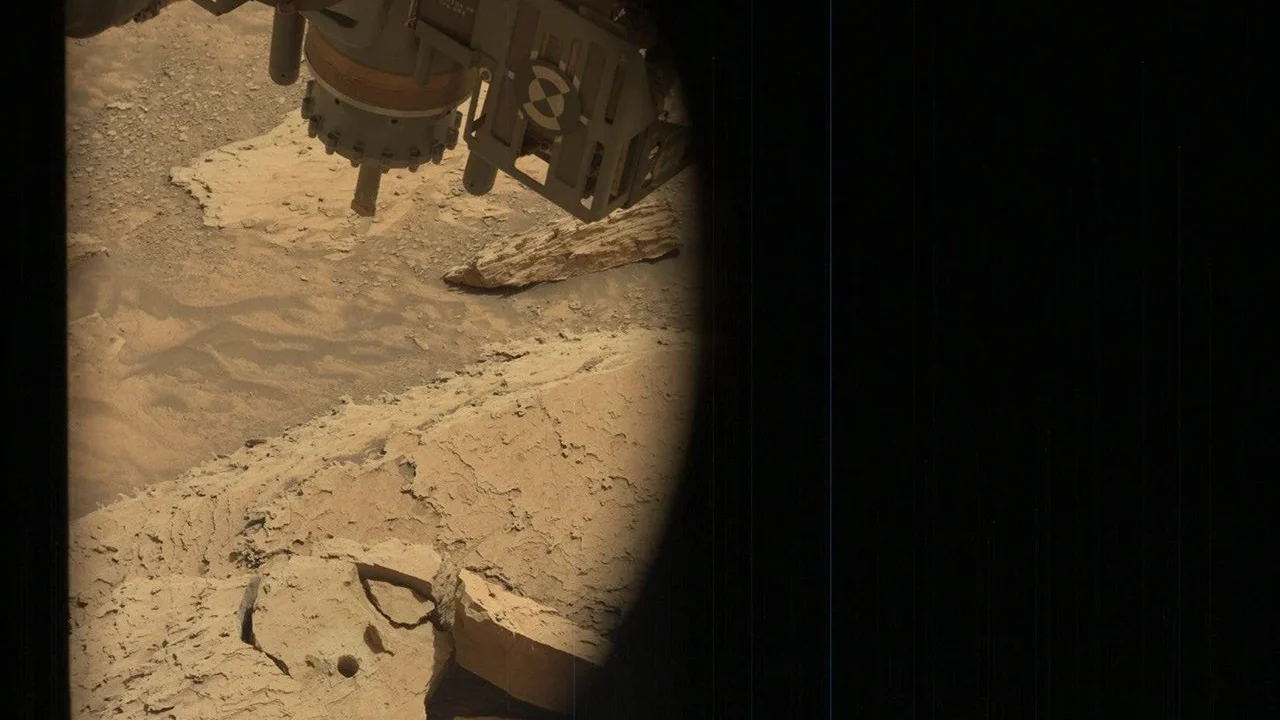
The Mars Science Laboratory’s Curiosity rover team encountered a challenge when the drill bit became stuck in a detached rock at the Atacama target on Mars. After initial drilling appeared successful, the rock was inadvertently lifted along with the drill bit, complicating sample collection efforts.
The Atacama site, named after Earth’s driest mid-latitude desert, presented a difficult environment for drilling. Upon realizing the rock had come loose with the drill bit, the rover planners executed a series of maneuvers, including reorienting the drill and applying percussion vibrations to dislodge the rock. By sols 4883 to 4885 (Martian days), these actions freed the drill bit from the Atacama block.
During the period when the drill was stuck, in-situ sampling was suspended, and the mission’s scientific focus shifted to remote sensing activities. Initial observations in sols 4879 and 4880 included ChemCam laser-induced breakdown spectroscopy (LIBS) analysis of nearby dark cobbles and pebbles, as well as passive reflectance measurements and imaging of distant geological features. Mastcam was used to document targets and monitor for surface changes.
Subsequent sols (4881-4882) continued LIBS scanning of bedrock points named El Plomo and El Turbio, alongside imaging and mosaic extensions of sites like Playa los Metales and Kimsa Chata. Following the detachment of the Atacama rock, sols 4883-4885 allowed ChemCam LIBS observations of granular material exposed beneath the dislodged block, including targets called Cuturipa and Chaitén, as well as a newly revealed light-toned block named Chiloé.
Additional imaging targeted geological layering at Mishe Mokwa butte and a rock exhibiting polygonal patterns, Azul Pampa. The team also conducted atmospheric and environmental measurements such as dust-devil surveys and APXS atmospheric observations.
Looking ahead, the mission plans to conclude drilling campaigns at the Atacama site and seek more stable rock targets to collect drill tailings, which were lost from the current site during the attempt to remove the drill bit from the loose block.
Why it matters
The successful recovery of the stuck drill bit was crucial to maintaining Curiosity’s ability to gather subsurface samples for geological analysis. Although Curiosity lacks Perseverance’s dedicated sample caching system, preserving the integrity of the drill system extends its scientific productivity. The experience underscores the challenges of operating robotic equipment in unpredictable Martian terrain and informs planning for future drilling targets.
Background
The Atacama desert on Earth, the mission’s namesake, is one of the driest places on the planet, and conditions there provide analogs for the harsh, arid environment Curiosity encounters on Mars. The rover’s ChemCam instrument uses laser pulses for elemental identification, while Mastcam provides detailed imaging. The rover’s scientific goals include understanding Mars’ geological history and searching for evidence of past life by examining rock composition.
Sources
This article is based on reporting and publicly available information from the following source:
Read more Space & NASA stories on Goka World News.