
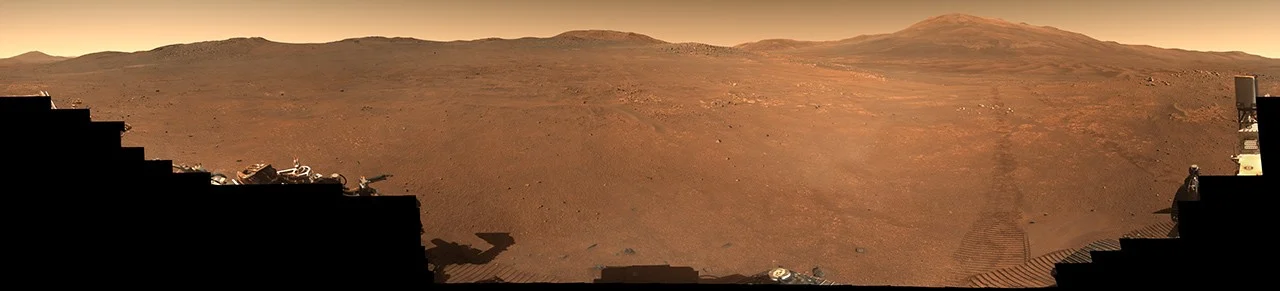
NASA’s Perseverance Mars rover has completed a detailed 360-degree panorama of a Martian region nicknamed “Crocodile Bridge,” located on the rim of Jezero Crater. The images were captured primarily on December 18, 2025, during the rover’s 1,717th Martian day (sol), with additional shots taken on January 25, 2026 (sol 1,754).
The panorama was created using Perseverance’s Mastcam-Z camera system and is presented in natural color, approximating how a human eye would perceive the landscape. It comprises 980 individual images stitched together to provide an immersive view of the terrain surrounding the crater’s rim.
Ancient Martian Terrain
Jezero Crater’s rim, including the “Crocodile Bridge” area, contains some of the oldest rock formations known in the solar system. These ancient rocks serve as a geological time capsule, preserving conditions from Mars’ early history when its crust and atmosphere were forming. Unlike Earth, which continuously reshapes its surface through tectonic activity, Mars lacks tectonic plates, allowing this primordial terrain to remain intact.
The “Crocodile Bridge” region also marks a transition zone leading into another site called “Lac de Charmes,” scheduled to be explored by Perseverance over the upcoming months.
Imaging and Collaboration
Alongside the natural-color panorama, NASA has released enhanced-color versions and 3D anaglyphs that highlight subtle details and provide depth perception of the area.
Operations of the Perseverance rover are managed by NASA’s Jet Propulsion Laboratory (JPL) in Southern California, which built the rover and oversees its mission as part of NASA’s Mars Exploration Program. The Mastcam-Z instrument, responsible for capturing these detailed images, is operated by a team at Arizona State University with technical collaborations including Malin Space Science Systems in San Diego and the Niels Bohr Institute at the University of Copenhagen.
Why it matters
Studying preserved ancient rocks on Mars offers scientists invaluable insights into the planet’s early geological and atmospheric evolution. These findings can improve understanding of Mars’ potential habitability and guide future exploration missions targeting the search for past microbial life.
Background
Perseverance landed in Jezero Crater in February 2021 with the goal of investigating the crater’s former lakebed and delta deposits for biosignatures. Mastcam-Z, its main navigation and scientific imaging system, plays a critical role in analyzing Martian geology and selecting sites for detailed examination.
Sources
This article is based on reporting and publicly available information from the following source:
Read more Space & NASA stories on Goka World News.