
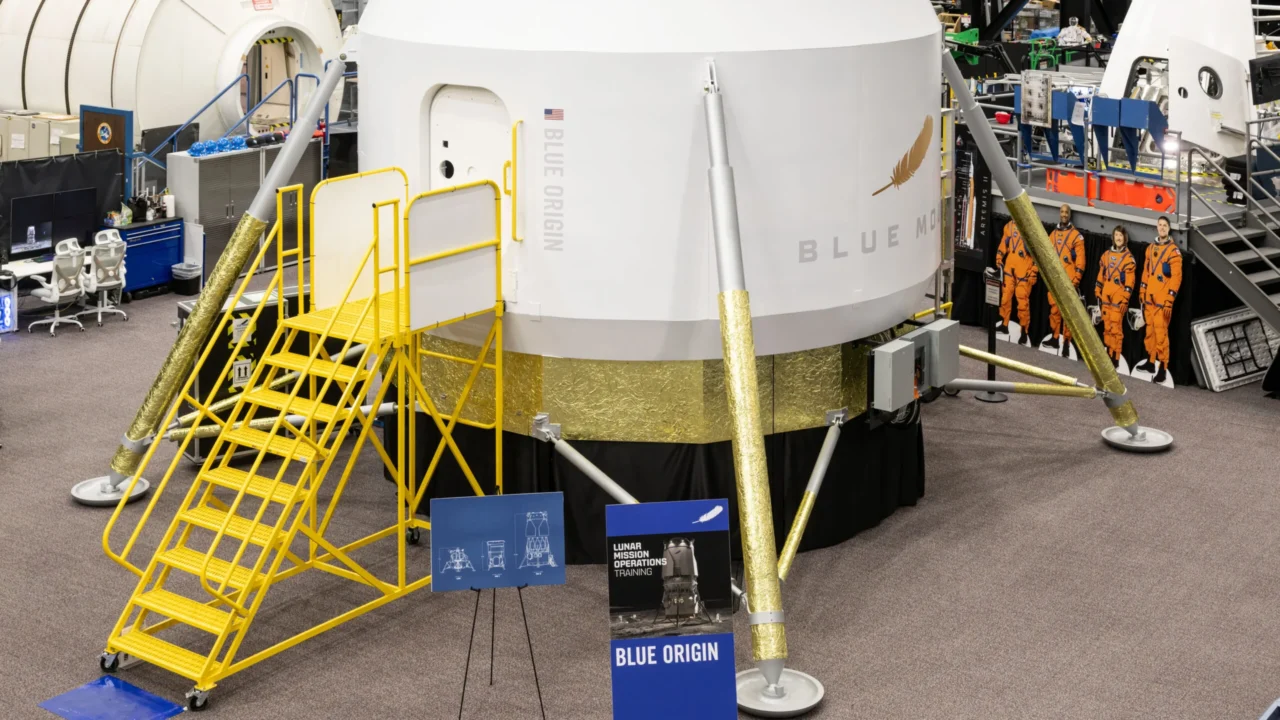
NASA has received a full-scale mock-up of Blue Origin’s crew cabin for its Blue Moon Mark 2 lunar lander, marking a significant step in training and mission simulations ahead of Artemis program lunar missions. The cabin, now operational at NASA’s Johnson Space Center in Houston, will support astronaut rehearsals and testing for dockings with commercial landers in Earth orbit starting in 2027, as NASA aims to return humans to the Moon by 2028.
Blue Origin’s Crew Cabin and Its Role in Artemis
Blue Origin is developing the Blue Moon Mark 2 lander under NASA’s Human Landing System program in partnership with other American industry teams. The lander is designed to transport two astronauts from lunar orbit—where they rendezvous with NASA’s Orion spacecraft—to the Moon’s surface and back. Standing about 52 feet tall, the crew cabin forms the base of the lander and serves as the living and working space during the lunar surface mission, including areas to eat, sleep, conduct science, and observe the environment. The cabin model at Johnson Space Center includes an exterior ladder astronauts will use when conducting moonwalks.
Training and Testing Capabilities
The mock-up will be used for “human-in-the-loop” testing involving astronauts practicing mission scenarios such as communications with ground flight control, spacesuit checkouts, and simulated extravehicular activities. This hands-on training environment will help both NASA and Blue Origin develop operational procedures and provide design feedback as the lander evolves. It is expected to become an integrated simulator with interactive systems for mission rehearsals.
Pathway to Crewed Lunar Missions
Following Artemis II’s recent crewed flight around the Moon, NASA plans to launch Artemis III in 2025, which will test critical systems for rendezvous and docking with commercial landers including those from Blue Origin and SpaceX. These operations will check life support, propulsion, communications, and potentially new spacesuit systems. Successful integration will pave the way for Artemis IV and V missions in 2028, marking the first crewed lunar surface landings using these commercial vehicles. These missions will support NASA’s longer-term goals of expanded lunar exploration and eventually crewed Mars missions.
Why it matters
This training cabin enables astronauts and mission teams to simulate real-flight conditions for docking, surface operations, and communications ahead of Artemis missions, reducing risks and improving mission readiness. It also provides immediate engineering feedback for Blue Origin as the lander design matures, ensuring safety and functionality for lunar surface expeditions.
Background
NASA’s Artemis program seeks to return humans to the Moon and establish sustainable exploration by the late 2020s, utilizing human landing systems developed by commercial partners. Blue Origin’s Blue Moon lander and SpaceX’s Starship will serve as the primary vehicles ferrying astronauts between lunar orbit and the surface. The Artemis program builds on previous Moon missions and aims to lay the foundation for human exploration of Mars.
Sources
This article is based on reporting and publicly available information from the following source:
Read more Space & NASA stories on Goka World News.