
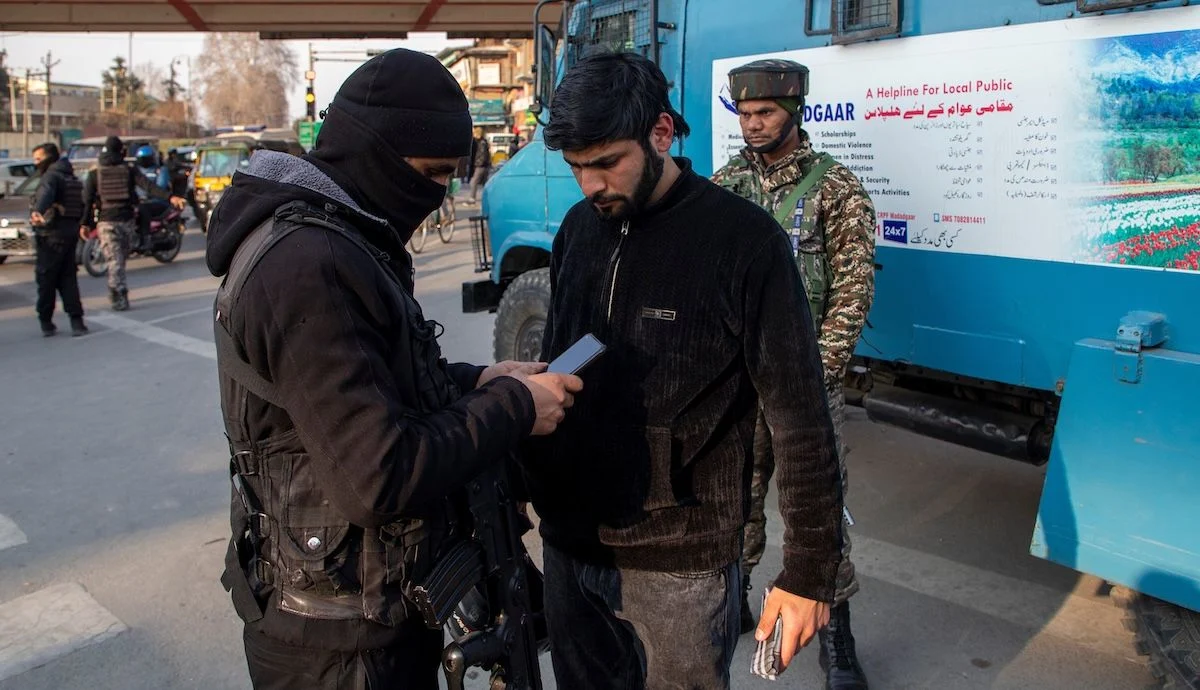
Kashmir’s security environment has become one of the most heavily surveilled in the world, increasingly restricting journalistic freedom through a combination of physical checkpoints, biometric data collection, and digital monitoring. Since the Indian government revoked Kashmir’s limited autonomy in August 2019, surveillance tools such as high-resolution CCTV cameras, drone patrols, and telecommunications surveillance have been widely deployed across the region.
This escalation intensified after a deadly militant attack in April 2025 near Pahalgam, which killed at least 26 civilians. The incident prompted a large-scale security response, including expanded military presence and further surveillance expansion. Journalists operating in Kashmir now contend with constant monitoring, digital data access demands by security forces, and threats of legal repercussions under stringent laws like the Digital Personal Data Protection (DPDP) Act and the Unlawful Activities (Prevention) Act (UAPA).
Daily Impact of Surveillance on Journalists
Journalists report that their phones and private communications are regularly accessed by security personnel, often without warrants. Individuals are compelled to hand over passwords at checkpoints, exposing personal messages and photos. Popular encrypted messaging apps such as Signal are effectively banned due to fears of confiscation and physical assault for users. A persistent surveillance presence via CCTV in public and private spaces, alongside pervasive mobile data tracking, cultivates an environment of self-censorship and fear.
One Kashmiri journalist, speaking under anonymity, described constant data collection by military intelligence, which maintains extensive profiles not only on individuals but also on their families and social networks. This data gathering has fostered mistrust and paranoia within communities, where anyone might be a government informant.
Legal Harassment and Intimidation of Journalists
Journalists face not only physical surveillance but also legal intimidation. In February 2026, Kashmiri journalist Majid Hyderi reportedly received death threats from police officers after pursuing a legal complaint at the Kashmir High Court. The court intervened to protect him and ordered the government to avoid harassment without due process. Such cases illustrate a broader pattern of intimidation intended to suppress dissenting voices.
Social media posts critical of the government or perceived as advocating separatism are monitored closely, often triggering legal action under controversial laws. Police have the authority to obtain and act on call detail records (CDRs) without further evidence, despite judicial rulings restricting their use in court.
Integrated Surveillance Infrastructure
The surveillance systems in Kashmir operate as a tightly coordinated network of physical, digital, and human intelligence methods. Cameras, biometric checkpoints, mobile data monitoring, and informant reports interconnect to surveil individuals continuously. For example, shared telecommunications data can be matched with CCTV footage, enabling authorities to track movements and associations precisely. Local religious leaders have even been enlisted to broadcast warnings related to security drone operations, showing how surveillance extends into community institutions.
Why it matters
The pervasive surveillance and legal intimidation in Kashmir severely curtail press freedom and civic rights in a region already marked by political conflict. Journalists face ongoing threats not only to their careers but to their personal safety, undermining independent reporting and transparency. This environment reflects broader trends where states justify expansive digital governance regimes as security measures, raising urgent questions about privacy, freedom of expression, and human rights.
Background
Kashmir, a region disputed between India, Pakistan, and China, experienced a major political shift in August 2019 when India revoked its special autonomous status, reorganizing it into two Union Territories. This move coincided with extensive internet shutdowns and increased militarization. Since then, digital surveillance and control frameworks have expanded significantly as part of India’s security strategy, further constraining the already limited space for dissent and journalistic activity.
Sources
This article is based on reporting and publicly available information from the following source:
Read more World News stories on Goka World News.